Key field management points for high-yield peanuts: topdressing, disease prevention, prevention of excessive vegetative growth, and prevention of premature senescence
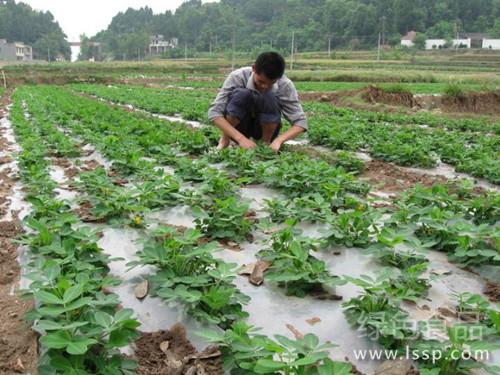
Peanut field management
I. Timely seedling emergence, replanting, and branch clearing.When the seedlings of film-mulched peanuts crack the soil mound and show green, remove the soil (mound) above the sowing row to the furrow, exposing the cotyledon node. For those that cannot break through the film on their own, manually break the film to release the seedlings. After full emergence, check the seedlings promptly; where there are more than 2 consecutive missing hills, pregerminate seeds and replant. Starting from the rosette stage (main stem has 4 compound leaves), promptly inspect and remove the lateral branches growing horizontally that are trapped under the film so they can grow vigorously; do this 2-3 times before first flowering.
II. Timely drainage and irrigation, preventing drought and waterlogging.For spring and summer peanuts sown with sufficient soil moisture, generally no watering is needed at the seedling stage; moderate drought can promote root development and improve the peanut's drought and waterlogging tolerance. For peanuts intercropped with wheat, if drought occurs at the seedling stage, water promptly to protect the seedlings. The mid-growth period (pegging stage and pod-setting stage) is when peanuts are most sensitive to water and also have the highest water demand; when peanut leaves wilt around midday, water promptly. In the late growth period (pod-filling stage), if drought occurs, promptly irrigate lightly with a small amount of water and use moist irrigation to prevent premature senescence and aflatoxin contamination. In addition, peanut fields should have the three ditches unobstructed to avoid waterlogging damage.
III. Timely intertillage, topdressing, and weed control.After wheat harvest, peanuts intercropped with wheat should be intertilled promptly to remove stubble and weeds. For plots that need topdressing, open a furrow on one side of the plant, apply the fertilizer, then cover with soil and water, and carry out intertillage at suitable moisture. When peanuts are close to closing the rows, trench between the two peanut rows and earth up; the earthing up should achieve clear furrows, loose soil, a plump ridge waist, and a concave ridge top, so that more peanut pegs enter the soil and set pods.
IV. Timely disease and pest control.When the diseased leaf rate of peanuts reaches 10%, use 60% Dithane M-45 wettable powder at 1500 times dilution, 70% thiophanate-methyl wettable powder at 500 times dilution, 43% tebuconazole at 1500 times dilution, and other fungicides alternately for foliar spraying, spraying 2-3 times consecutively at 10-15 day intervals to control leaf spot, net blotch, and other diseases. For root-knot nematode disease, use 1.8% abamectin emulsifiable concentrate at 1000 times dilution for root drenching. For foliar spraying, use 1.8% abamectin emulsifiable concentrate at 2000-3000 times dilution, or 40% phoxim emulsifiable concentrate at 1000-1500 times dilution, to control summer cotton bollworm, tobacco cutworm, and other pests.
V. Timely early control to prevent excessive vegetative growth.When the peanut main stem reaches 30-35 cm (general fields) or 35-40 cm (high-yield fields), use 5% uniconazole 40-50 g wettable powder per mu (active ingredient 2 -2.5 g), add 35-40 kg water, and spray on the leaves. If the main stem height exceeds 45 cm, spray once more to increase the pod-setting rate and filled-pod rate.
VI. Foliar topdressing to prevent premature senescence.After entering the pod-filling stage, prevent premature senescence. Per mu, spray on the leaves a mixture of 120-150 g potassium dihydrogen phosphate + 350-400 g urea + 70-80 g 75% chlorothalonil wettable powder and other fungicides in 35-40 kg water, spraying 2 times consecutively at 10-15 day intervals, to prolong the functional period of the peanut top leaves.