Key points for fertilization, watering, intertillage and earthing up, and harvest management of spring onions
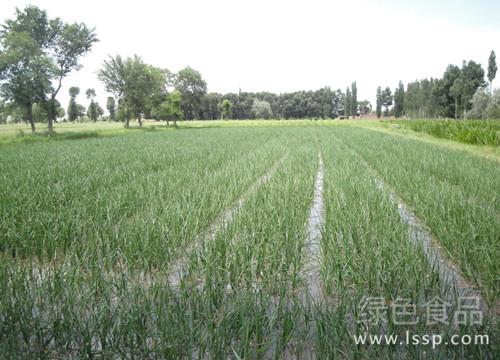
Onion
1. Scientific fertilization: After the spring regrowth, carry out the first fertilization to improve nutrition for onion root growth and at the same time lay the foundation for the later vigorous growth of the aboveground part of the onion. Fertilization should mainly use fully decomposed organic fertilizer, applying 1000 kg per mu, plus 20 kg of superphosphate and 10 kg of potassium sulfate.
When the onion grows to 8—10 true leaves and the bulb begins to expand, begin applying the bulb-promoting fertilizer, applying it 2—3 times in succession. Per square meter, 10—20 kg of ammonium sulfate may be applied, with the middle stage of bulb expansion as the key fertilization period, and the application rate at this time should be large. When the bulb begins to expand, do not apply too much nitrogen fertilizer, to avoid the onion becoming “green and sappy.” During the bulb expansion period, potassium sulfate should be added when fertilizing, with a rate of 5—10 kg per mu, because a lack of potassium in onions leads to poorer storability.
2. Timely watering: For onions planted before winter, the regreening water should be applied in spring. The timing of the regreening water should be appropriate. Watering too early will lower the soil temperature and is unfavorable for onion growth; watering too late will inhibit onion growth and cause dry tips on the leaves.
When the onion bulb begins to expand, water should be controlled to promote seedling hardening, and the duration of seedling hardening should be flexibly managed according to the soil, climate, and onion growth conditions. In sandy soil or during drought, the seedling hardening period should be appropriately shortened; in clay soil, low-lying terrain, or rainy conditions, the seedling hardening period should be appropriately extended. The goal is to promote the conversion of onion growth toward bulb expansion, and this stage generally requires about 10 days. It is generally believed that when the mature tubular leaves of the onion turn dark green, the leaf flesh becomes thick, the waxiness on the leaf surface increases, and the color of the heart leaves deepens, this is the sign to stop seedling hardening at this stage. After seedling hardening, generally water once every 5 days to promote rapid bulb expansion. When some onions in the field lodge, stop watering to prevent the bulbs from being unsuitable for storage after harvest.
3. Intertillage and earthing up: When onions are not covered with plastic film, intertillage must be carried out before seedling hardening. The number of intertillage operations in heavy clay soil should be greater than in sandy soil. The depth of intertillage should be controlled within 3 cm, shallower near the plants and deeper away from the plants. After the onions close their rows, stop intertillage. While intertilling, earthing up may also be carried out appropriately.
4. Harvest and storage: Harvest is generally carried out around mid-June. Signs of onion bulb maturity: in the late stage of bulb expansion, no new leaves fill the leaf sheaths, the false stem becomes hollow, and the onion falls over from the base of the false stem. The timing of bulb maturity is related to the onion variety's characteristics, planting time, climatic conditions, and so on. For varieties with a short dormancy period and poor storability, harvest should be appropriately advanced; when half of the onions have lodged, harvest may begin. For mid- to late-maturing varieties, the harvest period is later, and it is suitable to harvest when 70% of the onions have lodged.
Harvesting should be done on a sunny day, and it is best to have several consecutive sunny days. At harvest, pull out the whole plant and spread it out to dry for 2—3 days. When drying, dry only the leaves, not the bulbs; cover the bulbs with the leaves. This can promote after-ripening of the bulbs and make the outer skin dry. After that, remove the soil, cut off the fibrous roots and dead leaves, and then store. Some onions are also stored after harvest without removing the leaves, directly braided into strings or tied in bundles.