Peach tree gummosis causes branches to swell and exude yellow resin, how can it be prevented and treated?
Peach gummosis, also known as resin disease, has complex causes and is very common. Gummosis can occur on any part of peach tree shoots and twigs, and is extremely widespread, causing tree vigor to decline and fruit quality to drop, and in severe cases causing branch death and tree death.
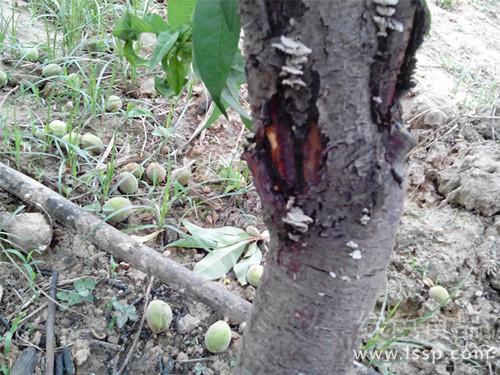
Peach gummosis
I. Damage symptoms: Gummosis caused by infectious pathogens occurs on peach tree root crowns, main trunks, branch forks and other parts. When the disease begins, swelling appears at the branch and trunk parts, exuding pale yellow transparent resin, especially after rain, when gumming is more severe. Over time, the jelly-like gum gradually turns light reddish-brown and brown. If the weather is dry, the gum becomes tea-brown hard gum blocks, appearing crystalline, adhering to the branch and trunk surface. Gumming caused by non-infectious factors is caused by mechanical injury, insect damage, sunscald and so on, initially white transparent gum, then gradually turning brown-red, and under suitable temperature and high humidity, the gum appears eruptive, accumulating on the wound surface, mainly occurring at mechanical wounds, insect wounds and artificial damage sites. Affected peach trees have weakened vigor, leaves become smaller and yellow, are easily infected by saprophytic fungi, causing wood rot. Peach gummosis affects development and loses edible value.
II. Disease conditions: Between April and October, it begins to occur when the temperature is above 15°C, and about 25°C with rain followed by high humidity may cause an outbreak. Older peach trees suffer severe gumming, while young trees are lightly affected. Damage by stink bugs easily causes gummosis in peach fruit. Clay loam, barren soil, vegetable garden soil, and peach orchards with excessively heavy acidity or alkalinity are prone to gummosis.
III. Causes of the disease:
1. Parasitic fungi and bacteria damage, such as dieback, rot disease, anthracnose, scab, bacterial shot hole, fungal shot hole, etc. These diseases either parasitize branches and trunks or endanger leaves, making diseased plants grow weakly and reducing resistance; 2. Insect pests, especially trunk-boring pests, cause wounds and induce gummosis; 3. Mechanical damage, causing wounds, as well as frost damage, sunscald, etc., excessive pruning during the growing season and heavy branch renewal; 4. Poor scions and use of incompatible rootstocks. Poor soil, such as excessively clayey, highly acidic, etc. 5. Poor drainage, improper irrigation, excessive water accumulation on the ground, etc.
IV. Prevention and treatment methods:
1. Strengthen peach orchard management and enhance tree vigor. Apply more organic fertilizer, improve soil structure, and increase soil aeration. For low-lying waterlogged land, pay attention to drainage; for acidic and alkaline soil, appropriately apply lime or superphosphate. Improve the soil; for saline-alkali land, pay attention to salt removal. Prune reasonably, reduce branch and trunk wounds, and avoid continuous cropping in peach orchards. For peach trees that have already developed gummosis, remove small branches by pruning, scrape off the gum on branches and trunks cleanly, and disinfect the wounds with 4-5 degrees Baumé lime sulfur mixture. In dry weather, the gumming sites and wounds can also be smeared with medical gentian violet, and after 10 days, apply once more.
2. Adjust pruning time. Adjust pruning time, changing growing-season pruning to dormant-season pruning. Although winter pruning also creates wounds, due to lower temperatures and dry air, wound gumming occurs less. Therefore, during the growing season adopt light pruning, timely pinching, and thin out some overly dense branches. The main thinning, heading back, and renewal pruning should be carried out after leaf fall in winter.
3. Whitewash the main trunk. Carry out whitewashing of the main trunk twice, in winter and summer. The first whitewashing is done after peach leaves fall, using 5 degrees Baumé lime sulfur mixture + fresh cow dung + fresh lime to paint the main trunk, or use Bordeaux powder mixed with tung oil to paint the main trunk and main branches of peach trees, reducing disease and pest infection and radiant heat damage, effectively reducing gummosis.
Prevent and treat peach tree pests
4. Timely prevent and treat pests. From April to May, timely prevent and treat pests such as longhorn beetles and jewel beetles that damage peach tree root crowns, main trunks, shoots and other parts, and prevent and treat pests that damage fruit such as peach fruit borer larvae, tortrix moth larvae, oriental fruit moth, and stink bugs.
5. Full-orchard mulching in summer. For peach orchards without golden grass or other green manure, cover the entire orchard with 10cm thick weeds or rice straw in summer and autumn, which can not only increase soil moisture content in the peach orchard, benefit peach root growth, and strengthen the tree body, but also prevent sunscald caused by ground radiant heat.
6. Chemical film prevention and treatment. If peach gummosis is caused by bacterial pathogens, agricultural streptomycin or Yeqingshuang, etc. can be sprayed and brushed on the main trunk. If peach gummosis is caused by fungal pathogens, antibacterial agent 401, carbendazim, thiophanate-methyl, iprodione, etc. can be sprayed or brushed on the main trunk; the concentration for brushing the main trunk can be higher than that for spraying. Before brushing the main trunk, scrape off the gum cleanly with a bamboo slice, then brush on the medicinal solution, or cut old clean cotton cloth into strips, soak them thoroughly in the medicinal solution, wrap them around the affected area, and then bind with 10cm wide plastic film. For the agent, choose 50% thiophanate-methyl ultra-micro wettable powder 1000-fold solution or 50% carbendazim wettable powder 800-fold solution, 50% iprodione wettable powder 1500-fold solution or 50% procymidone wettable powder 2000-fold solution.