How to prevent and control bean anthracnose? Watch out for brown spots on leaves and cracking on stems and petioles
Bean anthracnose occurs commonly, and the disease is severe in cool, rainy regions and seasons, causing yield reduction and lowering the quality and marketability of beans, which restricts bean production.
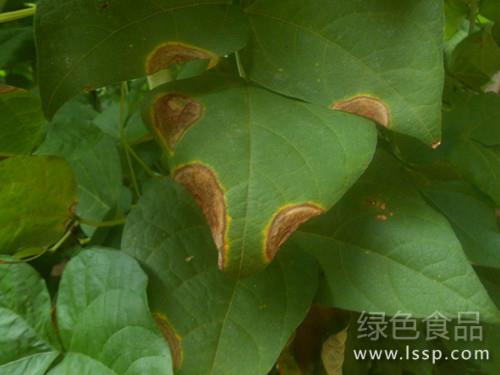
Bean anthracnose
1. Disease symptoms: ① From the seedling stage to the late harvest stage, all aboveground parts of the bean plant can be affected. After the seedlings emerge, red-brown nearly circular lesions appear on the cotyledons, with sunken rotting. On the lower part of young stems, light red-brown spots and long spindle-shaped depressions appear; sometimes the lesions merge and girdle the base of the stem, causing the seedlings to lodge and die.
② When disease occurs at the adult plant stage, red-brown streak lesions form along the veins of diseased leaves, later turning into black netted veins. When stems and petioles are infected, brown sunken cracked lesions appear, later becoming black-brown long streaks. When pods are infected, black circular sunken spots appear.
2. Disease development pattern: ① The pathogen can survive on bean seeds for more than 2 years, while pathogens overwintering in soil survive for a shorter time.
② The pathogen spreads through wind, rainwater and insects. Temperatures of 22-27°C favor disease development; above 30°C or below 15°C, the disease is suppressed. When relative humidity approaches 100%, conditions are suitable for disease development.
③ Factors such as lower temperatures, high humidity, low-lying terrain, poor ventilation, overly dense planting, heavy clay soil and excessive nitrogen fertilizer will worsen the disease.
3. Prevention and control methods:
(1) Select disease-free bean seeds and disinfect seeds: Collect seeds from disease-free fields and disease-free pods. Strictly sort the seeds and remove diseased seeds. Before sowing, soak in 45°C warm water for 10 minutes, or soak in 200-fold formaldehyde solution for half an hour, or soak in 200-fold 40% formalin solution for half an hour, or soak in 600-fold 60% Fanmeibao ultra-fine powder solution for half an hour, then remove, rinse clean with water, and air-dry before sowing; alternatively, mix seeds with 50% carbendazim or thiram wettable powder at 0.3%-0.4% of seed weight before sowing.
(2) Select disease-resistant varieties: Disease resistance differs among bean varieties. Generally, climbing varieties are more disease-resistant than dwarf varieties.
(3) Implement crop rotation: Rotate beans with non-legume vegetables for more than 2 years; before using old trellis materials, rinse and disinfect them with 1000-fold 50% amobam aqueous solution.
(4) Strengthen cultivation management: Improve cultivation techniques. Mulching with plastic film or straw can reduce or prevent the spread of soil pathogens and lower air humidity. Deeply plow the land, increase phosphorus and potassium fertilizer, promptly remove diseased seedlings, cultivate timely after rain, hill up soil after fertilizing, pay attention to drainage, and reduce soil moisture content.
(5) Chemical control: ① Begin spraying at the early stage of disease onset. Use 600-fold 75% chlorothalonil wettable powder, or 500-fold 50% carbendazim wettable powder, or 500-fold 50% thiophanate-methyl wettable powder, or 500-fold 70% mancozeb wettable powder, etc., 500-fold 80% anthracnose thiram wettable powder; or 500-fold 70% mancozeb wettable powder and other agents, spraying once every 5-7 days, for 2-3 consecutive sprays. Spray thoroughly, paying special attention to the undersides of bean leaves. If rain occurs after spraying, respray promptly.
② In protected cultivation, 30% chlorothalonil smoke agent, etc., can be used at 250-300 grams per mu, divided into 5-6 points and ignited for smoke fumigation control.