Spring Arch-Shed Lotus Root Cultivation Technique: Fresh Lotus Root Can Be Supplied in Midsummer
Fresh lotus root is normally only marketed in winter, but if cultivated in small arch sheds in early spring, the conventional cycle can be broken so that fresh lotus root is also available in midsummer. To grow spring lotus root, scientific fertilization is essential. Here is a brief introduction to the cultivation and fertilization techniques for spring arch-shed lotus root.
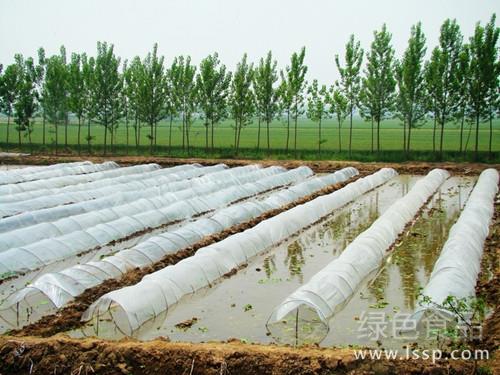
Lotus Root Cultivation in Arch Sheds
Spring Arch-Shed Lotus Root Cultivation Technique:
1. Soil selection. Choose idle low-lying plots or ditches with a relatively high groundwater table, long-term moisture or standing water, a relatively thick layer of silt, convenient drainage and irrigation, and easy access to water for growing lotus root.
2. Building the shed and pond. In early April, build an ordinary pillar-free arch shed with bamboo and wood materials. The orientation and size of the arch shed depend on the terrain, mostly running north-south to facilitate ventilation and light. It is 20 m long from north to south, 3 m wide from east to west, and 1.5 m high. First dig a pit pond 0.4 m deep, level the bottom, tamp the ground, and lay a layer of polyethylene film 0.10-0.12 mm thick. The film should extend 0.3-0.5 m above the surroundings to prevent water and fertilizer leakage during growth. Then, in combination with land preparation, apply base fertilizer and fill the pit pond level, but the fill soil should be placed according to soil layers. At the same time, trim and tamp the surrounding field ridges so that water can be retained later.
3. Selecting suitable varieties. Choose early-maturing varieties with tolerance to low temperature and weak light, strong growth vigor, high yield, and good market demand as the cultivation varieties. According to trials, the 'Dabaihua' lotus root variety is a good choice.
4. Land preparation and base fertilizer application. The principle of "supplying nitrogen, increasing phosphorus, supplementing potassium, and timely applying micro-fertilizers" should be adopted. In combination with filling the pond with soil, apply 50 kg of diammonium phosphate, 40 kg of potassium sulfate compound fertilizer, and 750-1000 kg of decomposed spent mushroom substrate or chicken manure per mu. Spread evenly, then deep plow and harrow finely twice. Ten days before planting, irrigate once thoroughly, then close the shed to raise the temperature.
5. Early planting. Plant one month before open-field planting, when the temperature is relatively stable (above 15°C). Each mu requires 210 kg of seed lotus root. Plant 3 rows in each small arch shed, with the lotus root tips of both outer rows facing into the shed, and in the middle row reverse the positions of adjacent plants so that stems and leaves are distributed evenly in the shed. Planting should preferably be done at noon on 3-5 consecutive sunny days, with the field water layer kept at 7-10 cm, just enough not to smother the lotus root tips. The rear end should be slightly higher, in a slanted position.
6. Pest and disease control. During the lotus root growing period, pests and diseases are not serious. In early May, aphids and mild brown spot disease may be found in a few shed ponds. Aphids can be controlled with 20% Dasaluli emulsifiable concentrate at 3000 times or 20% Yibianjing at 2000 times, and 20% mancozeb at 600 times or 75% chlorothalonil at 600 times can be sprayed early for brown spot. Detect early and control early, applying once every 5-7 days, generally 2-3 times.
Spring Lotus Root Fertilization Technique:
The amount of base fertilizer for the lotus root field should be determined according to soil fertility. In combination with land preparation, apply 2500-3000 kg of decomposed farmyard manure and 60-80 kg of general-purpose compound fertilizer per mu, and also apply calcium, boron, zinc and other fertilizers. Then deep plow 20-30 cm, plow finely and level, and add 3-5 cm of shallow water.
Rational topdressing: the entire lotus root growing period requires 2-3 topdressings. For the first, apply 15 kg of urea or 1500-2000 kg of decomposed farmyard manure and 7.5-10 kg of potassium sulfate per mu; for the second, apply 20-25 kg of high-nitrogen, potassium compound fertilizer per mu; for the third, apply 15-20 kg of high-potassium compound fertilizer per mu, or about 2000 kg of decomposed human and livestock manure.
When fertilizing, choose a clear, windless day and carry out the work in the early morning or evening. Before each fertilization, drain the water shallow so the fertilizer dissolves into the water. Two days after fertilization, irrigate again to the original depth. After topdressing, splash clean water to rinse the lotus leaves.