Chili peppers are sensitive to chloride and ammonia; how should fertilizer be applied scientifically?
Chili peppers are sensitive to chloride and ammonia and are indeterminate-growth crops, producing buds, flowers and fruit continuously at the same time. Chili peppers have a long growing period, but their root system is underdeveloped, with few roots and shallow penetration into the soil. Throughout the entire growth and development process of chili peppers, vegetative growth and reproductive growth both promote and compete with each other. According to the growth characteristics and cultivation management of chili peppers, the cycle can be divided into the germination stage, seedling stage, flowering and fruit-setting stage, and fruiting stage.
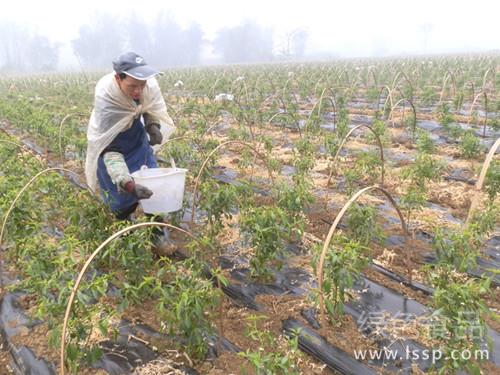
Topdressing for chili peppers
I. Fertilizer requirements:
(1) Nitrogen, phosphorus and potassium uptake. Chili peppers prefer fertile soil, are afraid of excessive nitrogen and poor soil fertility, have strong tolerance to fertilizer, and take up a relatively large amount of nutrients. The growth and development of chili peppers require sufficient nitrogen and potassium, while phosphorus can be relatively less; the ratio of nitrogen, phosphorus and potassium is about 1:0.3:1.4. According to the characteristics of chili peppers, such as high nutrient uptake and a long growth period, producing every 1000 kg of chili peppers requires about N 5.19 —5.80 kg, P2O5 0.58—1.10k g, K 2 O 6.46—7.40kg.
(2) Nitrogen, phosphorus and potassium uptake at different growth stages. The uptake of nitrogen, phosphorus and potassium by chili peppers varies at different growth stages. From emergence to budding, chili peppers take up about 16% of the total nutrients; from early flowering to the fruiting stage is the peak period of both vegetative and reproductive growth, and the uptake of nutrients and nitrogen is also the greatest, accounting for about 34% of the total; from full flowering to the maturity stage, vegetative growth is weak and reproductive growth is vigorous, and the demand for phosphorus and potassium is the greatest, accounting for about 50% of the total.
II. Scientific fertilization: the use of fertilizers such as ammonia water, ammonium bicarbonate and potassium chloride is prohibited for chili peppers. On the basis of insisting on the application of organic fertilizer, chemical fertilizers must be applied in combination, with nitrogen, phosphorus and potassium applied together. On the basis of applying sufficient base fertilizer, topdressing should be done well; the base fertilizer is mainly phosphorus and potassium fertilizer; the topdressing is mainly nitrogen fertilizer, light first and heavy later, applied respectively at the seedling stage, early flowering stage and swelling stage. Of the total topdressing amount, 10% is applied at the seedling stage as a seedling-promoting fertilizer, 20% at the early flowering stage as a flower fertilizer, and 70% at the swelling stage as a fruit fertilizer. The application amounts of the three major elements throughout the entire growth period are N:P2O5:K2O=35:10:40.
(1) Application of organic fertilizer. Throughout the entire growth period of chili peppers, the fertilization amount per mu is 3000—3700 kg of decomposed, finely crushed organic compost, applied all at once as base fertilizer during land preparation.
(2) Reasonably determine the application amounts of nitrogen, phosphorus and potassium. Throughout the entire growth period of chili peppers, the amount of nitrogen fertilizer applied per mu is 30—37kg of pure nitrogen (N); phosphorus (P2O5) 8—10 kg, and potassium (K2O) 37—40kg. Phosphate fertilizer and potassium fertilizer are applied all at once as base fertilizer; nitrogen fertilizer is applied in three split applications as topdressing. Of the total topdressing amount, 10% is applied at the seedling stage as a seedling-promoting fertilizer, 20% at the early flowering stage as a flower fertilizer, and 70% at the swelling stage as a fruit fertilizer. However, at the seedling stage, nitrogen and potassium should not be excessive, so as to avoid excessive growth of branches and leaves, delay flower bud differentiation and fruit setting, and affect reproductive growth. 1. Base fertilizer. Before transplanting, apply 50—65.6 kg of calcium superphosphate and 75—80kg of potassium sulfate per mu as fertilizer in the planting holes. 2. Topdressing. Apply 75.6—76kg of urea per mu in three split applications. 10—15d after planting chili peppers, apply 6.52—7.6kg of urea per mu diluted with water as a seedling-promoting fertilizer; when chili peppers reach the early flowering stage, apply 13.04—15.2kg of urea per mu diluted with water as the second topdressing; when chili peppers reach the swelling stage, apply 45.64—53.2kg of urea per mu diluted with water as the third topdressing.
(3) Targeted application of trace fertilizers. According to the growth characteristics and fertilizer requirements of chili peppers, zinc fertilizer needs to be supplemented; apply 1—2kg of zinc sulfate per mu as base fertilizer, either by soil application or by dilution with water at the seedling stage.
(4) For acidic fields, apply lime appropriately. Applying lime can regulate soil pH, supplement calcium fertilizer, and play a role in disinfection and sterilization, thereby facilitating the normal growth and development of chili peppers and increasing yield. Before transplanting, in conjunction with land preparation, broadcast 66.7kg of lime powder per mu all at once.
(5) Spraying foliar fertilizer. When chili peppers reach the fruiting stage, potassium must be supplemented in time. Through foliar spraying, nutrients can be quickly supplemented. At the flowering stage and fruiting stage, spray 0.2%—0.3% potassium dihydrogen phosphate on the leaves, once every 7—10d, for 2—3 consecutive sprays.