Scientific Fertilization Techniques for Chinese Bayberry: Organic Fertilizer as the Mainstay, Chemical Fertilizer as a Supplement
For Chinese bayberry fertilization, organic fertilizer should be the mainstay, with chemical fertilizer as a supplement; the use of chemical fertilizer is allowed in limited amounts. Balanced fertilization should be carried out according to the fertilizer requirements of Chinese bayberry, the soil's nutrient supply conditions, and fertilizer effects, so as to maintain soil nutrient balance and improve fertility in the Chinese bayberry orchard to the greatest extent, and reduce pollution to the Chinese bayberry and the environment caused by excessive loss of fertilizer components. Chinese bayberry has a low demand for phosphate fertilizer, but insufficient or excessive application can both cause adverse consequences. When excessive, it causes an excessive fruit set in a certain year, producing deformed, hard, and cracked Chinese bayberries, with sour taste and poor coloring, etc. However, phosphorus is also an indispensable element for root growth, canopy expansion, and flower bud differentiation, so it can be applied once every other year. Therefore, Chinese bayberry has a large demand for nitrogen and potassium, but after application, they are also easily lost, so it is best to apply them every year.
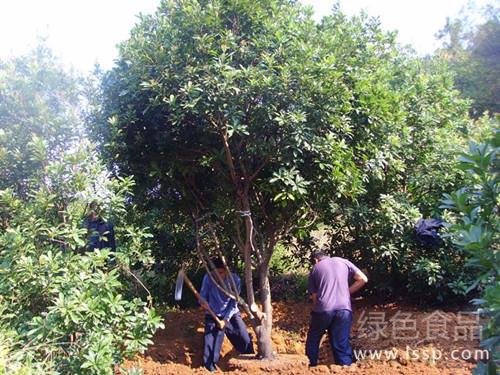
Fertilization for Chinese Bayberry
I. Fertilizer Types:
Farmyard manure: plant ash, rapeseed cake, pig, cattle, and sheep pen manure, poultry manure, etc.; chemical fertilizers: potassium sulfate, imported compound fertilizer (that is, compound fertilizer containing potassium sulfate), superphosphate, calcium magnesium phosphate, urea, ammonium bicarbonate, etc.; trace element fertilizers: borax, zinc sulfate, ammonium molybdate (agricultural grade), potassium dihydrogen phosphate, etc. Chinese bayberry organic special fertilizer.
II. Fertilization Periods:
Young trees. (1) Base fertilizer: mid-October to mid-November, to help Chinese bayberry overwinter safely, promote root growth, and promote early sprouting of spring shoots the following year. (2) Topdressing: after applying sufficient base fertilizer before planting the young seedlings, starting from germination, once a month from March to July, until the 3rd year; (3) Foliar topdressing: throughout the entire growth period, to supplement insufficient root-zone fertilization.
Fruiting trees. (1) Base fertilizer: mid-October to mid-November, to help Chinese bayberry overwinter safely, promote root growth and early sprouting of spring shoots the following year, further carry out flower bud differentiation, and supplement the nutritional needs of Chinese bayberry flowering, fruiting, and shoot sprouting in spring; (2) Topdressing: ① Pre-flowering fertilizer: late January to mid-February, aimed at promoting the sprouting of spring shoots and supplementing the nutritional needs of spring shoot germination, flowering, and fruiting, with emphasis on trees in an on-year, weak-growing trees, and trees with many flower buds, but for trees in an off-year, strong-growing trees, and trees with few flower buds, do not apply or apply less. ② Fruit-swelling and shoot-promoting fertilizer: late April to early May. The purpose is to promote the maturity of the current year's spring shoots and the rapid enlargement of the current year's Chinese bayberries. ③ Post-harvest fertilizer: late June to early July. The purpose is to supplement the insufficient tree nutrition after harvest, resist high temperature and drought, and promote summer shoot sprouting and flower bud differentiation, which is especially important for varieties that mainly bear fruit on summer shoots, such as 'Dongkui'. However, trees in an off-year and trees with many and vigorous spring shoots may not be fertilized or may be fertilized less. (3) Foliar topdressing: throughout the entire growth period except the June ripening period of Chinese bayberry, to supplement insufficient root-zone fertilization.
III. Fertilization Amounts:
Before planting young seedlings, apply sufficient base fertilizer: apply 25kg of pen manure or garbage compost per hole, or 3kg of decomposed cake fertilizer + 10-15kg of burnt mud ash and 0.5kg of superphosphate.
Young trees. (1) Base fertilizer: accounting for 70% of the annual fertilization amount; generally, 5kg of pen manure plus 7.5kg of burnt mud ash can be applied per tree, and as the tree age increases, the annual amount increases, until the initial fruiting tree, with 12.5kg of pen manure + 20kg of burnt mud ash per tree; (2) Topdressing: 0.05-0.1kg of urea or compound fertilizer per tree, and as the tree age increases, the amount per application increases, until the 3rd year. (3) Foliar topdressing: 0.2% potassium dihydrogen phosphate and 0.2% urea.
Fruiting trees. Taking a Chinese bayberry tree with a per-tree yield of 50kg as an example, (1) Base fertilizer: accounting for 70% of the annual fertilization amount; apply 12.5kg of pen manure or 25kg of compost plus 4-6kg of cake fertilizer or 25kg of burnt mud ash per tree. (2) Topdressing: ① Pre-flowering fertilizer: apply 15-20kg of burnt mud ash or 0.5-1kg of potassium sulfate per tree. ② Fruit-swelling and shoot-promoting fertilizer: apply 1-3kg of potassium sulfate or 25kg of burnt mud ash per tree. ③ Post-harvest fertilizer: apply 0.5-1kg of imported compound fertilizer containing potassium sulfate or 1-3kg of potassium sulfate or 0.5kg of urea + 1kg of potassium sulfate per tree. (3) Foliar topdressing: in March to April, 0.2% borax 1-2 times; at flowering stage, 1-2 times of 0.01%-0.02% ammonium molybdate; when preventing and controlling pests and diseases, each time add 0.2% potassium dihydrogen phosphate and 0.2% urea (urea: for strong-growing trees, it may be omitted or reduced).
IV. Fertilization Methods:
Chinese bayberry has a shallow root system, with no obvious main root; 70%-90% of the root system is distributed within 0-60cm, with the most at 5-40cm; its horizontal root distribution is 1-2 times the canopy diameter. According to the root distribution characteristics of Chinese bayberry, when fertilizing, a depth of 20-40cm and a fertilization position near the canopy drip line are preferable. For young trees, use dish-shaped fertilization centered on the main trunk, with the tree dish size similar to the canopy, shallow inside and deep outside, about 20-30cm deep; ring-shaped trench fertilization can also be used near the canopy drip line. For mature trees, strip trenches, ring-shaped trenches, or hole application can be used, also near the canopy drip line, 20-40cm deep. Pen manure and compost should be applied deeply, while chemical fertilizers can be applied shallowly; after application, cover with soil, and chemical fertilizers can also be broadcast on rainy days. Combined with winter soil turning, fertilizer can be broadcast over the entire orchard and turned into the soil.