Early spring greenhouse cultivation techniques for small watermelons: good returns as gift melons
Small watermelon, also known as pocket watermelon or mini watermelon, has fine tender flesh, few fibers, a fresh sweet taste, and is easy to carry. It is a high-grade gift melon and is well liked by consumers. Its price is high and the economic returns are considerable. Five key points should be grasped when cultivating small watermelons in greenhouses in early spring:
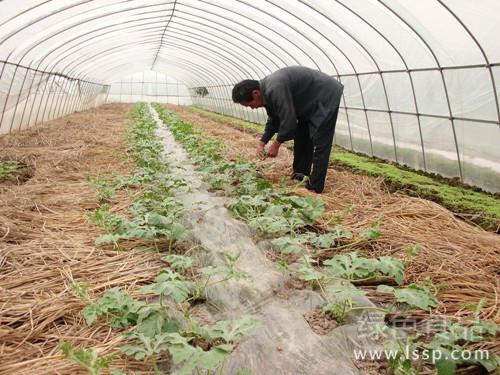
Early spring watermelon management
1. Variety selection: generally choose watermelon varieties that are early maturing, disease resistant, high yielding and of good quality, such as Hongxiaoyu, Texiaofeng, Heimeiren, Zaochun Hongyu, Xiaoyu, Yangchun, Chunguang, etc.
2. Cropping arrangement: greenhouse cultivation is the main cultivation method for early spring small watermelons. Multi-layer covering inside the greenhouse, such as small arch tunnels and plastic film mulch, should be used to raise soil temperature and air temperature as much as possible. The suitable sowing period is from late January to early February, and transplanting is done from late February to early March (3 true leaves and 1 heart leaf), making full use of March to May, when rainfall is relatively low and light is abundant. Harvest begins in mid-May, and multiple fruit settings are possible, giving high yields.
3. Raising strong seedlings: after seed soaking and germination, the gourd rootstock is sown in nutrition pots or plug trays. About 7 days later, when the gourd seedlings' cotyledons have separated and the true leaves have emerged, the watermelon seeds are then germinated and sown. When the first true leaf of the gourd seedling is half unfolded and the watermelon true leaf has emerged, cleft grafting is most suitable. After 20 days, when the grafted seedlings have grown 2 to 3 true leaves, they can be transplanted.
4. Timely transplanting: choose a plot with a low groundwater table, high and dry conditions, good drainage, and where cucurbits have not been grown for 3 years to plant watermelons.
1. Apply sufficient base fertilizer. Small watermelons have a high planting density, many fruit-setting rounds, a long harvest period, and a high fertilizer requirement, so base fertilizer should be applied heavily. Generally, apply 6 cubic meters of decomposed organic fertilizer and 50 kg of ternary compound fertilizer per mu, applied in layers. Open deep furrows at an average row spacing of 2-2.25 m, with a furrow width of 50 cm and a depth of 40 cm. Backfill half of the excavated soil first, apply 70% of the organic fertilizer, turn and mix evenly, irrigate to create bottom moisture, then backfill 2/3 of the remaining soil, apply the remaining 30% of the organic fertilizer, mix evenly, and water again, with thorough watering and leveling as the standard. Then scatter in the ternary compound fertilizer. After turning evenly and raking level, make small ridges 15 cm high along the center line, cover with plastic film, close the greenhouse, and prepare for transplanting.
2. Transplanting density. The planting density and cultivation method of small watermelons vary with the pruning method, and the pruning method is mainly ground-prostrate cultivation. With two-vine pruning, the transplanting density is about 800 plants per mu; with multi-vine pruning (4-5 vines), the transplanting density is about 400-500 plants per mu. When transplanting, open holes in the plastic film at a plant spacing of 40 cm. After planting the seedlings, pour a small amount of water into each hole until thoroughly moistened. After the water seeps in, seal the hole, then cover with the greenhouse film, and cover with the other covering layers in the afternoon to ensure nighttime temperature.
5. Field management:
1. Temperature and light management. The seedling recovery period requires high temperatures, about 30°C during the day and 15°C at night, and not lower than 10°C. At night, multiple layers of film are used in the greenhouse. After sunrise, remove the film layer by layer from outside to inside, and in the afternoon cover it layer by layer from inside to outside. After seedling recovery, keep it at 22°C-25°C during the day, and ventilate when it exceeds 33°C; at night keep it above 12°C. The flowering and fruiting period requires relatively high temperatures, 30°C-32°C during the day and 18°C at night, which helps flower organ development, pollination, fertilization and promotes watermelon development.
2. Reasonable pruning. Small watermelons have weak growth vigor and small fruit shape, so multi-vine and multi-fruit cultivation is suitable. The pruning method currently used is to pinch the growing point at the 6-leaf stage. After the secondary vines emerge, retain 3-5 secondary vines of similar growth and let them grow in parallel, and remove the remaining secondary vines and the tertiary vines formed on the secondary vines before fruit setting.
3. Fertilizer and water management. On the basis of sufficient bottom water, sufficient base fertilizer and heavy application of organic fertilizer, the first crop of watermelons is generally not watered or topdressed before harvest. If moisture is insufficient, it should be supplemented appropriately in the early fruit enlargement stage. After most of the first crop of watermelons is harvested, when the second crop of watermelons begins to swell, topdressing should be carried out, mainly with potassium and nitrogen fertilizers, while supplementing some phosphorus fertilizer. Apply 50 kg of ternary compound fertilizer per mu in furrows around the outer edge of the watermelon roots, then cover with soil and water. After most of the second crop of watermelons has been harvested, when the third crop of watermelons begins to swell, topdress according to the previous application rate and method, and appropriately increase the number of waterings.