Pollution-free cultivation techniques for cowpeas: simple to grow with good returns
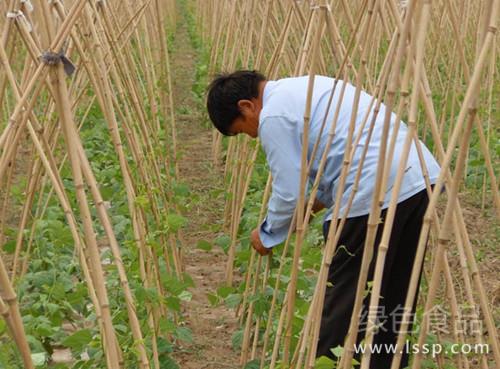
Trellising cowpeas
1. Land preparation and fertilisation:
The land for planting cowpeas should have deep soil rich in organic matter and should not have grown cowpeas the previous year. Before sowing, plough 25cm deep, apply 5000kg of organic fertiliser and 50kg of vegetable-specific compound fertiliser per mu as base fertiliser, and form beds 1.2m wide.
2. Sowing and raising seedlings:
For cowpea sowing, in open-field cultivation, seedling raising is in late March and direct sowing is in early to mid-April. The sowing rate is about 2.5kg per mu. For seedling raising, use a greenhouse; cowpea seedlings for transplanting can be raised in small plastic bags or paper pots, sowing 2-3 seeds per hole, watering thoroughly, taking care to keep warm and control leggy growth of the seedlings. When raising seedlings, put the selected seeds briefly into hot water at 80°C-90°C, then immediately add cold water to cool them down, keeping the water temperature at 25°C-30°C for 4 hours, then remove and dry slightly before sowing. The seedling age is about 20-25 days. After emergence, keep the daytime temperature at 20-25°C; the greenhouse must be kept warm while also being ventilated to ensure the seedlings grow uniformly and vigorously. During the seed germination and seedling stages, the seedbed soil should not be too wet, so as to avoid reducing the germination rate, or causing leggy growth or even root rot and seedling death.
3. Transplanting:
Transplant when the seedlings raised in nutrient pots have 2-3 compound leaves. For open-field cultivation, transplant in late April. Use a hole punch to make holes for transplanting; after transplanting, water well to settle the roots, fill with fine soil and seal the transplanting holes firmly. Generally, transplant cowpeas in two rows per bed, with a hole spacing of 20cm, at 5000-5500 clumps per mu.
4. Field management:
From transplanting to before flowering, cowpeas should mainly be managed by controlling water and hoeing to promote root growth, with appropriate seedling hardening to promote flowering and pod setting; after pods set, supply sufficient fertiliser and water to promote flowering and increase pod setting. After cowpeas flower and set pods, generally top-dress 2-3 times, each time applying 5-15kg of urea per mu or 750-1000kg of decomposed human manure; at the peak harvest period, top-dress once with irrigation water, applying 25kg of diammonium phosphate or 25kg of potassium dihydrogen phosphate per mu. After cowpeas start to run vines, trellis them promptly, with a trellis height of 2.0-2.5m; after the trellis is set up, guide the vines promptly, doing so on a sunny afternoon, never in rain or in the morning, to prevent breakage. Prune reasonably so that the stems and vines are evenly distributed and light use efficiency is improved. Use both the main vine and side vines for pod setting to increase the number of flower clusters and the pod-setting rate, extend the harvest period and increase yield. To this end, appropriately retain side vines, remove late-forming first flower clusters and weak side vines, and retain vigorous side vines that form their first flower cluster early; among those growing from the middle of the main vine upward, after the first flower cluster appears, pinch off the top leaving 4-5 leaves, to increase the number of flower clusters and promote flower cluster development; when the main vine reaches the top of the trellis, at a vine length of about 2m, pinch off the top to promote the formation of secondary flower buds on each flower cluster.
5. Pest and disease control:
The main diseases of cowpeas include rust, downy mildew, anthracnose and leaf spot, and the pests include aphids, red spider mites and pod borers. For rust, in the early stage of the disease, alternate sprays of 20% triadimefon at 1500-2000 times dilution, or 40% DuPont Fuxing at 4000 times dilution, or 50% Jianajin at 600-800 times dilution; for downy mildew, alternate sprays of 72% Shuangke at 600-800 times dilution or metalaxyl mancozeb; for aphids, alternate sprays of Delike at 1500-3000 times dilution or 10% imidacloprid at 2000 times dilution; for red spider mites, spray 2% abamectin emulsifiable concentrate at 6000 times dilution; for pod borers, alternate sprays of 2.5% deltamethrin at 2000 times dilution or fenvalerate.