Key Points for High-Yield Cultivation and Management of Spring Corn under Plastic Mulch
Spring corn cultivation under plastic mulch has the obvious effects of increasing temperature, preserving soil moisture, preserving fertilizer, ensuring full stands, suppressing weed growth, reducing insect pests, promoting corn growth and development, early maturity, and increasing yield. The key to applying this technique lies in strengthening field management, with emphasis on doing several things well:
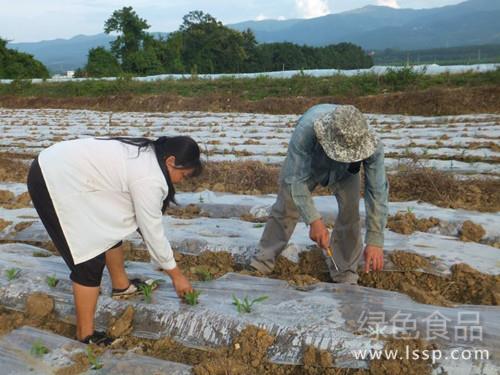
Breaking the plastic mulch to release corn seedlings
1. Frequently inspect the plastic mulch. After sowing under mulch, frequently inspect the plastic mulch. If damaged or ventilated spots are found, seal them tightly with soil in time to prevent air leakage, temperature loss, and moisture loss.
2. Break the mulch and release seedlings in time. Inspect 7-10 days after sowing. Once corn seedlings have basically emerged completely, choose early morning or late afternoon on a sunny day to release seedlings; cloudy days are best for releasing seedlings, and seedlings should not be released on windy days. Release larger seedlings, not smaller ones; release green ones, not yellow ones; break the mulch and release seedlings in time. After releasing seedlings, seal the seedling holes tightly with moist soil in time.
3. Thin and finalize seedlings in time. When the 3-4 leaves of corn seedlings are fully expanded, thinning can be carried out; if too late, the corn will be crowded, shade each other, and compete for nutrients. Finalize seedlings when there are 5-6 leaves, mastering the principles of removing weak seedlings, leaving seedlings evenly, leaving complete seedlings, and leaving strong seedlings. Where seedlings are missing, double plants can be retained by borrowing seedlings to compensate, or transplanting with a soil ball and watering can be used, ensuring 4500-5000 plants per mu for compact corn and 3200-3500 plants per mu for corn with flat leaves.
4. Seedling hardening and tiller removal. Seedling hardening means preventing excessive seedling growth where the soil layer is fertile and basal fertilizer and basal soil moisture are sufficient, controlling water so roots can grow downward. In seedling hardening, harden green seedlings but not yellow ones, harden fat seedlings but not thin ones, harden wet seedlings but not dry ones. Tiller removal: around jointing, axillary buds at the leaf axils of the corn plant extend as tillers; they cannot form ears and waste nutrients in vain. Remove tillers on clear days to help wounds heal and reduce disease infection.
5. Scientific topdressing. According to seedling conditions, use soil testing and formula fertilization technology. When corn has 6-9 leaves, apply 15 kg urea per mu to ensure the nitrogen fertilizer needed by corn during the seedling stage. At the large trumpet stage of corn, apply 20 kg urea per mu as ear fertilizer, deeply topdressing along the side of the ridge, with a topdressing depth of 8-10 cm.
6. Integrated control of diseases and insect pests. The main diseases and insect pests of corn during the growth period are northern leaf blight and southern leaf blight of corn, corn borer, rust, aphids, and so on. Control can be carried out as appropriate and in a timely manner according to the occurrence of corn diseases and insect pests.
7. Remove waste mulch in time and harvest at the right time. After corn harvest, remove old waste plastic mulch from the field in time to protect the farmland ecological environment and purify the soil.