Potted peach tree planting and management methods: beautify the environment and harvest fresh fruit
Potted peach trees combine fruit tree horticulture and bonsai art. Besides being pleasing to the eye, beautifying the home, and providing delicious fresh fruit, they can also bring wealth.
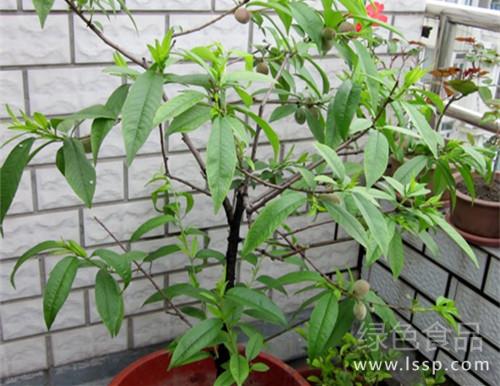
Peach tree potting
1. Variety selection: Any peach variety can be used, but varieties with strong self-fertility and an open tree habit are best.
2. Nutrient soil preparation and disinfection: Mix 6 parts humus soil, 2 parts vegetable garden soil, and 1 part each of decomposed pig manure and chicken manure to make the nutrient soil. After mixing, spray with a 0.4% potassium permanganate aqueous solution. After spraying, pile it up and cover it tightly with plastic sheeting. After 1 day, remove the plastic sheeting and let the solution volatilize.
3. Container selection: Clay pots are best. The initial pot mouth is about 45cm. After 3 years of growing, repot into a large pot with a mouth of about 65cm.
4. Seedling selection: Choose 1-year-old grafted seedlings. The seedling height should be about 60cm, with 3 to 5 branches and a well-developed root system.
5. Transplanting: Before transplanting, first prepare the nutrient soil, and soak the peach seedling and clay pot thoroughly in water. When transplanting, trim off excess root hairs from the peach seedling, then place the peach seedling in the pot, fill it with nutrient soil, water thoroughly, and finally cover the pot mouth tightly with plastic film.
Peach tree pruning
6. Training and pruning: After planting, select 3 robust branches with different directions and similar lengths as the main branches, and at the same time thin out excess branches. Method for determining the trunk height: cut off 0.5cm above the uppermost main branch. In the 2nd year, when the peach tree sprouts new shoots, wrap wire around the pot in a circle, tie string to the wire and the main branches, and pull the main branches to a certain angle. After branch pulling, the branches growing on the main branches can be trained into round, slanting-trunk, weeping-branch, fan, and other shapes through techniques such as branch bending, branch circling, branch tying, and branch twisting, so as to promote peach tree growth and fruiting and increase beauty. If light inside the tree canopy is insufficient, the tall branches can be cut back and overly dense branches thinned out. The peach tree begins to bear fruit after growing for a certain period. For small-fruited peaches, leave 1 fruit per 30 leaves; for large-fruited peaches, leave 1 fruit per 50 leaves. To make the peach plant more attractive, the "T" budding method can be used for multi-head grafting of scions from different peach varieties. For winter pruning, first prune the 3 main branches so that their lengths tend to be balanced. Next, for the branches on the main branches, use the single-branch renewal and two-branch renewal methods to train some into branch groups and distribute them evenly on the main branches. For the remaining branches, focus on shaping, and either leave them unpruned or prune them lightly.
7. Fertilization: From bud break to the end of May, apply 0.3% to 0.5% urea solution; from June onward, apply 0.5% to 1% monopotassium phosphate aqueous solution. The number of topdressings depends on the vigor of the peach tree, the season, and the fertility of the potting soil. Apply base fertilizer before leaf fall in autumn. Method: remove 10cm of soil from the pot (preferably without damaging the roots), then fill in soil mixed with decomposed organic fertilizer and water thoroughly.
8. Watering: Whenever the potting soil is short of water, water it promptly. Water thoroughly, and do not allow the phenomenon of "wet on top and dry below." Prevent the soil from becoming compacted after watering. After watering, loosen the soil promptly to improve aeration.
9. Pest and disease control: The main diseases of peach trees are brown rot and anthracnose. To control peach brown rot, spray with 65% zineb wettable powder at 500 times dilution. To control anthracnose, spray with 70% thiophanate-methyl at 1000 times dilution. The main insect pests of peach trees are peach fruit borer and aphids. To control peach fruit borer, spray with 20% fenvalerate emulsifiable concentrate at 4000 times dilution. To control aphids, spray with 40% omethoate emulsifiable concentrate at 2000 times dilution.
10. Repotting and soil replacement: After the peach tree has grown for 2 to 3 years, the root system becomes larger and the nutrients in the potting soil become poor. At this time, after leaf fall in autumn, replace the nutrient soil and use a larger pot. Five days before repotting, water the potting soil thoroughly, soak the new pot in water, and prepare the nutrient soil at the same time. Then, take out the peach tree with its soil ball, use a sharp blade to shave off a 3cm-thick layer from the outer edge of the soil ball together with roots, place the trimmed soil ball into the new pot, fill the gaps with new nutrient soil, and water thoroughly.
11. Overwintering: Most peach varieties can endure low temperatures of -22 to -25°C, so peach trees can basically overwinter safely. However, note that peaches require a certain amount of low temperature in winter to sprout, bloom, grow, and bear fruit normally, usually requiring 600 to 1200 hours of chilling. Therefore, pay attention to low-temperature treatment for peach trees in winter. Do not place them in a room with heating, and at the same time prevent the potting soil from drying out. If it dries out, water it promptly.