Early Market Listing Brings Good Returns: Greenhouse Grape Cultivation and Management Techniques
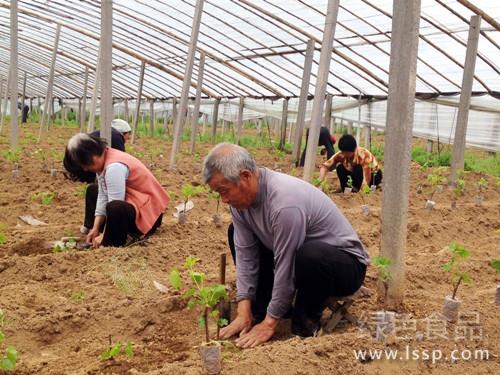
Greenhouse Grape Planting
1. Site selection: Plant greenhouse grapes in sandy loam soil with convenient transportation, abundant water, deep soil layers, fertile soil and low salinity and alkalinity.
2. Variety selection: The purpose of protected cultivation of grapes is to make grapes ripen earlier, so early-maturing varieties can be chosen. Next, choose varieties with a short dormancy period, low chilling requirement, suitability for artificial breaking of dormancy, strong adaptability to soil and climate, and strong disease resistance. In addition, consider choosing grape varieties that are easy to form flowers, have a high fruit-setting rate and excellent commercial traits. Such as Summer Black, Red Balado, Jumeier, Black Balado, Jasmine Fragrance, Aimi, Seedless Prince, Gaomo, etc.
3. Planting: 1. It should not be too early, from mid-March to late April. If it is a greenhouse idle in winter, the plastic film should be covered about 15 days in advance to raise the ground temperature. After planting, the survival rate is high and the growth is good.
2. The selection of greenhouse grape cultivation seedlings depends on the insulation performance of the greenhouse. A large-span thick-wall greenhouse can start heating in January to February and will not freeze the roots, so both cuttings and grafted seedlings can be used; other greenhouses have poor insulation performance and are prone to freezing roots during overwintering, so grafted seedlings should be selected.
3. Choose a north-south row direction, single-row planting, and double-cane pruning. The plant spacing and row spacing should be determined according to the characteristics of the grape variety.
4. After grapes are planted, the planting strip cannot be loosened and fertilized for many years, so before planting, planting trenches should be dug according to the selected row spacing, and fully decomposed organic fertilizer should be applied; on the one hand, it meets the needs of growth, and at the same time, the grape root system's tendency to seek fertilizer is used to make the roots go deeper, improving drought resistance and cold resistance. The dug planting trench is 40 cm deep and 50 cm wide, and 5000 kg of organic fertilizer is applied per mu.
5. After planting, water thoroughly in time, and cut the seedlings to retain 3-4 buds. When the planting strip is dry and wet alternately, loosen the soil to preserve moisture, or cover with film to preserve moisture; if covered with film to preserve moisture, cover with loose soil after breaking holes in the film to expose the branches and buds. After that, water as little as possible. After planting, the daytime temperature is about 20°C and the nighttime temperature is about 10°C. Since new roots have not yet grown, the daytime temperature should not be too high.
6. After entering the vigorous growth period, poor control of temperature and humidity in the greenhouse can easily cause grape diseases. To save labor and effort, after the outside air temperature stabilizes at 20°C, the greenhouse film can be removed, and before the early frost comes, the greenhouse film should be covered again.
4. Summer pruning: When the grape plant survives and grows 3 or 4 leaves, select and retain two better buds and remove the rest. Use thin string in time to tie the branches so that they are evenly distributed on the trellis surface. When the new shoot grows to about 1.5 m, pinch the tip. All secondary shoots growing from the leaf axils of new shoots at a height below 50 cm should be removed; for those above 50 cm, retain 2-3 leaves and repeatedly pinch the tips. Remove tendrils in time to save nutrients. For fruit-bearing grapevines, it is also necessary to remove buds, set shoots, pinch clusters, thin fruit, bag, and remove old leaves, etc.
5. Temperature and humidity management during the growing season:
1. Temperature control: After greenhouse grapes begin to lift the curtain and raise the temperature, they need more than 500 degree units of effective accumulated temperature above 10°C, and generally begin to sprout after 30-40 days. The temperature should not rise too quickly. Try to make the ground temperature and air temperature rise synchronously to avoid disharmony between the upper and lower levels. Before bud break, the nighttime temperature is 5-15°C, and the daytime temperature is 20-28°C; from bud break to flowering, the nighttime temperature is controlled above 15°C, and the daytime temperature is within 28°C; from the grape swelling stage to the coloring stage, the nighttime temperature is about 15°C, and the daytime temperature is 25-28°C; from the coloring stage to the maturity stage, the nighttime temperature is 13-15°C, and the daytime temperature is 20-28°C.
2. Humidity control: The air humidity from before bud break to before inflorescence emergence is above 80% to ensure uniform sprouting; during the inflorescence elongation stage, appropriately control water, and the air humidity is about 60%; from flowering to fruit setting, relatively dry conditions are required, with air humidity at 50%, which is beneficial to improving the fruit-setting rate; from the grape swelling stage to the coloring stage, the air humidity is about 60-70%; from the coloring stage to the maturity stage, the air humidity is about 65%.
Grape Winter Pruning
6. Overwintering management:
1. After entering November, open the ventilation opening day and night to lower the temperature and promote grape leaf drop. After leaf drop, carry out winter pruning. Cut off all secondary shoots, retain about 1 m of the main branch, and there is no need to lower it from the trellis or bury it in soil. 2. Cover the cotton curtain well so that the greenhouse receives no light, and keep the temperature at -10-7.5°C. This can both increase the amount of low temperature and prevent the grapes from freezing. 3. If the greenhouse's overwintering performance is not good, heating needs to be delayed. When the outside air temperature is about -20°C, the cotton curtain can be rolled up 1-2 m from 8 a.m. to 3 p.m. every day to raise the greenhouse temperature. The lowest temperature in the greenhouse should not be lower than -13°C. 4. For greenhouses with good overwintering performance, the curtain can be lifted to raise the temperature by mid-January.
7. Pest and disease control:
In grape cultivation, there are few insect pests. In individual plots, there are a small number of thrips and stink bugs. From after bud break to the leaf expansion stage, use fenvalerate for control. Diseases include gray mold, rachis brown blight, powdery mildew and downy mildew, which can be controlled with thiophanate-methyl, cymoxanil mancozeb, etc. However, in grape disease control, special attention should be paid to controlling humidity. After watering, ventilate in good time and apply pesticides in time for prevention. In addition, strengthen the disinfection of the greenhouse after leaf drop.