The flowering stage of broad beans is the peak period of fertilizer demand: understanding the fertilizer demand pattern and fertilization methods
Broad beans require relatively large amounts of nutrients, such as nitrogen, phosphorus, potassium, calcium, etc. The flowering stage is the peak period of fertilizer demand for broad beans, when dry matter accumulation is greatest. In addition, broad beans have a high demand for trace elements and are sensitive to molybdenum and boron. Attention should be paid to boron deficiency in broad beans; they are known as a "phosphorus-loving crop." The ratio of nitrogen, phosphorus and potassium absorbed throughout the whole growth period is about 1:0.5:0.6. Producing 100 kg of broad beans requires the absorption of about 4.45-4.80 kg of pure nitrogen (N), 1.09-1.40 kg of P2O5, and 1.66-2.10 kg of K2O. Because broad bean rhizobia have nitrogen-fixing capacity, they can supply about 2/3 of their own nitrogen requirement.
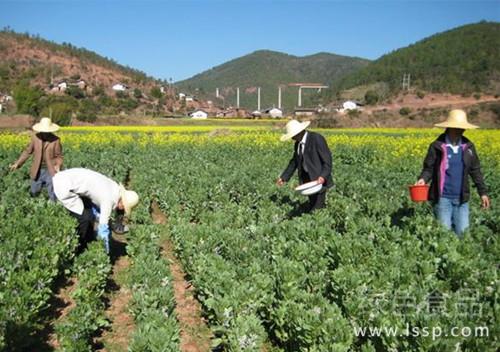
Topdressing for broad beans
1. Nitrogen, phosphorus and potassium uptake at different growth stages:
Broad beans absorb different amounts of nitrogen, phosphorus and potassium at different growth stages. Analyzing the growth stages: in the early stage, when broad bean rhizobia have not yet multiplied in large numbers and carried out nitrogen fixation, a small amount of nitrogen needs to be supplied, while phosphorus, potassium, calcium, boron and other elements are urgently needed. Before the branching stage, nutrient uptake is 20%; at the bud stage, uptake is 20%; at the flowering and pod-setting stage, growth and development are rapid and nutrient uptake is also greatest, accounting for 60% of the entire growth period, and rhizobial activity is most vigorous during this period.
2. Scientific fertilization techniques:
For broad bean fertilization, persist in applying chemical fertilizers together with organic fertilizers, and apply nitrogen, phosphorus and potassium in combination. When fertilizing, base fertilizer must be applied heavily, phosphorus fertilizer increased, nitrogen fertilizer applied according to seedling condition, and flower-pod fertilizer supplemented. On the basis of applying sufficient base fertilizer, topdressing should be done well; base fertilizer should be mainly phosphorus and potassium fertilizer; topdressing should be mainly nitrogen fertilizer, applied as a single application at the flowering and pod-setting stage. In the late growth stage, generally no more topdressing is applied. The total fertilization amount throughout the growth period should not exceed N:P2O5:K2O=4:5:6.
3. Application of organic fertilizer:
For broad beans throughout the whole growth period, the fertilization amount per mu is 1000-1500 kg of decomposed, finely crushed organic compost, applied as a single base fertilizer application during land preparation.
4. Reasonably determining the application rates of nitrogen, phosphorus and potassium:
For broad beans throughout the whole growth period, the nitrogen fertilizer application rate per mu is 3-4 kg of pure nitrogen (N); phosphorus (P2O5) 4-5 kg, and potassium (K2O) 5-6 kg. Phosphorus fertilizer and potassium fertilizer are applied as base fertilizer in a single application; at the early flowering and pod-setting stage, nitrogen fertilizer is applied as flower-pod fertilizer in a single application.
1. Base fertilizer. To improve soil structure, ensure the bean seedlings are uniform, complete and strong, and lay the foundation for branching, flowering, pod-setting and high yield, apply 25-31.25 kg of superphosphate and 9.26-11.1 kg of potassium chloride per mu as a single base fertilizer application in combination with land preparation.
2. Topdressing. Apply 6.5-8.7 kg of urea per mu as a single flower-pod fertilizer application at the early flowering and pod-setting stage.
5. Targeted application of micro-fertilizers:
According to the growth characteristics and fertilizer requirements of broad beans, boron fertilizer and molybdenum fertilizer need to be supplemented. Apply 0.5-1 kg of borax per mu as base fertilizer, and apply 0.3-0.4 kg of ammonium molybdate to the soil as topdressing at the branching stage or the flower-pod stage.
6. Appropriate application of lime on acidic plots:
The suitable soil pH for broad bean growth is 6.2-8. On acidic plots, appropriately applying lime can regulate soil acidity and alkalinity, supplement calcium fertilizer and disinfect and sterilize the soil, which is beneficial to the normal growth and development of broad beans and increases yield. During land preparation, apply 66.7 kg of lime powder per mu in a single broadcast application.
7. Spraying foliar fertilizer:
The flowering and pod-setting stage is the peak period of fertilizer demand for broad beans, so foliar fertilization should be carried out in a timely manner. At the bud stage and the flower-pod stage, spray a 0.2%-0.3% potassium dihydrogen phosphate solution on the leaves respectively to increase grain weight and raise yield.