How to prevent and control kiwifruit root rot causing soft rot of the root crown cortex and leaf drop
Kiwifruit root rot is devastating. Its pathogen overwinters in the soil with diseased plant residues. In the following spring, after the tree begins to grow, the pathogen spreads with cultivation or the activity of underground pests, invading through root wounds or root tips, causing the cortical tissue of the roots to rot, and it can also enter the xylem. July to August is the peak period of the disease, and during this period the pathogen can cause multiple secondary infections. After a plant is infected, the tree vigor weakens, yield decreases, and quality deteriorates; in severe cases, the entire plant dies.
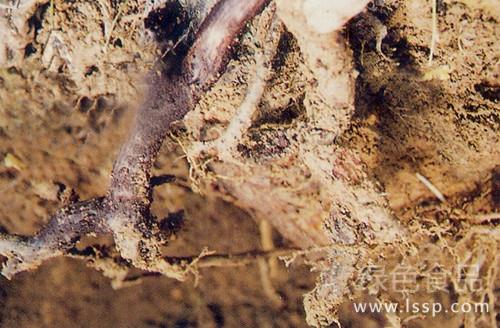
Kiwifruit root rot
1. Symptoms: The disease can occur from the seedling stage to the mature plant stage of kiwifruit, and the affected parts are all in the roots. Root rot is caused by a variety of fungi, and symptoms vary depending on the pathogen.
One type is caused by Armillaria mellea. Disease symptoms: In the early stage, yellow-brown water-soaked patchy spots appear on the cortex of the root crown of kiwifruit; the cortex gradually turns black and soft-rots; the phloem and xylem separate and easily fall off; the xylem can also turn brown and rot. In the aboveground part of the diseased plant, new shoots are thin and weak, leaves are small, leaf color is pale, and growth is weak. When soil moisture is high, the lesions spread rapidly, causing the entire root system to turn black and rot, leaves to turn yellow rapidly, and the whole plant to wilt and die. During the vigorous growth period of the fruit tree or after fruit set, especially in July to August, if there is sudden clearing after prolonged rain, or consecutive high temperatures, diseased plants may suddenly wilt and die entirely. In the later stage, white mycelium can be seen inside the diseased tissue; the rotting roots produce many pale yellow clustered umbrella-shaped fruiting bodies.
The other type is caused by Phytophthora, with two infection routes: one is invasion from the root tip, then gradually developing inward; the other is invasion from the root crown or graft union, where water-soaked lesions appear at the affected site, the cortex necroses and rots, and in severe cases it becomes ring rot. Aboveground growth is weak, budding is delayed, leaves are small, and leaf color is yellow; in severe cases, the whole plant dies. White mold-like substances are produced when the soil is moist or during the peak period of the disease.
2. Disease conditions:
Kiwifruit root rot is often related to soil looseness and pH, planting depth, and water and fertilizer management. According to surveys: (1) Heavy, dry, hard soil with poor aeration leads to poor root growth and susceptibility to this disease. (2) On river beach land, such as along the Heihe River and Weihe River, the groundwater level is high, and waterlogging in the rainy season is severe, making the disease likely to occur. (3) Baishan soil that has not been matured is hard, lacks organic matter, is unfavorable for root development, and is prone to the disease. (4) In plots with excessively high pH, iron is fixed and cannot be absorbed normally, leading to root rot. (5) Improper watering and fertilization damage the roots and easily induce root rot. (6) Planting too deep obstructs root respiration and easily leads to root rot. (7) Excessive fruit load or years of using Daguoling causes weakened tree vigor and reduced resistance, easily inducing root rot.
3. Integrated control: Cultivating disease-free seedlings, strengthening field management, timely removing diseased plant residues from the field, eliminating underground pests, and combining chemical control can effectively control or reduce root rot.
(1) Agricultural control. (1) Cultivate disease-free seedlings; kiwifruit seedlings should be raised in disease-free land where gramineous plants have been grown for many years. Fertilization should be based mainly on fully decomposed barnyard manure or cake fertilizer. For heavy soil, in addition to increasing organic fertilizer, mix in sand when conditions permit. For sandy land, in addition to increasing organic fertilizer, mix in heavy soil for improvement. When pH is greater than 8, cultivation must not be carried out; after improvement, the pH should be neutral or weakly acidic before cultivation. (2) When establishing a new orchard, remove all plant residues in the soil. (3) Kiwifruit needs water but fears waterlogging and has weak moisture tolerance. In high-temperature seasons, reasonable irrigation methods must be used; never use flood irrigation or serial irrigation from tree basin to tree basin, but introduce water separately from canals. Where conditions permit, sprinkler or drip irrigation can be used; irrigation should be uniform to prevent water from standing too long and affecting root respiration. 4. For orchards with high groundwater levels, low-lying terrain, and poor drainage, ditches should be opened promptly for drainage after long periods of rain or heavy rain, to reduce field humidity and increase soil aeration. 5. Reasonable planting depth. Kiwifruit has no main root, but fibrous roots are well developed. If planted too deep, first, root respiration is obstructed, vitality declines, and it is susceptible to pathogen infection; second, water easily accumulates outside the graft union and allows pathogens to invade. 6. Reasonable load. In some cases, leaving too much fruit or using Daguoling causes severe overloading of the fruit tree, leading to weakened tree vigor and reduced resistance.
(2) Chemical control. For mature orchards already affected by the disease, 0.8% Junlimei at 300 times or 40% carbendazim at 400 times can be used for root drenching, with 2-3 kg of solution per tree, once every 15 days, for 2-3 consecutive applications; both can inhibit root rot and increase the per-plant yield of kiwifruit.