Key management points for open-field cultivation of green peppers: preventing waterlogging that kills plants and excess fertilizer that burns roots
Green peppers like warmth, water, fertilizer and high temperatures, are prone to disease, die easily from waterlogging, and suffer root burn from too much fertilizer. Green peppers have different management requirements at different stages, carried out in four stages.
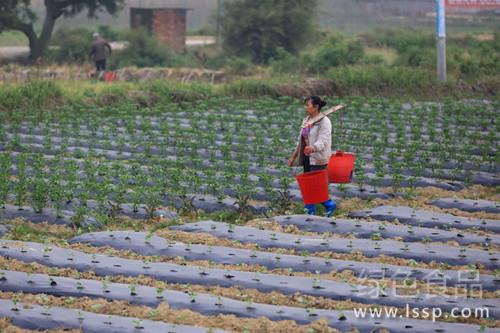
Watering green peppers
1. Seedling stage management:
After green peppers are transplanted, the early soil temperature is low and the root system's absorption capacity is weak, so one should "promote the strong and control the weak," that is, water shallowly, apply topdressing early, cultivate frequently, and train the seedlings lightly. After the transplanting water, when the soil shows dry-wet condition, cultivate and loosen the soil promptly to increase soil temperature and promote root growth. After 8-10 days, water a second time and carry out deep cultivation (about 7cm), slightly shallower near the roots and deeper farther away, to increase soil permeability and raise soil temperature. If the seedlings turn yellow and grow weakly, apply a light fertilizer appropriately (together with the second watering). Apply 500 kg of decomposed human manure per mu with the water, or 7-8 kg of urea; this is also called seedling-control fertilizer, aiming for early seedling recovery and root development, and fast plant growth. After the second watering and cultivation, carry out seedling training, that is, control water to push the root system to develop deeper, achieving deep roots and lush leaves; if water and fertilizer are excessive at this stage, it easily causes excessive vegetative growth and lowers the fruit-setting rate. The seedling training period is about one week.
In recent years, green pepper yields have declined year after year, and an overly long seedling training period is one reason. Green pepper flowering and fruit setting are related to air humidity, so watering promptly after seedling training ends not only increases soil moisture but also raises field air humidity, which favors flowering and fruit setting. When the first layer of green peppers grows to the size of a broad bean, stems, leaves, flowers and fruits grow simultaneously, so water and apply topdressing promptly, applying 500-1000 kg of decomposed human manure per mu or 10-15 kg of (quick-acting) urea, along with some phosphorus and potassium fertilizer, to promote strong plants and prevent flower and fruit drop. After fertilizing, when the soil surface turns white, cultivate promptly to improve soil permeability and enhance the soil's fertilizer-holding capacity.
2. Peak fruiting stage management:
During the peak fruiting stage, temperatures rise, rainfall increases, and pests and diseases occur one after another; this is the key period determining yield. If early growth is poor and mid-term management is also poor, plant growth stalls, viral disease soon occurs, fruits do not enlarge, and yield drops rapidly; in severe cases, plants turn yellow and shrink, with almost no yield. To prevent premature aging, harvest the first fruits promptly, water promptly, maintain soil moisture, promote plant growth and fruit development, and aim to close the rows before the high-temperature season. Before closing the rows, earth up to protect the roots and apply fertilizer.
3. High-temperature rainy season management:
Excessively high surface temperature inhibits normal root growth of green peppers. Therefore, keep the ground surface moist, and water frequently and lightly, that is, the amount of water each time should not be too large, while the interval between waterings should be short, to protect the roots through summer so that green pepper growth can recover after the high temperatures and a second peak of flowering and fruit setting appears.
Green pepper roots fear waterlogging and cannot tolerate standing water. If soil is waterlogged for several hours during the rainy season, green pepper roots will suffocate, the plants will wilt, and root rot and plant death will occur. Therefore, before the rainy season, clear the drainage ditches and drain rainwater promptly. Sudden rain on a clear hot day, or clear weather after long rain, easily reduces soil air and causes green pepper wilting. Therefore, after rain, water promptly with clean water, watering and draining at the same time, to reduce soil moisture, increase soil permeability, and prevent root weakening.
4. Late fruiting stage recovery and rejuvenation management:
After the high-temperature rainy season, from August to September the temperature is cool and sunshine is ample, gradually becoming suitable for green pepper growth; this is the second peak period of flowering and fruit setting for green peppers, so fertilizer and water management should be strengthened to promote new branches, more fruit, and increased late-stage yield. Topdressing and watering are carried out alternately: after 1-2 times of clear water, apply a quick-acting chemical fertilizer once, 10-15 kg per mu, and water once every 7-8 days. Decomposed diluted manure water can also be applied as topdressing.