Tomato flower drop and fruit drop reduce yield; how to protect flowers and fruits?
Strengthen tomato cultivation management measures: First, during the flower bud differentiation period of tomato seedlings, strengthen the management of temperature, light, water, and nutrients to cultivate strong seedlings. Second, when transplanting and setting plants, reduce root damage and speed up recovery. Third, after planting, strengthen fertilizer and water management, avoid excessive or insufficient nitrogen fertilizer, and promptly train, remove side shoots, and pinch off growing tips to prevent excessive vegetative growth, so as to prevent flower drop and fruit drop.
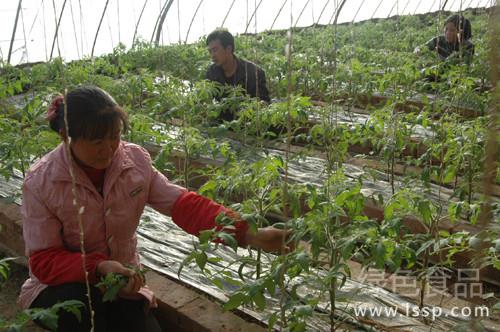
Tomato pruning
I. Regulation of temperature and light:
During the tomato fruit-setting period, the temperature at the flowering stage must be well controlled: the daytime temperature should be about 28°C and must not exceed 34°C, and the night temperature should be about 20°C and must not exceed 22°C. If the summer temperature is too high, to protect flowers and fruits, reduce the concentration of the flower-setting agent, and use agents such as 2,4-D or 4-CPA to protect flowers and fruits. If 2,4-D is used, the suitable concentration is 15 mg/kg; if 4-CPA is used, the suitable concentration is 25 mg/kg. Be careful not to apply the solution to the heart leaves and tender stems to prevent hormone poisoning. In summer, using a shade net for shading helps tomato fruit retention. However, in the morning and evening, the temperature inside the greenhouse is suitable for tomato growth and the sunlight intensity is not strong, which is exactly suitable for tomato flowering and fruit setting, so do not cover with a shade net during these two time periods.
II. Fertilizer and water management:
First, reduce the temperature and humidity inside the greenhouse and increase the day-night temperature difference. This can be done by installing a shade net, increasing bottom ventilation, and watering frequently with small amounts of water. Second, control the amount of nitrogen fertilizer. During the tomato flowering and fruit-setting period, increase the use of potassium fertilizer and boron fertilizer, while reducing or even not applying nitrogen fertilizer. Apply potassium sulfate type fertilizer and Jubaoboron by irrigation, or spray on the leaves with high-energy boron potassium or 0.3% potassium dihydrogen phosphate mixed with Jubaoboron or 1200 times Suleboron. Third, spray the leaves once with 750 times mepiquat chloride or 1500 times chlormequat to control excessive growth and increase the fruit-setting rate.
During the flowering and fruiting period, the soil moisture content should be maintained at about 75%, and ventilation should be carried out in time to remove moisture, so as to reduce air humidity and keep the relative air humidity at about 60%. Note that you should water frequently with small amounts of water, and do not flood irrigate, otherwise it is likely to cause physiological diseases such as yellow leaves.
III. Plant adjustment:
For non-self-topping tomato types, single-stem pruning or double-stem pruning can be used. With single-stem pruning, about 7 trusses of fruit are retained per plant. The first truss retains 3 fruits; for the second to fifth trusses, retain 3-4 fruits per truss and remove the excess. Remove side buds in time, and thin flowers and fruits in time to keep the fruits large and uniform. Generally, first retain 5-6 fruits per truss, and when the tomato fruits grow to about 2 cm in diameter, remove deformed fruits and diseased or insect-damaged fruits, retaining 4-5 fruits. However, for the first few trusses of tomatoes, do not retain too many fruits, to prevent nutrients from being concentrated in supplying tomato enlargement, which would cause severe flower drop and fruit drop in the upper part.
IV. Hormone regulation:
Use effective hormone agents such as 2,4-D and tomato hormone in time to prevent high-temperature flower drop in summer and autumn. The suitable concentration of tomato hormone is 26 mg/kg, and the suitable concentration of 2,4-D is generally 10-20 mg/kg. In high-temperature seasons, when dipping flowers or spraying flowers, the concentration can be slightly lower; otherwise, it can be slightly higher. However, using 2,4-D is labor-intensive, requires careful work, and is prone to residual phytotoxicity, with a relatively large amount of toxic residue, so tomato hormone is mostly used. Use a small sprayer to spray the inflorescence evenly from the inside outward. Try to avoid touching the tender shoots and tender leaves of the tomato to avoid phytotoxicity.
V. Disease and pest control:
The main diseases harming tomato flowers and fruits include early blight, gray mold, canker, and streak virus disease. It is recommended to do a good job of chemical prevention. Early blight and gray mold are fungal diseases, and can be prevented with agents such as chlorothalonil, thiophanate-methyl, or carbendazim; canker is a bacterial disease, and can be prevented with agricultural streptomycin or copper-based agents (DT, copper hydroxide, etc.); to prevent viral diseases, spray moroxydine•copper acetate (Virus A) + ningnanmycin, and at the same time pay attention to applying imidacloprid or acetamiprid to control whiteflies, aphids, and others.