Pest-free cultivation techniques for water spinach: it loves fertilizer and water, and is simple to grow
Water spinach, also known as bamboo-leaf vegetable, swamp cabbage, and vine vegetable, originated in southern China and India and has a long history of cultivation. Its tender stems and leaves are eaten and are rich in nutrients; it also relieves summer heat, clears heat, cools the blood, promotes urination, aids digestion, and detoxifies. It is suitable for stir-frying, making soup, or pickling.
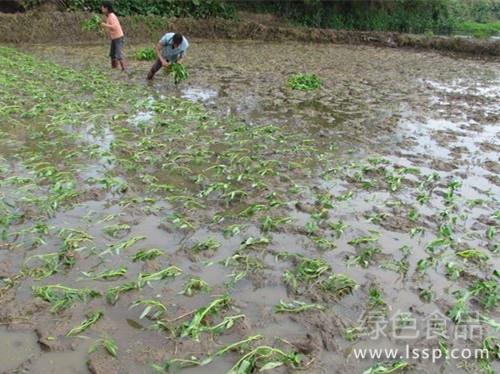
Water spinach transplanting
1. Characteristics. Water spinach is an annual or perennial herbaceous plant of the Convolvulaceae family. It has a fibrous root system that is shallowly distributed and has strong regeneration capacity. The stem is flat-round or nearly round, green or light green, hollow and jointed, with adventitious roots easily forming at the nodes. The cotyledons are opposite and horseshoe-shaped; the true leaves are alternate, heart-shaped, long ovate, or lanceolate, with petioles, entire margins, smooth, and green. The inflorescence is axillary, and the corolla is funnel-shaped, white or light purple. The capsule is ovate and contains 2-4 seeds. The seeds are nearly round, black-brown, with a thick seed coat, and the 1000-seed weight is 32-37 grams.
Swamp cabbage prefers a warm and humid climate. The seeds can only germinate above 15°C. The optimum temperature for water spinach seedling growth is 25°C, and the optimum temperature for stem and leaf growth is 25-35°C. Below 10°C, growth stalls, and when exposed to frost, the stems and leaves wither and die. It is not strict about light and is relatively shade-tolerant. It is not drought-tolerant, and when water is insufficient, yield decreases. It has strong adaptability to soil, but prefers fertilizer and water, so clay loam with strong fertilizer and water retention capacity should be selected.
2. Main types and varieties. Seed swamp cabbage: thick stems, large leaves, light green leaf color. It flowers and sets seed in summer and autumn and can be propagated by sowing or cuttings; it is the main cultivated type. Representative varieties: Guangdong Daguqing, Sichuan Han Swamp Cabbage, Zhejiang Youlong Water Spinach, etc. Vine swamp cabbage: rarely flowers and sets seed, mostly propagated by cuttings. It has a long growth period and high yield. It is tender, strongly flavored, and of good quality. Representative varieties: Guangdong Fine-leaf Tongcai, Hunan Vine Swamp Cabbage, Sichuan Large Swamp Cabbage, etc.
3. Key cultivation points:
1. Sowing, seedling raising, and transplanting. Sow successively from April to July. In early spring, broadcasting is often used, with dense sowing and thinning by pulling; the seeding rate is about 10 kg per mu. In summer, drilling or spot sowing is generally used. After sowing, loosen the soil with a rake to cover the seeds, and apply 1500-2000 kg of human manure per mu as covering fertilizer for the seeds; seedlings emerge in about 1 week. Using cold frames or small arched sheds to raise seedlings can save water spinach seeds and bring the crop to market earlier. Sow in mid-to-late March and transplant in mid-to-late April; the seeding rate is about 20 kg per mu of seedbed, which can transplant 15-20 mu of field. When seedlings are about 20 cm tall, they can be thinned and sold or transplanted. Overwintered old plants or current-year seedling plants can be used for layering or cutting propagation. In dry land, the row spacing for planting water spinach is about 16 cm, and in paddy fields about 22 cm.
2. Field management. (1) Dryland cultivation. Choose low-lying, moist, and fertile land, apply about 2500 kg of high-quality organic fertilizer per mu, plow, and make beds. Before the rows close, cultivate and weed in time. Keep the soil moist at all times. After seedling emergence or after transplanting or cuttings have survived, apply a topdressing once in time, then topdress once every 3-5 days, each time applying 1500 kg of dilute manure water fertilizer per mu, pouring it along the rows to reduce pollution. Fertilization should preferably be done after each cultivation. (2) Paddy field cultivation. Choose paddy fields with convenient irrigation and drainage, facing the sun, fertile, and with a shallow mud layer for planting. Generally, seedling transplanting or cutting propagation is used. In the early growth stage, keep the water depth at about 3 cm to help raise soil temperature. After entering the vigorous growth stage, maintain a water layer of about 8 cm to meet the transpiration needs of water spinach and accelerate growth. Topdressing should mainly use decomposed manure and other quick-acting nitrogen fertilizers, from light to concentrated, and topdress once after each harvest. (3) Floating cultivation. Choose water surfaces with a thick mud layer, fertile, and water depth above 30 cm for planting. In April and May, use ropes, bamboo branches, etc. to weave and clamp water spinach seedlings or cuttings, place them in the water, and fix them with wooden stakes. Basically no fertilizer or water management is carried out.
3. Pest and disease control. The main pests of water spinach include diamondback moth, red spider mite, aphids, etc., which can be controlled with high-efficiency, low-toxicity pesticides such as imidacloprid and azadirachtin. The common disease is white rust, which can be protected against by spraying Bordeaux mixture or zineb.