Pepper magnesium deficiency causes yellow leaves, green veins and small fruit, how should it be prevented and controlled?
Peppers often suffer from magnesium deficiency during the fruiting stage. The pepper leaves turn yellow along both sides of the main vein, gradually spreading to the whole leaf, with only the main vein and lateral veins remaining green. In sweet peppers, magnesium deficiency often starts at the leaf tip and gradually spreads to the mesophyll on both sides of the veins. The more fruit set on a single pepper plant, the more severe the magnesium deficiency. Once magnesium is deficient, photosynthesis declines, fruit is small, and yield is low. Magnesium deficiency in peppers mainly damages the leaves, and in severe cases causes reduced pepper yield and quality, so how should magnesium deficiency in peppers be prevented and controlled?
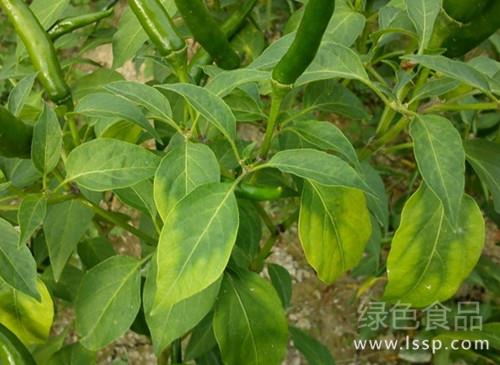
Magnesium deficiency in peppers
Causes of magnesium deficiency in peppers:
① Insufficient soil magnesium supply: Insufficient soil magnesium supply is the main cause of magnesium deficiency in peppers. Southeast China is warm and rainy with relatively strong leaching, making it an area prone to magnesium deficiency. Factors affecting the content of available magnesium in soil include:
First, the degree of soil weathering. Different soil parent materials and degrees of weathering result in different magnesium contents. Red soil has a high degree of weathering and rather thorough mineral decomposition, and generally contains very little magnesium. Purple soil has a low degree of weathering and high magnesium content. Red soil vegetable bases in the Jiangnan area of China are prone to magnesium deficiency.
Second, soil texture. Magnesium in strongly sandy soil is easily leached and its content is low, often unable to meet the needs of pepper growth. Magnesium-deficient soils with coarse texture are mainly distributed in river valley and hilly areas.
Third, soil acidity and alkalinity. The content of available magnesium in soil decreases as soil acidity increases, because available magnesium in strongly acidic soil is easily leached.
② Climatic conditions: Climate affects magnesium deficiency in two ways: one is abundant rain, and the other is drought and strong light. Abundant rain leads to magnesium loss, and this effect is regional in scope, such as the many magnesium-deficient soils in the south. Drought and strong light induce magnesium deficiency as a small-area effect; for example, peppers at the edge of beds and corners of fields fully exposed to sunlight tend to develop the problem more often and more severely than those in inner rows shaded by one another. Drought reduces the absorption of magnesium by peppers. Strong light in summer can aggravate magnesium deficiency, possibly because strong light destroys chlorophyll and accelerates leaf chlorosis.
③ Improper fertilization: When excessive potassium fertilizer and ammonium nitrogen fertilizer are applied to peppers, magnesium deficiency can be induced, because excessive potassium and ammonium ions disrupt nutrient balance and inhibit magnesium uptake by peppers.
Prevention and control measures for magnesium deficiency in peppers:
1. Timely irrigation: Keep the soil moist to reduce the effect of high soil salt concentration on magnesium uptake; apply magnesium fertilizers such as magnesium sulfate at about 10-20 kg per mu. For some acidic soils, magnesium lime is best, at about 50-100 kg per mu; control the amount of nitrogen and potassium fertilizers. For soils with poor magnesium supply capacity, prevent excessive nitrogen and potassium fertilizers from affecting magnesium uptake. It is best to apply fertilizer in small amounts several times. Spray with a 1%-2% magnesium sulfate solution before symptoms intensify, once every 5-7 days, for a total of 3-5 sprays.
2. Apply magnesium fertilizer: For magnesium deficiency caused by insufficient soil magnesium supply, magnesium fertilizer can be applied as a supplement, generally fertilizers such as magnesium sulfate at about 2-4 kg per mu (calculated as effective magnesium). For some acidic soils, magnesium lime (lime burned from dolomite) is best at 50-100 kg, which both supplies magnesium and improves soil acidity. Many chemical fertilizers, such as calcium magnesium phosphate fertilizer, contain relatively high magnesium and can be selected according to local soil conditions and fertilization practices. According to some reports, combined application of phosphate fertilizer and magnesium fertilizer helps magnesium uptake.
For magnesium deficiency caused by root uptake disorders, foliar magnesium supplementation should be used to correct it. Generally use a 1%-2% magnesium sulfate solution, spray before symptoms intensify, once every 5-7 days, for 3-5 consecutive sprays. Magnesium nitrate can also be sprayed.
3. Control the amount of nitrogen and potassium fertilizers: For soils with poor magnesium supply capacity, prevent excessive nitrogen and potassium fertilizers from affecting magnesium uptake. This is especially true for greenhouse peppers. Fertilization is often excessive, and with no rainwater leaching, nutrients accumulate in the root zone and inhibit magnesium uptake. Therefore, when applying nitrogen and potassium fertilizers in greenhouses, it is best to apply small amounts several times.