How to manage pear trees during the flowering period? Master the key points: only with flowers can there be fruit
Only with flowers can there be fruit. Improper or absent management of pear trees during the flowering period easily leads to the phenomenon of a tree full of flowers but only half a tree of fruit, with a low fruit-setting rate and low economic returns. Using the following management methods during the flowering period of pear trees can increase the fruit-setting rate, improve pear quality, and increase economic returns.
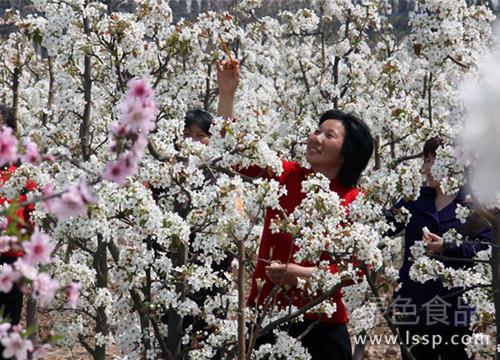
Hand pollination of pear trees
I. Topdressing before flowering:Topdressing before flowering can improve flower bud quality, meet the nutrients consumed by flowering, and increase the fruit-setting rate. Half a month before flowering, apply quick-acting fertilizer mainly composed of compound fertilizer, generally 0.5-1 kg per mature pear tree; for weak trees, add 1-2 kg of urea. The fertilization amount accounts for 10-15% of the total annual amount.
II. Supplementary pruning before flowering:For pear trees that were pruned too lightly and have too many flower buds retained, carry out supplementary pruning, thinning out thin and weak branches, diseased and dead branches, and overly dense branches, and adjust the load of the pear tree. According to the amount of fruit to be retained, determine the amount of flowers to be retained. Generally, the amount of flowers retained is 1-2 times more than the amount of fruit retained. Keep only 1 flower bud per fruit spur, and thin out excess flower buds. For pear trees that are not sensitive to pruning response and do not easily form flowers, the string of flower buds formed by leaving long shoots unpruned should be appropriately cut back, so that the fruiting branches are close to the trunk and new growth branches are promoted, preparing for future fruiting.
III. Flower thinning and hand pollination:Pear flower buds are compound buds, with as many as 5-8 flowers per inflorescence. Flowering consumes a large amount of nutrients from the pear tree. Thinning out excess flowers can concentrate nutrient supply and increase the fruit-setting rate. Flower thinning can be carried out when the inflorescences separate. Flower thinning standards: for large-fruited varieties, leave one inflorescence every 25 cm; generally leave one inflorescence every 20 cm; for weak trees, fruit should be spaced even more sparsely. Issues to note in flower thinning: first, thin out small flowers, central flowers, and poorly positioned flowers, and keep lateral flowers, because lateral flowers open first and set fruit of better quality; second, when flower quantity is uneven, keep more on strong branches and fewer on thin and weak ones; third, keep more on the middle and rear parts of scaffold branches and appropriately fewer on the front parts.
Pollination is effective within 5—7 days after pear flowering, with the first 3 days being preferable. Pollination can be done from 8 a.m. to 4 p.m., and the suitable time varies with the climate during the flowering period. When the temperature is below 10°C, the pollination effect is poor. If low temperatures occur during the flowering period, choose around noon when the temperature rises above 12°C. If high temperatures occur, with the daily maximum temperature reaching about 30°C, pollinate in the early morning or evening; otherwise the stigma will wither and burn, with no effect. The suitable temperature for pollination is 15—20°C. When the climate during the flowering period is unfavorable, it is best to pollinate twice.
IV. Spraying boron to promote fruit setting:Boron can promote pollen tube germination and elongation and promote sugar transport in pear trees. Spraying boron during the flowering period can increase the fruit-setting rate of pear trees. When 25% and 75% of flowers are open, spray once each time with a 0.3-0.5% borax (boric acid) solution, adding 0.3-0.5% urea. Flowering requires large amounts of phosphorus and potassium. Adding or spraying alone a 0.3% monopotassium phosphate solution can also increase the fruit-setting rate.
V. Frost protection during the flowering period:Pear trees bloom early, and the flowering period is mostly before late frost, so they are easily damaged by late frost. After pear flowers are frozen, the pistils turn brown and shrink, and the flowers bloom but cannot set fruit. Frost prevention methods:
1) Irrigate before flowering to lower soil temperature, delay root activity, postpone the flowering period, and reduce or avoid late frost damage; 2) Whitewash the trunk. Whitewashing the trunk before flowering slows the rise in tree temperature and can delay the flowering period by 3-5 days, avoiding or reducing frost damage; 3) Smoke to prevent frost. Smoking can reduce the radiation and loss of soil heat and has a moisture-retaining effect. At the same time, smoke particles can absorb moisture, causing water vapor to condense into liquid and release heat, raising soil temperature and reducing or avoiding frost damage. During the flowering period, pay attention to weather changes. When the temperature may drop to -2°C, frost prevention is necessary. Common smoking materials: sawdust, straw, firewood, leaves, etc., stacked in alternating layers, with kindling inserted in the middle to facilitate ignition and smoke production. Before smoking, organize manpower, assign dedicated personnel by section to be on duty, hang a thermometer 1 m above the ground, and record the temperature regularly. If the temperature suddenly drops to 0°C in the early morning, ignite and smoke. When igniting, follow a unified signal and proceed simultaneously. After ignition, prevent open flames, make it produce thick smoke as much as possible, and never scorch the tree trunk and branches. Frost-prevention smoke agents can also be used. A common formula is ammonium nitrate 20-30%, sawdust 50-60%, waste diesel oil 10%, and fine coal powder 10%. The finer the ammonium nitrate, sawdust, and coal powder, the better. After mixing in proportion, put it into iron cylinders and ignite when used. Use 2-2.5 kg per mu, placed on the windward side.
VI. Pest and disease control:Before and after the flowering period of pear trees is a key period for controlling major pear pests and diseases (such as pear psylla, yellow mealworm, pear fruit sawfly, and black spot disease). The main measures are as follows:
1) Before flowering is the key period for controlling adult pear fruit sawflies and pear psylla. Spray 2000 times diluted deltamethrin or 2000 times diluted beta-cypermethrin, and at the same time control yellow mealworm. In addition, add 2000 times diluted Bio and 5000 times diluted Ripeile to alleviate freezing damage and prevent late spring cold damage. 2) When 80% of pear flowers have fallen, begin spraying. This is a key pesticide application and must be done well. Main targets: pear psylla, yellow mealworm, mites, black spot disease, etc. Example: pesticide formula: 5000 times diluted Movento + adjuvant I + adjuvant II + 800 times diluted Antaisheng solution + 1000 times diluted Jiayuan monopotassium phosphate. In addition, diseased bud shoots and new shoots damaged by pear stem sawfly should be cut off at any time.