Linden wood shiitake cultivation technology: short cycle, early fruiting, high yield
Shiitake linden wood cultivation was developed from the log-hacking cultivation method. Unlike the old method, linden wood cultivation involves cutting the mushroom tree into logs of a certain length, inoculating them artificially, and then carrying out careful management. With linden wood cultivation, the success rate is high, the production cycle is short, fruiting is early, the yield is high, and the adoption rate is high.
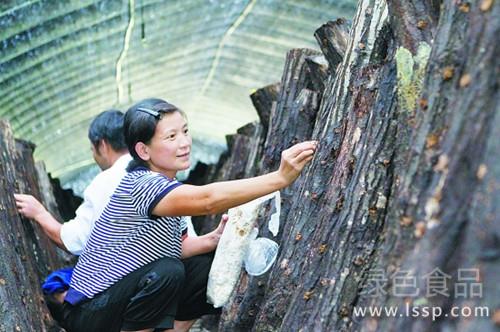
Inoculation of linden wood shiitake
I. Preparation of shiitake linden wood:
1. Felling trees: It is best to fell the mushroom trees in winter. During this period the trees are dormant, rich in nutrients, with low water content, and the bark is tightly bound to the xylem and not easily detached.
2. Artificial inoculation: After the linden wood has dried and cracks appear on the cut ends, when the water content is about 40%-45%, artificial inoculation can be carried out.
II. Good shading and seedling cultivation management:
Common stacking methods include the well-crib style, the strip-stack style, and the tile-overlap style. About every one month, the positions should be swapped from top to bottom, repeatedly rearranged, and the upper and lower mushroom logs should be staggered to facilitate ventilation and the absorption of water.
III. Management during the fruiting period:
If the site has good ventilation conditions, the mushroom logs tend to dry and crack easily. During the fruiting period, special attention should be paid to water management. The air humidity of the mushroom yard should be 80%-90%, and the water content of the mushroom logs should be 50%-60%. If there is clear weather without rain, spray water once in the morning and once in the evening every day to increase the temperature difference and humidity difference so as to stimulate the differentiation and formation of mushroom buds. If the mushroom logs are too dry, soak them in water for 12-24 hours, then gather them together and cover them with plastic film to keep them warm and moist, ventilating three times a day, which can promote the emergence of mushroom buds in large numbers. During the fruiting period, shiitake has vigorous respiration. To keep the air in the mushroom yard fresh, the weeds around the mushroom logs must be completely removed to ensure ventilation and air permeability in the mushroom yard.
IV. Harvesting and drying:
After the mushroom buds emerge, with suitable temperature and humidity, they can be harvested after about 7-10 days. Judging by the appearance of the cap, when it is 60%-70% open, the edge is still slightly inward-curled, and the partial veil at the cap margin is still clearly visible, this is the right time to harvest. The harvested shiitake should be dried immediately. Separate the fresh shiitake by size, thickness, and dryness, place them on the drying equipment, and first dry them slowly at 40-45°C so that the moisture is gradually lost. After the mushroom bodies slowly soften, gradually raise the temperature to 60-65°C until they are dried. The drying technique directly affects the quality of the shiitake. Controlling the temperature well is most important; too high and it is easy to scorch, too low and it is difficult to dry. If the temperature exceeds 70°C, combined with poor ventilation, it is easy to cause the mushroom caps to turn black. Severe temperature changes can also lead to shrinkage of the mushroom caps, cracking, and inward curling of the edges, thereby reducing their commercial value.
V. Pest and disease control:
There are many weeds parasitic on the mushroom logs, such as Trichoderma, Schizophyllum commune, Panus lepideus, Lenzites betulina, Trametes versicolor, and so on. Among harmful insects, there are slugs and snails that eat fresh mushrooms; those that harm the mushroom logs include longhorn beetle larvae, bark beetles, termites, and so on. In control, the policy of "prevention first, integrated control" should be implemented, strengthening the management of the mushroom yard and mushroom logs, creating an environment favorable for shiitake growth but unfavorable for the occurrence of weed fungi and pests, so as to prevent trouble before it happens. Once it occurs, it should be eliminated promptly so as not to let it spread.
1. Manual scraping method: When weed fungi appear on the mushroom logs, they should be scraped off promptly with a knife, and 2% lime water should be applied. For pests such as snails and slugs, they can be captured and killed in the early morning or evening.
2. Chemical control: When weed fungi contaminate the mushroom logs, use lime liquid for local brushing. For slugs and snails, a mixture of lime and bleaching powder (10:1) can be scattered on the shiitake yard for control.