Spring vineyard clearing techniques: preventing and controlling pests and diseases from reproducing and infecting new buds
Although grape pests and diseases cannot yet cause damage in early spring, they will intensify their reproductive activity and are ready at any time to carry out primary infection when the grapes bud. Therefore, the main management tasks for grapes in early spring are as follows:
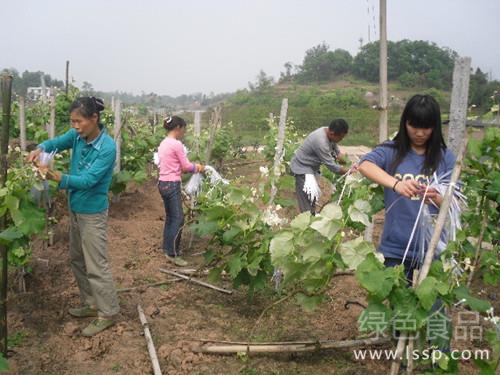
Tying grape vines
1. Training onto the trellis and tying the vines.When tying the vines, first distribute the canes evenly over the trellis surface, keeping the spacing between canes roughly equal, generally 20-25 cm on the same side. This avoids canes crossing, overlapping and becoming crowded. When tying, leave room for the grape canes to grow, while ensuring they are firmly attached to the trellis, using a cross-shaped tie. The tying material is best something soft that will not easily damage the tree, such as cloth strips, straw, hemp rope, corn husks, etc.
2. Clearing the vineyard and disinfecting.After completing the work of tying the vines onto the trellis, promptly scrape off the old coarse bark on the thick grape branches, and remove all of it together with the weeds, dead branches, dry leaves and the miscellaneous materials left on the wires from tying the new shoots, clearing them all out of the vineyard and burning or deep-burying them. When the grape winter buds begin to swell, spray the whole vineyard with chemicals once to thoroughly clear it. The pesticide formula is: Jintoukui 52.5% chlorpyrifos-cypermethrin emulsifiable concentrate at 800 times + Dingsheng Longjuanfeng 25% diflubenzuron wettable powder at 2000 times + Dingjia 10% difenoconazole or 70% Ruinuo methyl thiophanate at 1000 times, mixed solution. A 3-5 degree Baume lime-sulfur mixture can also be used to eliminate the pathogens and pests overwintering in the vineyard. This spraying must be comprehensive and thorough, covering the trees, the ground, the posts, the wires, etc.
3. Before budding, fertilize and water.After cultivating to conserve soil moisture and clearing the vineyard, when the grape buds begin to swell, the scales crack and the fuzz appears, apply fertilizer once, and irrigate immediately after fertilizing. The purpose is to ensure normal bud break and the growth of new shoots. Generally, apply organic fertilizers such as farmyard manure, barnyard manure and chicken manure per mu, mixed with a small amount of nitrogen fertilizer. For mature grape vines, generally use 50-100 kg of organic fertilizer plus 0.5 kg of urea per plant, mix well and apply, or 15 kg of diammonium phosphate, applied in furrows or holes at a depth of 15 cm. After the soil becomes loose, cultivate the orchard once, with a cultivation depth of 5-10 cm being suitable, and rake level after cultivating.
4. Mulching under the trees to raise temperature and conserve soil moisture.After fertilizing and irrigating the grapes, if conditions permit, cover the ground under the trees with black plastic film. Mulching has many benefits: first, it can raise soil temperature, promote root growth, absorb more nutrients, and help flowering and fruiting; second, it can reduce water evaporation from the soil surface, keep the soil moist, and help the grapes develop and swell; third, it can inhibit weed growth, reduce nutrient consumption, lower humidity in the vineyard, and reduce pests and diseases. Before mulching, the tree basin should be trimmed, taking care that it is low on the inside and high on the outside. When mulching, press the edges down firmly with soil.