White radish is nutritious and in high demand; carry out field management well during the cultivation period
White radish is nutritious and contains a variety of trace elements. Eating it regularly can enhance human immunity and inhibit the growth of cancer cells. Minerals such as potassium and magnesium and B vitamins in radish can promote gastrointestinal motility and help eliminate waste from the body.
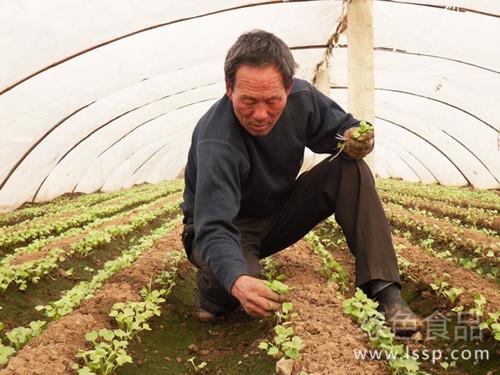
Thinning white radish seedlings
1 Preparation before sowing: To grow white radish, choose a greenhouse that has not grown cruciferous vegetables in the past two years. After the previous crop is harvested, promptly clear the residual plants, rotten leaves and weeds out of the greenhouse and carry out centralized harmless treatment such as high-temperature composting to reduce sources of disease and pest infection. Apply more than 4 000 kg of fully decomposed, finely crushed organic fertilizer per mu, or more than 2 000 kg of commercial organic fertilizer, do not apply undecomposed fertilizer, and mix it evenly with the soil. After fertilizing, mix 250 g of sulfur powder with 1 000 g of dry sawdust per mu, ignite it, seal the door and vents tightly, and disinfect the greenhouse.
2 Sowing: Use 80-150 g of seed per mu. Plant spacing 20cm, row spacing 45-55cm, and planting density per mu is 5 500—6 500 plants. Use the hole sowing method, punch holes in the plastic film, then sow, place 2 seeds in each hole, cover with soil 1.5cm thick, and press lightly after covering to ensure the seeds and soil are closely combined.
3 Seedling stage management: 5—6 days after sowing, check the seedlings once. If there are missing seedlings or broken rows, reseed immediately. Thin the seedlings when the radish cotyledons are fully expanded and the true leaves are emerging, and finalize the seedlings when there are 3-4 true leaves. Keep one plant per hole, and remove diseased and weak seedlings. From emergence to row closure, cultivate and loosen the soil 2-3 times to raise soil temperature and promote young root growth.
4 Management during the vigorous leaf growth period: mainly control water, carry out cultivation and seedling hardening. The specific seedling hardening time should be determined according to climate and soil conditions, generally 12-15 days. In sandy soil and drought conditions, the seedling hardening time should be shortened. Daytime 18-22°C, nighttime 10-12°C; increase light, especially in winter and spring, wipe the greenhouse film every day to improve its light transmittance so the radish receives more light.
5 Management during the fleshy root enlargement period: After the radish shoulders appear, keep the soil moist, prevent the soil from alternating between dry and wet, water frequently with small amounts, and avoid excessive drought and flooding. Timely and appropriate watering is an important measure to ensure the appearance, marketability and taste quality of white radish; stop watering one week before harvest. Optimum temperature: daytime 18-22°C, nighttime 10-12°C, soil temperature 13-18°C. In summer and autumn, cool down through ventilation, shade net covering, watering and other measures, and in winter do a good job of heat preservation and cold protection. In terms of light, sufficient light is required, photosynthesis is strong, material accumulation is greater, the fleshy root expands quickly, and the yield is high. In winter, increase light duration and intensity as much as possible. When base fertilizer is applied sufficiently, generally no additional fertilization is needed; some boron fertilizer can be applied with water to prevent root cracking. If the base fertilizer application rate is low, apply a fully decomposed organic fertilizer once with water at the beginning of root stem enlargement, 300-500 kg per mu; if drip irrigation facilities are available, apply 10 kg per mu of water-soluble NPK fertilizer with a content of 40% with water. Spray foliar fertilizer 3-5 times throughout the growth period, and you can choose 0.25% borax or a mixture of 0.3% potassium dihydrogen phosphate plus 0.5% urea.
6 Harvesting: The harvest period for white radish is generally when the fleshy root is fully enlarged. Harvesting too early affects yield, and too late increases fiber, easily causing cracked roots and spongy hearts, reducing marketability. When the fleshy root diameter reaches more than 5cm, it can be harvested successively. When harvesting, cut the petiole leaving 7-10cm, wash and sell. Handle gently during harvest to prevent bruising the fleshy root.