Key technical points for intercropping sugarcane with corn: improving land, moisture and light use efficiency
Intercropping sugarcane with corn means growing corn between sugarcane rows with sugarcane as the main crop. It can increase the multiple cropping index, raise yield and income, and improve land, moisture and light use efficiency. Returning corn leaves and stalks to the field can also improve soil fertility and soil physical and chemical properties. Sugarcane and corn have a long symbiotic period and shade the rows earlier, which can reduce soil moisture evaporation and avoid weed damage. When intercropping sugarcane with corn, several points need attention:
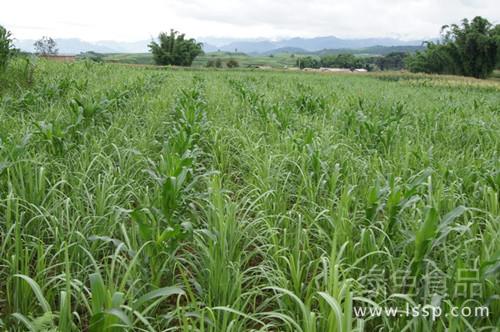
Intercropping sugarcane with corn
1. Adapt to local conditions and choose the sugarcane field. The choice of sugarcane field determines to a certain extent whether sugarcane and corn can achieve high and stable yields. Corn has a large leaf area index and a high water demand. Therefore, fields with certain irrigation conditions should be chosen, requiring fertile soil, high nitrogen, phosphorus and potassium content, high organic matter content, and a moderate PH value.
2. Use good varieties and sow early at the right time. For corn, it is advisable to choose hybrid varieties that are early-maturing, short-stalked, compact in plant and leaf type, lodging-resistant, widely adaptable, high-yielding and good in quality, or local early-maturing waxy corn. For sugarcane, it is advisable to choose good varieties such as the New Taitang series and 69/421. Sugarcane should be planted at more than 6000 buds per mu, with more than 5500 final effective stalks and a yield of 5-7 tons per mu. After planting sugarcane, sow corn in time, with the average daily temperature at corn emergence above 10°C-12°C. In Yunnan and other places, temperatures rise steadily after February, so sowing should be completed by mid-March. Under suitable conditions, the earlier corn is sown, the higher the yield, and the earlier it matures, the smaller the impact on sugarcane, making it easy to obtain a double harvest of sugarcane and corn. Practice has shown that full film mulching can increase soil temperature, preserve water and fertilizer. It is advisable to use 4 m wide plastic film to cover the whole field, pulled tight and pressed firm, to promote early growth and rapid development of sugarcane and corn. For intercropping corn in ratoon sugarcane, after harvesting sugarcane, clean the sugarcane field in time, loosen the stumps, apply sufficient base fertilizer, cover with film and then sow, and the later management is the same as for newly planted sugarcane.
3. Skip two rows and intercrop one row, with rational close planting. A reasonable planting density can promote coordinated growth of individuals and the population and can also take into account the mutual benefit and complementarity of the main and secondary crops. When intercropping corn in every row of sugarcane, although corn yield per unit area is high, it affects sugarcane yield and the overall benefit is poor. Intercropping corn every two rows of sugarcane does not affect the growth of sugarcane and corn, intertillage fertilization, or earthing up, has little effect on sugarcane yield, and the overall benefit is higher than planting sugarcane alone. With a sugarcane row spacing of 90 cm, using the method of skipping two rows and intercropping one row, with a hole spacing of 50-60 cm and 2 plants per hole, ensure 1200-1500 corn plants per mu.
4. Apply sufficient base fertilizer and topdress in time. Before planting, apply heavy base fertilizer. Apply 1500-2000 kg of finely crushed organic fertilizer per mu, plus 20 kg of urea, 60 kg of ordinary calcium superphosphate, and 20 kg of potassium sulfate as seed fertilizer. When corn has 4-5 leaves, quick-acting nitrogen fertilizer can be applied as a seedling-promoting fertilizer. When jointing begins, stems and leaves grow rapidly and fertilizer demand increases sharply. Combined with intertillage and weeding, apply 20 kg of urea, 40 kg of ordinary calcium superphosphate, and 10 kg of potassium carbonate per mu as jointing fertilizer to enhance lodging resistance and drought resistance.
5. Harvest in time and pull up stalks for turning and pressing into the field. When corn matures, pick the ears in time, pull up the stalks, and, combined with topdressing for sugarcane, turn and press the corn stalks into the field, and carry out heavy earthing up to increase soil organic matter content, build up soil fertility, keep the soil loose, and increase water retention and drought resistance. This has a good effect on enhancing the later growth potential of sugarcane and increasing yield per unit area.