Key points for growing potted cherries: enjoy the flowers and taste the fruit
A potted cherry can be seen as a miniature cherry orchard: you can enjoy the sight of branches covered in blossoms and heavy with fruit, and also taste the fine fruit after enjoying the flowers. In recent years, with the improvement of potting techniques, potted cherries are gradually entering the balconies and courtyards of thousands of households.
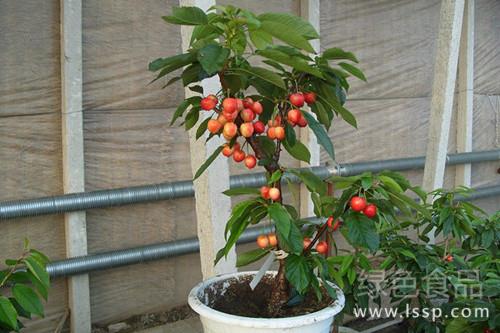
Potted cherry
1. Variety selection: Cherry is a cross-pollinated fruit tree. When growing it in pots, pay attention to variety matching, and it is best to graft 2—3 varieties per pot. For potting, choose cherry varieties with large fruit, bright color and strong ability to bear fruit continuously.
2. Potting the cherry: Container selection: the container should match the size of the cherry seedling. For 1-2 year old cherry seedlings, choose a container with a rim diameter of 25-30cm. The container should have good air permeability and no toxic effect on the root system. Practice has shown that unglazed clay pots and wooden barrels work best; purple clay pots and plastic pots are second; glazed ones are the worst, with the lowest survival rate. Nutrient soil preparation: the cherry root system has vigorous respiration and a high oxygen demand. The soil must have high permeability. Nutrient soil formula: turf soil : barnyard manure : sand = 5 : 3 : 2. Seedling selection: vigorous growth, full buds, well-developed roots, free of pests and diseases. For perennial small trees, the trunk should be headed low, the branches should be reasonably distributed, and the taper between branches should be large. Potting: usually in early spring. Before potting, first prune damaged roots and branches to expose fresh cuts; cut off parts affected by pests and diseases. Next, check the container's drainage holes and keep the container draining freely. Potting method: place a piece of tile upside down over the drainage hole, then spread a layer of about 20cm of furnace ash and slag, add nutrient soil, and finally place the sapling. After lifting the seedling and pressing the soil 2-3 times, finish when the soil surface is about 5cm below the container rim.
3. Fertilizer and water management: fertilizer and water are the hardest things to master in pot cultivation. The physiological activities of the cherry, such as growth, flowering and fruiting, all depend on daily fertilizer and water management. When fertilizing and watering the cherry, apply little but often; water when dry and let it dry out between waterings; water thoroughly and let it drain through. For cherry trees that have not yet fruited, in spring apply a small amount of PBO in the container. Fertilize frequently before July to promote tree growth. Common fertilizers include cake fertilizer, livestock hooves and horns, sesame paste residue, sour milk, rice-washing water, crushed bone scraps, etc. It is best to soak them until fermented and apply them as a liquid fertilizer. Apply organic fertilizer water once every 10-15d. After August, add monopotassium phosphate to the organic fertilizer water; for cherry trees that have entered the fruiting stage, apply urea once more before flowering and once after flowering, and add phosphorus and potassium fertilizer to the fertilizer water; in September also apply 50g of potassium sulfate at one time. In summer, irrigate once a day, and often spray some water on the leaves to cool the tree and clean it. In spring and autumn, irrigate less often. In winter, basically do not water. The best amount of irrigation is when the bottom of the container drips slightly. Making organic fertilizer water: soak soybean meal in clear water at a ratio of 1:5, then ferment for 5-10d, then dilute with 10 times the amount of water.
4. Flower and fruit management: the focus of flower and fruit management is thinning flowers and fruits. Thinning buds is better than thinning flowers, and thinning flowers is better than thinning fruits. The tree has a large number of flower buds, so during the bud-break period, thin out some of the flower buds. Method: on flower-cluster fruiting branches, thin out 1/3-1/4 of the flower buds. During the flowering period, ensure pollination between varieties. When the cherries grow to the size of soybean grains, thin out the fruits with irregular shapes.
5. Training and pruning: the terminal buds of the cherry and the central buds of the flower-cluster fruiting branch groups are leaf buds. Flower buds are pure flower buds, mainly axillary flower buds and flower clusters. Axillary flower buds are borne at the base of 1-year-old branches. When pruning, pay attention to the position of the flower buds. Pruning is mainly summer pruning, with winter pruning as a supplement. Winter pruning: mainly to adjust the tree shape and balance tree vigor. Mainly thin out competing branches, upward-growing branches, strong vigorous branches and slender branches. Shorten the extension branches and cut back the fruiting branches. Summer pruning: mainly to maintain the tree shape and promote flowers and preserve fruits. Cut off competing branches and upward-growing branches. Pinch the tips when the branches grow to 15-20cm. This is generally done before July, no more than 2 times a year. Around September, when the branches have just stopped growing, pull the branches flat.
6. Pest and disease control: Cherry bacterial shot hole, with spots the size of a needle head first appearing on the leaf surface, gradually expanding into round brown spots, with grayish-brown mold growing on the diseased area; the diseased area dries and shrinks, and an abscission layer forms around the edge, often causing it to fall off and form brown shot holes with irregular edges. After the flowers fall, spray 70% mancozeb 500 times dilution, once every 7-10d, for 3-4 consecutive sprays. Spider mites: feed on the underside of host leaves, piercing cells and sucking sap. On affected leaves, pale spots first appear on both sides of the main vein near the leaf stalk, and as the damage worsens, the leaves can turn grayish-white and dark brown. During the growing season, spray with abamectin 3000-4000 times dilution.
7. Overwintering techniques: cherries are prone to twig dieback during overwintering. This is mainly due to insufficient water supply from the underground root system in winter, so before overwintering, water thoroughly and cover the ground to reduce water evaporation. Measures such as early pruning of the fruit tree branches, spraying anti-transpiration oil emulsion, and wrapping the branches with plastic film are also effective.