What to Do When White Knobby Bumps Appear on the Surface of Oyster Mushroom Substrate
In recent years, oyster mushrooms have been affected by a serious new disease, mostly occurring after the first flush is harvested, and in a few cases after the second or third flush. When the disease first appears, a small number of white, knobby spots grow on the surface of the oyster mushroom substrate, resembling undifferentiated oyster mushroom fruiting body primordia; they gradually enlarge and merge into a single mass, later turning brown. The disease is highly contagious, and once it occurs, the mushrooms no longer fruit normally. Growers call it "white bump disease."
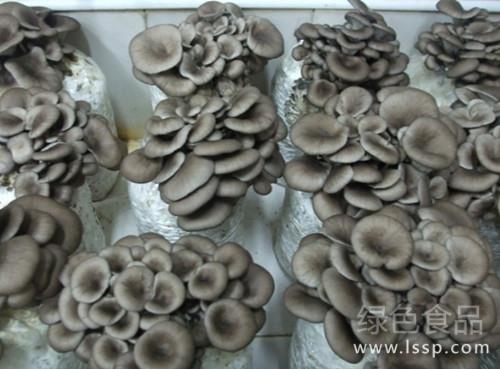
Oyster mushroom
According to reference materials, this disease once occurred on shiitake logs in Japan, where it was called "large button mushroom." Its mycelium is white, lusterless and whisker-like, and to the naked eye looks very much like oyster mushroom mycelium. During reproduction it gives off an unpleasant odor. It is a parasitic fungus that uses oyster mushroom mycelium as its nutrient source. It secretes an enzyme that destroys the mycelial cell walls and absorbs nutrients from the mycelium, causing the oyster mushroom mycelium to die. Once this disease occurs, there is currently no cure, but as long as prevention is emphasized, it can be effectively prevented. Through practical experience, the following three control methods have been summarized for everyone's reference:
1. Change varieties to enhance disease resistance. Practice has shown that repeatedly planting the same variety in the same area results in a high incidence of the disease. It is best to change varieties once a year, and in particular to select and breed varieties with strong disease resistance, thus laying a solid foundation for a good harvest.
2. Arrange bags correctly to prevent mycelial burning. In recent years, oyster mushroom fruiting has mostly used wall-type three-dimensional casing soil. This method is easy to manage, gives high yields and makes watering convenient, but it does not dissipate heat easily and tends to burn the mycelium; because the soil itself also carries pathogens, the disease occurs easily. It is best not to case with soil, but to arrange bags in a single row with mushrooms fruiting from both ends, separating the layers with small bamboo poles or sorghum stalks, and leaving a certain gap between bags to help lower the temperature. With single-row arrangement, as long as watering is timely and management is strengthened, high yields can also be achieved. If casing soil is used for fruiting, several points should be noted: ① Strictly sterilize the soil, fumigating it with formaldehyde; ② Cover with moist soil, not mud, because synthetic mud easily compacts and has poor air permeability, so it cannot meet the oxygen requirements for oyster mushroom growth and waste gases are not easily released; ③ Water appropriately in the water channel; adding too much water makes the substrate contain too much moisture, causing oxygen deprivation to the mycelium, making the mycelium thin and weak with poor disease resistance, and the disease occurs easily.
3. Integrated control to eliminate sources of the pathogen. ① During the mycelial growth period, spray caustic soda water once every 10 days; this not only effectively sterilizes but also clears acidic substances, making the mycelium grow thick and strong with strong disease resistance; ② Before fruiting, spray the mushroom house space and walls once with 1 ‰ carbendazim for sterilization, and after each flush is harvested, spray the substrate surface, space and walls again with 1 ‰ carbendazim; ③ During the fruiting period, keep the mushroom house clean and promptly remove mushroom stumps to eliminate hidden hazards; ④ Promptly remove spent substrate after fruiting is finished and keep it far from the mushroom house; ⑤ Disinfect and sterilize the mushroom house promptly, using methods such as spraying and washing with caustic soda or lime water, or burning sulfur for fumigation; if conditions permit, burning with fire can also be used for sterilization, creating excellent conditions for the next oyster mushroom cultivation. As long as the measures are reasonable, this disease can be completely avoided.