Bagging technology for improving the quality of thick-skinned muskmelon, avoiding pesticide spots and keeping the fruit skin smooth and clean
High humidity inside the greenhouse causes diseases to occur on the surface of thick-skinned muskmelon from time to time, and spraying pesticides will also form pesticide spots on the fruit surface and increase pesticide residues, seriously affecting the marketability and safety of the muskmelon. For this reason, muskmelons are bagged. After years of trials, the muskmelons produced not only have smooth and clean skin, bright color and good marketability, but also reduce pesticide contamination, improve quality and efficiency, and are well received by the market. The key techniques for bagging muskmelon are introduced as follows:
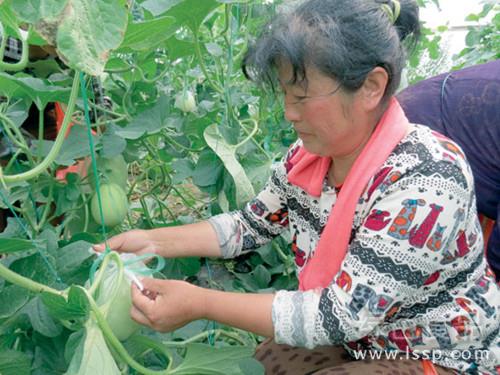
Muskmelon bagging
1. Suitable season: For greenhouse thick-skinned muskmelon, bagging technology is suitable for early-maturing cultivation in spring and delayed cultivation in autumn. For oversummering cultivation of muskmelon, bagging is generally not suitable because the high temperature and high humidity inside the bag easily induce diseases.
2. Variety selection: After bagging, the light on the surface of the muskmelon is reduced, and photosynthesis and dry matter accumulation are affected, which leads to a decrease in the sugar content of the muskmelon. Therefore, in production, it is best to choose high-sugar smooth-skinned varieties for bagging cultivation. After bagging, netted-type varieties often have net formation affected by the high temperature and high humidity inside the bag, resulting in reduced marketability, so they should be used with caution.
3. Bag selection: The bags should be low in cost, not easily damaged, and have no adverse effect on muskmelon growth. By material, they are divided into paper bags and plastic bags. Paper bags are made from newsprint, parchment paper, kraft paper, old newspapers, special paper for bagging pears, etc., while plastic bags are mostly transparent. The bag size can be determined according to the size of the muskmelon, as long as it does not affect muskmelon growth. Before use, cut off a corner at the bottom of the bag so that the transpiration water from the fruit can escape into the air, avoiding water accumulation in the bag and reducing diseases. Generally, white-skinned melons do not have high requirements for the light transmittance of paper bags, and all types of bags can be used, while for yellow-skinned honeydew melons it is best to choose bags with good light transmittance such as newsprint bags, parchment paper bags, and transparent plastic bags; otherwise, the fruit skin color becomes lighter.
4. Bagging time: Bagging is generally carried out about 10 days after flowering and pollination of the muskmelon, that is, after the muskmelon has set fruit, when the muskmelon has grown to about the size of a goose egg. Bagging too early easily causes damage to young melons and affects fruit setting; bagging too late reduces the effect and effectiveness of bagging. One day before bagging, a broad-spectrum protective fungicide can be evenly sprayed inside the facility. Bagging should be carried out after 10 a.m. on a sunny day, when there is no dew inside the greenhouse and the melon surface is relatively dry.
5. Bagging method: Muskmelons with a suitable fruiting node position (generally 12-14 nodes is best), regular fruit shape, and no pests or diseases should be selected for bagging. Before bagging, the residual flowers on the fruit stalk should be removed to prevent the residual flowers from being infected by pathogens and then infecting the muskmelon. When bagging, first open the paper bag with your hands, then hold the paper bag with one hand and the fruit stalk with the other, gently put the paper bag over the muskmelon, then fold the bag opening inward with both hands and seal it, and fix it with a paper clip or grafting clip, etc., to prevent the bag from falling off. When bagging, be careful and gentle, and try not to damage the fine hairs on the muskmelon. After bagging, care should be taken to protect the bags during field management operations to avoid damage.
6. Management after bagging: After muskmelon is bagged, because it is isolated from the outside, it is not easily infected by pests and diseases. In terms of plant protection, the main focus is on protecting the leaves, and generally spraying various compound fungicides during the growing period is sufficient. The temperature management and water and fertilizer management during the muskmelon growing period are the same as conventional methods.
7. Bag removal time: Generally, the bags are removed 5-7 days before the muskmelon matures to promote sugar accumulation. For yellow-skinned muskmelon varieties, it is best to remove the bags about 7 days before the melon matures, so as not to affect fruit skin coloring. For high-sugar white-skinned varieties, the melon can be picked together with the bag after it matures, and the bag can be removed when packing.