Tomato flowering and fruit set determine yield formation: key points of flower and fruit promotion and control techniques
When tomatoes enter the fruiting stage, that is, the stage from fruit set on the first truss to the completion of tomato harvest, the tomato plant shifts from simultaneous stem and leaf growth and flowering and fruit set to being dominated by flowering and fruit set, and this is the critical period for tomato yield formation.
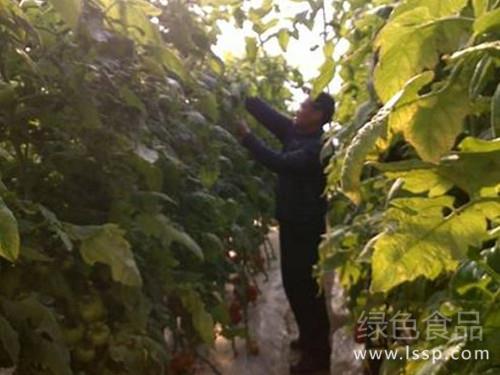
Tomato leaf removal
1. Fruit thinning and fruit setting: The main work in this period is to determine the number of trusses according to tomato plant density, and to determine tomato size according to the number of trusses. Each plant can retain 8-10 trusses, and each truss can retain 3-4 tomatoes with a regular shape, uniform size, and no pests or diseases, which helps promote tomato growth. If too many fruits are set, tomatoes will often vary in size, single fruit weight will decrease, and quality will decline.
After fruit set, tomato growth speeds up, so ventilation should be provided in time to remove moisture, the temperature and humidity inside the greenhouse should be adjusted well, water and fertilizer management should be strengthened, and pest and disease control should be done well to promote tomato ripening and improve yield and quality.
2. Watering and fertilizing: First, control the temperature well and water the first time in time. When the first truss fruit grows to walnut size, the second truss fruit to broad bean size, and the flower buds of the third truss begin to bloom, end seedling restraint and begin irrigation, once every 10-15 days, combined with topdressing urea, 15-20 kg per mu each time.
After the first truss fruit enters the coloring stage, as light duration lengthens and intensity increases, to prevent excessively high greenhouse temperatures from affecting tomato coloring and strong light from scalding the fruit, gradually increase ventilation so that the daytime temperature inside the greenhouse is controlled at 20-25°C, the nighttime temperature at 13-17°C, and the relative air humidity at 45%-50%. To prevent strong light from scalding fruit and to prevent the phenomenon of wilted plants, flower drop, and fruit drop caused by excessive leaf transpiration from strong light irradiation after sudden clearing on rainy days, it is best to cover with shade netting around noon.
3. Leaf removal: When the first truss fruit of the tomato has grown large enough and no longer continues to enlarge, and turns white-green, all the leaves below the fruit truss can be removed to reduce nutrient consumption, prevent disease and senescence, increase ventilation and light penetration, and promote earlier color change and ripening of the tomatoes.
4. Disease control: In recent years, with the expansion of tomato cultivation area, the number of disease types has increased and the degree of damage has worsened, and this has become an important factor hindering tomato development. The main diseases include early blight and leaf mold. At present, while taking other control measures, chemical control is still the main measure. During the growing period, sulfur can be used for greenhouse fumigation. Prevent early blight and other diseases.
Leaf mold is a disease that commonly occurs and causes serious damage in greenhouse tomatoes, and it often causes early withering of leaves and premature vine pulling. Once the disease occurs, apply pesticide early for control; the pesticide can be 80% mancozeb wettable powder at 400-500 times dilution, or 50% carbendazim wettable powder at 500 times dilution, for spraying.
Under low temperature conditions, tomatoes will mature 45-50 days after flowering; if the temperature is high, they can mature about 40 days after flowering. During the ripening process, tomatoes can be divided into 4 stages, namely the green ripe stage, color change stage, firm ripe stage, and full ripe stage. If harvested at the green ripe stage, the tomatoes are firm and suitable for storage and transport, but the sugar content is low and the flavor is relatively poor. The general harvest standard: harvest when the top of the tomato begins to turn slightly red, that is, at the color change stage. On the one hand, this is beneficial for storage and transport, and on the other hand, it is also beneficial for later tomato development. Reasonable fertilization and watering, timely regulation of temperature and humidity, correct spraying of chemical hormones, and timely shaping and leaf removal are important technical measures during the tomato flowering and fruiting period. Only by mastering the utilization of nutrients and the reasonable regulation among trusses can the goal of high yield and high efficiency in tomatoes be achieved.