Xiangtang taro has strong glutinousness and intense aroma and sells well on the market; detailed explanation of green cultivation techniques
Xiangtang taro is a local variety of Rugao, named because it fills the room with fragrance during cooking. The plant height is 140 cm-155 cm, the leaves are broadly ovate, and the petioles are grayish green; usually each plant has 6-10 daughter taros, and the daughter taros bear granddaughter taros, great-granddaughter taros, etc. The daughter taros, granddaughter taros, etc. are elliptical and dark brown, with purple-red markings at the top and light red bud tips; the taro flesh is milky white and firm, with strong glutinousness and intense aroma. It is mid-late maturing, planted from mid-March to early April, harvested from October to December, with a growth period of 200-220 days. The yield per mu is 2000 kg, of which daughter taros, granddaughter taros, etc. account for about 1000 kg.
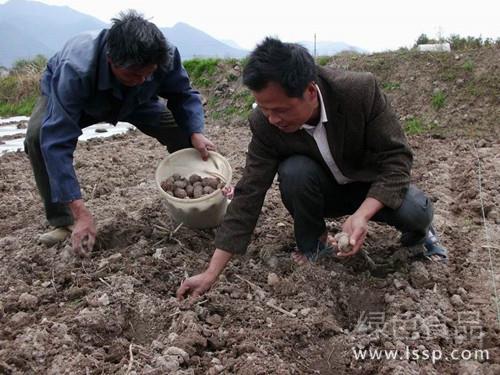
Taro sowing
I. Field production and preparation:
1. Selection of taro field. Taro is not suitable for continuous cropping; it is advisable to choose sandy soil that has not been planted with taro for 1-2 years and is rich in organic matter with deep, fertile soil layers. 2. Decomposition of organic fertilizer. The use of decomposed farmyard manure is advocated, and commercial organic fertilizer may also be used. Farmyard manure must undergo harmless treatment to kill various parasitic eggs, pathogenic bacteria, and weed seeds, remove harmful organic acids and gases, and meet sanitary standards. Main farmyard manures: compost, waterlogged compost, ash manure, barnyard manure, biogas manure, cake fertilizer, etc. 3. Selection of seed taros. Daughter taros with sound apical buds, free of pests and diseases, and individual weight of 25-40 grams should be selected as seeds. 4. Apply sufficient base fertilizer in the field. 20 days before sowing, deeply plow 30-35 cm, and apply 3000 kg of decomposed organic fertilizer, 30 kg of 45% ternary compound fertilizer, and 30 kg of superphosphate per mu. After fertilizing, plow and level the soil, and ensure the three-ditch system is complete.
II. Sowing:
1. Sunning the seeds. Sun the seeds for 2-3 days before sowing, and at the same time peel off the dry leaf sheaths around the taro buds. 2. Disinfection of seed taros. Soak the seeds for 20-30 minutes with 600 times dilution of 50% azoxystrobin, 500 times dilution of 50% carbendazim, or 600 times dilution of 75% chlorothalonil. 3. Sowing time. For open-field cultivation, sow when the ground temperature stabilizes at 12°C, generally at the end of March and the beginning of April, that is, around Qingming. 4. Sowing amount and density. The seed quantity per mu is 100-125 kg. Generally, wide-narrow row cultivation is adopted, with a large row spacing of 80-100 cm, a small row spacing of 30-40 cm, and a plant spacing of 30 cm, planting about 3000 plants per mu. 5. Sowing method. Sow by grade according to the size of the seed taros. When sowing, place the seed taros flat in the sowing furrow and cover with 2-3 cm of soil; ridge and film mulching cultivation may also be used, with a ridge height of 15-20 cm. For fields with a high weed base, after sowing, use 50 ml of 96% S-metolachlor emulsifiable concentrate, or 200 ml of 40% glyphosate plus 150 ml of 90% acetochlor for soil closure treatment.
III. Field management:
1. Fertilizer and water management: topdressing. Taro has a long growth period and a high fertilizer requirement. In addition to base fertilizer, topdressing should be adopted to promote growth and corm development. When the taro seedlings have 5-6 true leaves, apply 3000 kg of decomposed organic fertilizer per mu, or when they have 7-8 true leaves, apply 30-40 kg of 40% potassium sulfate type compound fertilizer (N:P:K=15:5:20) per mu. Water management. Build soil moisture before sowing; the soil moisture content during the taro germination stage should not be too high; during the growth period, keep the soil moist, and pay attention to timely drainage of accumulated water when it rains. During the seedling stage and vigorous growth stage (from the 5th leaf to full leaf expansion), irrigate when drought occurs; in the late growth stage, gradually control water, and keep the soil slightly dry before harvest.
2. Intertillage and earthing up: after the seedling stage, timely intertillage, loosening of soil, and weeding should be carried out to increase ground temperature, promote rooting and seedling growth, and replant missing seedlings in time when found. Earthing up is generally carried out 2 times. The first earthing up is carried out in late June, and the major earthing up is carried out in late July, with a ridge height of 15-20 cm. During earthing up, press the marginal leaves and lateral buds into the soil to reduce nutrient consumption and facilitate the expansion of daughter and granddaughter taros. If ridge cultivation with black film mulching is adopted, the steps of intertillage and earthing up may be omitted.
IV. Pest and disease control: prevention first, integrated control.
1. Agricultural control. Implement crop rotation; taro is best subjected to paddy-upland rotation for 1-2 years; transfer seeds from disease-free areas and select and retain disease-free seed taros; choose plots with flat terrain that are easy to drain and can be irrigated; apply sufficient base fertilizer, increase phosphorus and potassium fertilizer, and avoid one-sided or excessive application of nitrogen fertilizer; for underground pests, use irrigation to kill insects.
2. Chemical control: (1) Disease control. Control period. Around late June, according to the plum rain conditions, use a copper preparation such as copper hydroxide once. From July to August, depending on rainfall conditions, spray with 600 times dilution of 58% metalaxyl•mancozeb or 600 times dilution of 69% dimethomorph•mancozeb, for 1-2 control applications, and add adjuvants such as organosilicon during control.
(2) Pest control. For aphid control, spray with 1000 times dilution of 10% imidacloprid or 5000-6000 times dilution of 40% acetamiprid; for red spider mite control, spray with 2000 times dilution of 5% abamectin or 1500 times dilution of 10% pyridaben; for Spodoptera litura control, spray with 1000 times dilution of tea nucleus polyhedrosis virus•Bacillus thuringiensis 10000 PIB/μL •2000 IU/μL or 1000 times dilution of 10% emamectin benzoate•indoxacarb, generally after 4 p.m.