Key points of high-yield cultivation techniques for blackcurrant with strong disease resistance
Blackcurrant, scientific name blackcurrant (Ribes nigrum), bears small berries rich in sugar, citric acid, tartaric acid, malic acid, vitamins and other substances. Its vitamin C content is especially high, second only to kiwifruit among fruits, and it can be used as a raw material for extracting vitamin C. Its juice is purple-red and transparent, and can be made into juice, fruit wine and jam, or eaten fresh.
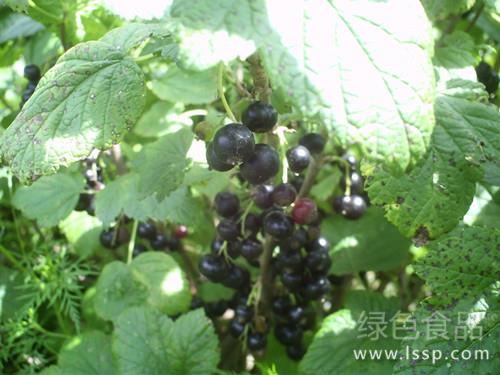
Blackcurrant
1. Variety selection: For many years, the main cultivated varieties of blackcurrant were 'Liangye Houp i' and 'Baopi Heidou'. 'Liangye Houpi' has a long lifespan and strong adaptability, but it must be buried in soil for overwintering and is not disease-resistant; 'Baopi' has strong cold resistance and does not need soil burial for overwintering, but its fruit quality is poor, its yield per unit area and juice yield are low, and it does not tolerate transport. Through introduction trials and cross-breeding, domestic research institutions have bred a group of new varieties with good quality, high yield and strong disease resistance, such as 'Heizhenzhu', 'Heijinxing', 'Zaoshenghei', 'Misui', 'Aoyibin', 'Bulaode', 'Hanfeng' and 'Zaofeng'. These varieties yield as much as 1000 kg per mu2 or more, about 20% more than 'Liangye Houpi', have strong disease resistance, basically require no pesticides throughout the whole growth period, are immune to powdery mildew; have a high juice yield and high sugar content, and their soluble solids content is higher than that of 'Liangye Houpi'.
2. Propagation techniques:
1. Cutting propagation. After autumn, cut strong basal shoots from good mother plants, cut them into 20-25 cm cuttings, tie every 50-300 into a bundle, and store them buried in moist sand in a trench (or cellar). The following spring, when the soil temperature reaches above 5°C, cut the cuttings into 10-15 cm and insert them, and they will root in about half a month. Under good management, they can be considered young plants by the following autumn. In places with heavy winter snow, autumn cutting can also be done.
2. Layering propagation. In spring, press the basal shoots produced last year around the bush and cover them with 5 cm of soil. After the new shoots grow taller, cover with another 3 cm of soil to expand the rooting range. After cutting them away from the mother plant in autumn, they become seedlings.
3. Division propagation. Generally there are adventitious roots under each basal shoot; dig up the bush and divide it into several small bushes.
3. Orchard establishment techniques:
1. Site selection. Blackcurrant likes light, warmth, moisture and fertility, so a relatively warm, sunny and fertile site with sufficient water should be chosen for orchard establishment.
2. Planting density. The plant and row spacing is preferably 1.5-2.0 m or 1.5-2.5 m. The ratio of main varieties to pollinator varieties is 3-4:1. The size of the planting hole is 30×30 cm. After planting, 2-4 shoots should emerge above the soil surface so as to produce more lateral branches. Each hole can be planted with 1-3 seedlings.
3. Planting techniques. Spring is suitable for planting. The size of the planting hole is 30×30 cm. After planting, 3-4 buds of the branches are exposed above the soil surface, and 2-4 seedlings are planted per hole. To promote more adventitious roots and more basal shoots at the base, deep planting and slanting planting can be used.
4. Training and pruning:
1. Training methods. Bush training is mainly used. When planting in spring, all branches are cut back short, leaving 4-5 well-developed buds on each branch; by the following autumn, branches of 4-5 first-order branches (2-year-old scaffold branches) are formed, and the lateral branches begin to form flower buds. Some bushes produce basal shoots from the root crown.
Blackcurrant harvest
2. Pruning methods. Cultivate and maintain 15-20 scaffold branches of different ages in the bush; maintain good light conditions and thin out overly dense branches. Cut back basal shoots by 1/2-1/3 of their total length to cultivate strong scaffold branches; for extension shoots and new shoots on scaffold branches, leave 2-5 buds at the tip; do not cut short fruit spurs and fruit spur groups. To cultivate long-lived and robust scaffold branches, control the basal shoots produced at their base. Apart from retaining renewal buds, wipe off all other buds produced at the base. Aged scaffold branches should be renewed in time and cut back to strong lateral branches. Diseased, pest-damaged, weak and injured branches should be removed from the base as early as possible.
5. Fertilizer and water management: Apply base fertilizer in autumn or spring. For mature orchards, apply 3-4 tons of organic fertilizer per mu; for young orchards, apply 2-3 tons, with the effective components of inorganic fertilizer being 4-5 kg of nitrogen and 3-4 kg each of phosphorus and potassium, applied in strip trenches or ring trenches. Trench application means opening a trench near the roots, 10-20 cm deep and 20-30 cm wide, and covering with soil after fertilization. As the tree age increases, the position of the fertilizer trench is opened farther outward year by year, and the trench is also deepened and widened until fertilizer has been applied throughout the entire inter-row area. Base fertilizer can be applied once every 1-2 years. Topdressing is mainly applied once in spring and once in June; the first is mainly nitrogen fertilizer, and the second is a combined application of nitrogen, phosphorus and potassium. Irrigation is mainly carried out in spring and the early growth stage, and can be done by furrow irrigation or hole irrigation; the root distribution layer must be irrigated thoroughly, and after irrigation the soil should be raked level to preserve moisture. After irrigation, cultivate and weed in time.
6. Harvesting: Blackcurrant is easy to drop after ripening, so it must be harvested in stages. When harvesting, choose fully ripe blackcurrants; at this time the berries are heavy, the juice color is good, and the vitamin content is high. Harvesting should be done in the afternoon and evening, when the berries are less likely to rot. Put the harvested berries in wooden boxes and later sell them together with the boxes. Ripe berries can only be stored for 2-3 days, so after harvest they should be processed promptly and made into juice locally to reduce losses.