Management of greenhouse cherries during the flowering and fruiting period to improve fruit set and prevent fruit cracking
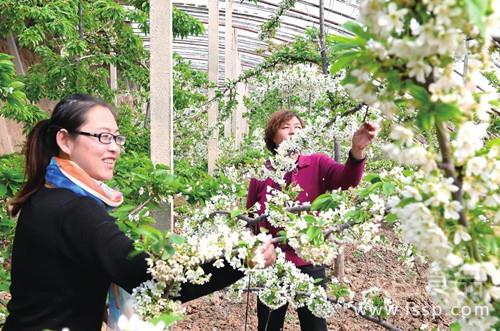
Hand pollination of cherries
I. Improving the fruit set rate.
① Hardening the flower organs. Starting 10 days before full bloom of cherries, on sunny days at noon, ventilate every day so that the flower organs are hardened as early as possible and receive a certain amount of direct light, improving the quality of flower bud development.
② Spraying fertilizer and chemicals. Before and after full bloom, at an interval of 10 days, spray once each time with 0.3% urea plus 0.3% borax or a 600-fold potassium dihydrogen phosphate solution, or spray 50×10-6 gibberellin or a 300-fold rare earth micro-fertilizer solution at full bloom, which can significantly improve the fruit set rate of cherries.
③ Hand pollination. Hand pollination should begin in the early full-bloom stage of greenhouse cherries, with 2 to 3 consecutive pollinations. When the flower-bud-like flowers open, lightly touch and tap them with a feather duster against the flowers of the pollinizer trees. Pollen can also be collected by hand and applied with a brush or eraser. Pollination can be carried out from flowering to the 3rd day after flowering, but pollination on the day of flowering is best. No matter which pollination method is used, starting from the early full-bloom stage, it should be carried out in 2 to 3 sessions to ensure that different flowers during the flowering period can all be fully and timely pollinated.
④ Pollination by bees. Using honeybees or mason bees to assist pollination can increase the fruit set rate by more than 20%. During the cherry flowering period, one box of honeybees can be placed in each greenhouse. When using mason bees for pollination, the nest should be placed 1 m above the ground, with 250 to 300 nesting tubes in each nest. The nesting tubes are 15 to 20 cm long, with a wall diameter of 5 to 6 mm.
⑤ Pinching new shoots. About 10 days after flowering, pinch the new shoots in time to prevent the new shoots from competing with young fruit for nutrients, which can improve the fruit set rate.
II. Reasonable load. To increase the single-fruit weight of cherries and improve uniformity and quality, measures such as thinning flower buds, thinning flower buds, thinning flowers and thinning fruit can be used to adjust the load of the tree.
① Thinning flower buds. Before bud break, thin the flower buds. Generally, a flower-bud-like short fruit branch with 7 to 8 flower buds can have about 3 small, thin flower buds removed, retaining 4 to 5 plump flower buds.
② Thinning flower buds or flowers. After the flower buds sprout, thinning flower buds or flowers can save nutrients and improve the fruit set rate, but late flowers, weak flowers and flowers on vegetative branches should be thinned.
③ Thinning fruit. Carry out after the physiological fruit drop of cherries. The degree of fruit thinning depends on the fruit set of the whole plant. Generally, a flower-bud-like short fruit branch retains 3 to 4 fruits, and at most 4 to 5 fruits; when thinning fruit, small fruits, weak fruits, deformed fruits, and fruits that are not easily reached by light and poorly colored should be thinned; weak flower-bud-like fruit branches with fewer than 5 leaves generally should not retain fruit.
III. Promoting cherry enlargement and coloring.
① Foliar fertilization. After flowering and before calyx shedding, spraying amino acid compound micro-fertilizer or rare earth micro-fertilizer on the leaves can improve leaf quality, increase photosynthetic efficiency, and promote red color development and fruit weight of cherries.
② Leaf removal. On the basis of reasonable shaping and pruning and improving ventilation and light transmission within the canopy, during the cherry coloring period, remove the leaves that block light from reaching the cherries. However, the degree of leaf removal should not be too heavy, so as not to affect flower bud differentiation and development.
③ Laying reflective film. Lay reflective film under the canopy 10 to 15 days before cherry harvest to increase light reflection under the canopy and promote cherry coloring. During the cherry coloring period, if the late frost has passed, consider removing the top film to improve lighting and promote coloring.
Cherry fruit thinning
IV. Preventing fruit cracking.
① Stabilizing soil moisture conditions. From the pit-hardening stage of cherries to the second rapid growth stage, keep the water content of the soil at a depth of 10 to 30 cm stable at about 12%.
② Spray calcium salt before cherry harvest. Before harvest, spray 0.3% calcium chloride solution, about once every 7 days, for 3 consecutive sprays, which can increase the soluble solids content in cherries and reduce cherry fruit cracking.
V. Pest and disease control. During the young fruit stage, spray 1 to 2 times with 1000-fold 70% thiophanate-methyl; after cherry harvest, spray 1 to 2 times with 500 to 600-fold 70% mancozeb or 700-fold 50% carbendazim; in July and August, spray 2 to 3 times with 200 to 240-fold equal-amount Bordeaux mixture to control shot hole disease, leaf spot disease and dieback; for gummosis, in the early stage of the disease, make several vertical cuts at the diseased spots, squeeze out the sap, and apply the stock solution of lime sulfur mixture. For caterpillar-type and slug moth-type pests, spray 20% fenvalerate 1500 to 2000-fold solution during the 1st to 2nd instar larval stage, or take advantage of the gregarious habit of young larvae to inspect the cherry orchard in time and, once found, concentrate on killing them.