Fertilization Precautions for Greenhouse Watermelon: Skillful Fertilization for High Yield and Quality
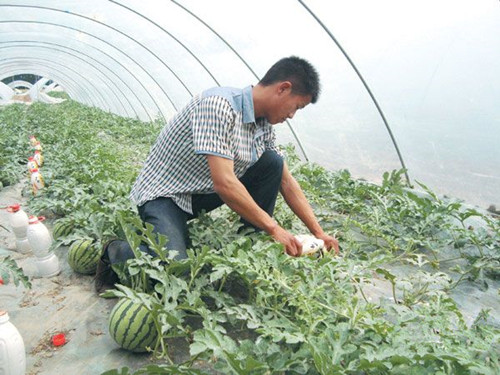
Fertilization of Greenhouse Watermelon
1 Nutrient Requirements:
Watermelon grows quickly and has a high nutrient demand, especially in greenhouse production, where the yield per mu can reach over 3500kg, and the nutrient demand increases significantly. Practice shows that for a yield of 3500kg of watermelon per mu, the crop needs to absorb 10.7kg of nitrogen, 3.8kg of phosphorus, and 11.5kg of potassium, with a ratio of 2 .8:1:3.1. In greenhouse watermelon cultivation, on the basis of ensuring nitrogen supply, increase the application of organic fertilizer and phosphorus and potassium fertilizers, and avoid excessive nitrogen application that causes excessive vine growth or reduced quality. Because watermelon has different growth amounts and growth rates at different growth stages, its nutritional needs also differ. The overall nutrient requirement characteristics are: at the seedling stage, nutrient absorption is relatively low, and the absorption of nitrogen, phosphorus, and potassium accounts for only 0.55% of the total; at the vine extension stage, growth speed accelerates and growth amount increases, accounting for about 14.6% of the total; at the fruiting stage, growth amount is the largest, accounting for about 84.85%, and during this period potassium absorption increases while nitrogen absorption decreases.
2 Key Technical Points of Fertilization:
2.1 Fertilization of the Seedling Bed: The nutrient soil used for watermelon seedling cultivation should be rich in organic matter, loose, and have strong water and fertilizer retention capacity. To prepare the nutrient soil, use 1 part decomposed toilet manure + 1 part garden topsoil that has never been planted with cucurbits + 1 part finely crushed furnace slag, crush and mix evenly, then sieve, and then add 1kg urea, 0.5kg diammonium phosphate and 0.5kg potassium sulfate per square meter, plus 25g carbendazim and 0.5kg phorate, mix evenly, pile and seal for 7-10d (days), then fill into nutrient pots and wait for sowing.
2.2 Land Preparation and Fertilization: Heavy application of base fertilizer is the foundation for ensuring robust growth of watermelon vines and high yield. After the previous crop is harvested, in combination with deep plowing and land preparation, apply 4000kg of decomposed organic fertilizer per mu, open planting furrows 30cm deep according to the specified row spacing, apply a 10cm-thick layer of organic fertilizer at the bottom of the furrow, then apply 30kg of compound fertilizer or 10kg of urea, 15kg each of diammonium phosphate and potassium sulfate, then apply another 10cm-thick layer of organic fertilizer, and on the top layer apply 20kg of compound fertilizer or 10kg each of diammonium phosphate, potassium sulfate, and urea. Mix the chemical fertilizers, organic fertilizer, and soil in the furrow evenly, level and form ridges, water promptly, and cover with plastic film and greenhouse film.
2.3 Topdressing After Planting
2.3.1 Vine Extension Fertilizer: When watermelon enters the vine extension stage, the demand for fertilizer and water increases. At this time, topdressing should aim to promote vine and leaf growth and expand leaf area, but excessive growth must be prevented. Topdressing should be mainly decomposed organic fertilizer, combined with an appropriate amount of chemical fertilizer. The application rate is 750kg of organic fertilizer per mu plus 15kg of compound fertilizer, or 50-75kg of decomposed cake fertilizer plus 10kg of superphosphate, 10-12kg of potassium sulfate, and 10kg of urea, mixed evenly before application. Apply in furrows: open a 20cm-deep fertilization furrow on one side of the plastic film, 20cm away from the watermelon root, apply the fertilizer, seal the furrow, and water promptly to keep the soil alternately dry and moist.
2.3.2 Fruit Swelling Fertilizer: When normal watermelon grows to the size of an egg, it begins to expand rapidly, and nutrient demand gradually reaches the peak of the entire growth period. At this time, heavy application of fruit swelling fertilizer should be carried out to promote fruit expansion and prevent premature aging. Topdressing should be mainly phosphorus and potassium fertilizers, with little or no nitrogen fertilizer, to avoid reducing watermelon quality due to excessive nitrogen. Apply 15kg of diammonium phosphate, 15kg of potassium sulfate, and 10kg of urea or compound fertilizer per mu. Apply in holes beside the ridge 30cm from the watermelon root, or between two plants near the irrigation ditch. After fertilization, water promptly for fruit swelling to promote nutrient absorption and accelerate watermelon expansion.
2.3.3 Rejuvenation Fertilizer: After the first crop of melons is harvested, immediately apply a quick-acting chemical fertilizer once, generally 15-20kg of urea, 15kg of potassium sulfate, and 10kg of diammonium phosphate per mu, and combine with topdressing by watering heavily once. Through strengthened management, supplement nutrients and water in the soil, maintain strong watermelon growth, and prevent premature aging of vines and leaves.
2.4 Skillful Application of Foliar Fertilizer:
Foliar spraying is a necessary means to compensate for insufficient root absorption in watermelon and to supplement nutrition and balance nutrients. It has the characteristics of low cost, uniform application, quick fertilizer effect, and high utilization rate. Generally, starting from the fruit swelling stage of the first crop of melons, spray 0.3%-0.5% potassium dihydrogen phosphate solution once every 7-10d (days); it can enhance watermelon stress resistance, increase flowering and fruit setting rates and sugar content, improve quality and yield, with relatively significant effects.