Tea tree mushroom is rich in nutrients and in high market demand; how can it be cultivated for high quality and high yield?
Tea tree mushroom (Agrocybe aegerita) has a thick, fleshy fruiting body and a crisp, tender stipe. It is rich in nutrients, high in lysine, arginine and glutamic acid, and in great market demand. For high-yield cultivation of tea tree mushroom, the following key techniques should be mastered.
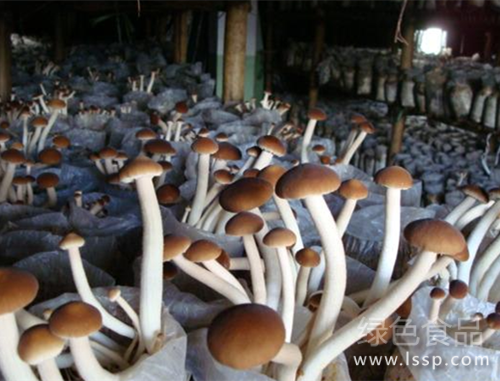
Tea tree mushroom
Selecting superior spawn: The mycelium of superior tea tree mushroom spawn is pure white, dense, thick, vigorous in growth and uniform. Any spawn showing yellow, green, black, orange-red or other colors is contaminated by foreign fungi and must not be used.
Selecting the best cultivation period: The suitable temperature for fruiting of tea tree mushroom is 16°C to 30°C. Inoculation is generally done in March, and the suitable cultivation time can also be chosen locally according to local climatic conditions.
Formulating the substrate: The cultivation substrate formula for tea tree mushroom is: cottonseed hull 50%, sawdust 26%, wheat bran 15%, cornmeal 5%, gypsum 2%, phosphate fertilizer 1%, lime 1%. You can also add 1 to 3% tea seed cake or tea seed hull to the formula, which improves the aroma of the tea tree mushroom. After choosing the formula, three points should be noted when mixing the ingredients: First, cottonseed hull, wheat bran and the like must be fresh; if moldy or caked into lumps, they cannot be used. Sawdust is best as broadleaf tree sawdust that has been piled for more than half a year and is loose in texture. Second, mix the ingredients evenly, achieving "three evenness" (even substrate, even water, even pH value). Third, after mixing, check the water content of the substrate so that it reaches 60% to 65%.
Bag cultivation requirements: Cultivation generally uses 15cm×30cm or 17cm×33cm polypropylene plastic bags, with each bag holding 0.3 to 0.35 kg of dry substrate. After the substrate is put into the bag, put on a collar ring and cover with a sponge cap.
Thorough sterilization: Sterilization of the cultivation substrate is divided into atmospheric pressure sterilization and autoclave sterilization. Atmospheric pressure sterilization is kept at 100°C for 14 hours; high pressure sterilization is maintained at a pressure of 1.5 kg/sq cm for 2 hours. Disinfection and sterilization must be thorough, otherwise foreign fungal contamination will be serious, causing reduced yield or even total crop failure.
Inoculation and culturing: After the cultivation substrate is sterilized, inoculation can be done only when the substrate temperature drops to about 30°C. Inoculation should be carried out inside an inoculation box. During inoculation, several points should be observed: First, after the cultivation substrate is placed in the inoculation box, fumigate with formaldehyde and potassium permanganate to disinfect the space, using 10 ml formaldehyde and 7 g potassium permanganate per cubic meter, and inoculate only after mixing and sealed fumigation for half an hour. Second, the hands of the inoculator and the inoculation tools should be wiped with 75% alcohol, and inoculation should be carried out above the flame of an alcohol lamp, with quick movements. Third, during inoculation, appropriately increasing the inoculation amount helps the mycelium to germinate. Culturing is carried out indoors, and the cultivation substrate can be arranged either in a single layer standing upright or in a wall-style arrangement. After arranging, it is best to sprinkle some lime powder at the opening to reduce contamination. The culturing room should be ventilated, kept at 23°C to 28°C, and preferably shaded from light. After 50 to 60 days of culturing, the mycelium can grow to the bottom of the bag.
Fruiting management: When the mycelium has filled the bag, remove the collar ring, straighten the bag opening, and dig out the old mycelial block. The fruiting site can be indoors or in a shade shed built outdoors. The fungus bags at the fruiting site can also be stacked wall-style or arranged in a single layer standing upright. After arranging, maintain a certain amount of scattered light and spray water 1 to 2 times a day so that the air humidity reaches 86% to 95%. Water spraying depends on the weather: spray more on sunny days, less on cloudy days, and none on rainy days. At the same time, pay attention to ventilation to avoid producing deformed mushrooms.
Timely harvesting: After 15 to 20 days of management, when the fruiting bodies grow to eight-tenths maturity, they can be harvested. When harvesting, to give the tea tree mushroom a good shape and high commercial value, it is best to harvest once in the morning and once in the afternoon. After harvesting, let the fungus bags rest without water to recover for 5 to 10 days, then continue water spraying management, and a second flush of mushrooms will appear shortly after. Generally 3 to 4 flushes of mushrooms can be harvested.