Wasabi has high economic value and good returns: a detailed explanation of the key points of green cultivation techniques
Wasabi, also known as mountain vegetable, is a spice with a unique flavor that is pungent, spicy, dry and sticky. It is the raw material for processing green mustard and has high economic value. In Japan, Taiwan, China and other places it is regarded as a delicacy and has become the best partner for seafood and sweet but not spicy foods.
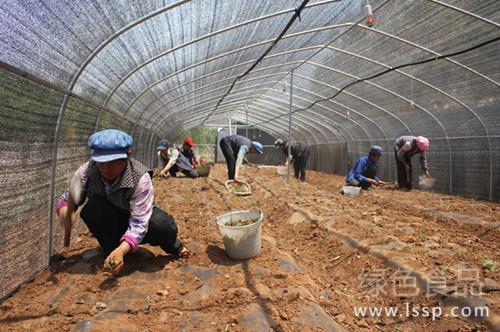
Wasabi cultivation
I. Wasabi cultivation conditions:
(1) Temperature: minimum 8°C, maximum 20°C, optimum temperature 15—18°C; it suffers cold damage at minus 5°C, and growth is inhibited above 20°C.
(2) Humidity: Wasabi prefers shade and moisture; field capacity 75%, relative humidity 80—90%. Below 70% or above 95% is unfavorable for wasabi growth.
(3) Soil quality and field selection: sufficient water source, good irrigation and drainage conditions, altitude 2000-2300 m, good surrounding vegetation, slope 5-10°, fertile, well-aerated sandy loam. The optimum soil PH is 6—7. Choose land rich in organic matter, with a gentle slope of 5—15° as the best. To prevent direct sunlight, choose a slightly shaded plot for planting.
(4) Nutrient requirements: N:P:K=1:0.94:0.52.
II. Cultivation management:
(1) Planting density and method: wasabi plant height is about 25—65 cm. To obtain high yield, the planting spacing between plants and rows is 6×4 or 6×3 cun, with 20,500—28,000 plants per mu in ridged beds, and shade nets are stretched to keep it in a shaded state for a long time. Wasabi seedlings can be propagated using their own roots, buds, seeds, etc.
1. Tillering bud seedlings: at harvest, collect and plant the young seedlings tillered from roots and stems by large, medium and small grades.
2. Root seedlings: at harvest, cut vigorous roots or fibrous roots (about 0.20 cm or more), shallow-bury them in cool forest land in autumn, and after about 4—6 months they can be transplanted to the field.
3. Seed seedling raising: seeds are harvested around May—June. After harvest, the seeds must undergo cold treatment for a period (about 100 days) at a refrigeration temperature of 0—5°C, and are sown in October—November, germinate in February—March of the following year, and after growing to a certain height are transplanted to the field in autumn.
(2) Fertilization techniques: apply sufficient base fertilizer, mainly organic fertilizer, with high-temperature-treated chicken manure being the best, using 600—700 kg per mu. For topdressing, compound fertilizer or superphosphate should be used, at 15—20 kg/mu. Topdressing is done in spring and autumn. When topdressing, note that it should not be applied directly at the wasabi roots; apply it in a ring around the plant 3 cm away from the roots to prevent black rot and other diseases.
(3) Pest and disease control: wasabi prefers shade and moisture, and its growth environment is special, so it is prone to various pests and diseases. The most harmful is black heart disease. Black heart disease is also called ink entry disease, black spot disease, black shank disease, black rot disease, and leaf ink spot disease. The field incidence rate is 100%, the diseased plant rate is 90%-100%, the field leaf incidence rate is 25%-70%, losses reach 30%-70%, and in severe cases the whole plantation can be destroyed. The specific control methods are as follows.
1. Choose a suitable plot. When wasabi grows and develops poorly, black heart disease tends to occur more often, so choosing the cultivation site is very important. Site selection requires an altitude of 2000-2300 m, good surrounding vegetation, a non-south-facing slope, sufficient water source, a slope of 5-10°, and fertile, well-aerated sandy loam.
2. Choose disease-resistant varieties. At present there are no varieties with obvious resistance to ink entry disease, but Shimane No. 3 and Shizuoka Prefecture's green stem line have strong disease tolerance.
3. Use seedling-grown plants. For wasabi division seedlings, if the mother plant carries disease, the seedlings will also be infected, and wounds are inevitably present when taking seedlings, so black heart disease is easily spread during operations. Seedling-grown plants only need seed disinfection and screening, and if care is taken when digging seedlings, they will not carry too many wounds. Their growth and development is also good, so they are less infected by disease.
4. Use disease-free vigorous seedlings. Division seedlings should be taken from disease-free mother plants, and the vascular bundles at the base of the division seedlings should be carefully checked to see whether they have turned black. Any with black spots in the vascular bundles must be discarded. When purchasing division seedlings, pay attention to the disease situation in the place of origin. For those using seedling-grown plants, because seeds can also transmit the disease, when collecting seeds, siliques whose seed coats are diseased and blackened should be discarded.
Wasabi weeding
5. Pay attention to field hygiene. Weeds should be pulled frequently. If the weeds grow taller than the wasabi, they will affect wasabi growth and worsen pests and diseases. However, never weed on cloudy and rainy days or in the morning when humidity is high. After weeding, spray medicine to protect the many tiny wounds on the wasabi.
6. Scientifically control insect pests. The pathogen of black heart disease invades through wounds, so wounds are an important cause of the disease. Therefore, it is also very important to control pests such as diamondback moth, cabbage caterpillar, flea beetle, and slug.
7. Do a good job in water and fertilizer management. In summer, when the surface temperature exceeds 20°C, the disease is likely to occur, so a good suitable transplanting period should be chosen for planting, and as far as possible the stems and leaves should close the rows before high temperature and drought, which can effectively control weeds, maintain moisture, and lower the surface temperature. In places with strong sunlight, plant trees for shade, or use shade nets for shade. In the two peak growth seasons of spring and autumn, do a good job in fertilizing and watering, pay attention to balanced fertilization, applying less to small seedlings and more to large seedlings.
8. Shorten the growth period. The nature of this disease is that it easily invades the aging parts of the rhizome. The rhizome should be made to expand as quickly as possible, and harvest should be as early as possible, which can reduce the harm of this disease.
9. Rational crop rotation. Avoid continuous cropping as much as possible. Wasabi should be rotated with leguminous or gramineous crops, and green manure covering is best.
10. Pesticide control. Use 70% thiophanate-methyl wettable powder 500 times liquid spray for protective prevention. In the early stage of disease, use 50% iprodione suspension concentrate 1000-1500 times liquid spray, once every 7-10 days, for 3 consecutive times.