Master the key technical points of concentrated asparagus seedling raising and transplanting in spring to increase yield
Using the seedling raising and transplanting method to produce asparagus gives a high emergence rate, saves seeds, lowers costs, facilitates concentrated management, helps prevent and control asparagus pests and diseases and cultivate strong seedlings; it can extend the growing period in the planting year and increase the yield of the following year; during cultivation, directional planting can be carried out according to the growth direction of asparagus, making management operations such as ridging and spear harvesting easier.
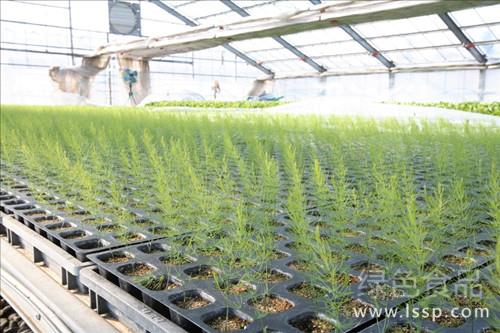
Asparagus seedling raising
1. Cultivation season and sowing period: Asparagus is mostly sown in spring, but can also be sown in autumn. For spring sowing, sow from February to April and transplant from April to June, and begin harvesting spears in the following spring; for autumn sowing, sow from August to September and transplant from October to November, and harvest spears in the following autumn. The asparagus sowing period can be calculated backward from the transplanting period by 60 to 80 days according to the crop rotation and seedling raising conditions.
2. Seedling raising site: Choose loose soil, fertile soil, or sandy loam with good air permeability, with conditions for watering and drainage, and an open and ventilated environment. Since asparagus and the onion and garlic crops all belong to the Liliaceae family, to reduce pests and diseases, plots whose previous crop was onion or garlic should not be used as asparagus seedling raising or cultivation sites.
3. Seedling raising methods and seedbeds: These mainly include solar greenhouse seedling raising, plastic low tunnel seedling raising, cold frame seedling raising, and open-field seedling raising. Nutrient pot seedling raising is recommended, as it causes less root damage during transplanting and gives a high survival rate.
1. Solar greenhouse seedling raising: Nutrient pot seedling raising can be used. The nutrient pots should be prepared before sowing, with a diameter of about 8 to 10 cm. The nutrient soil is prepared with 30% garden soil, 35% barnyard manure, 30% peat soil, 1.5% compound fertilizer, 0.5% urea, 1% phosphate fertilizer, and 20% potassium chloride, then sieved and put into pots, and placed in the bed. Before placing them, use 4 to 5 kg of phoxim per mu of seedbed, add an appropriate amount of sandy soil, prepare medicinal soil, and spread it on the seedbed to prevent underground pests. Cover with film and grass mats 10 to 15 days before sowing to increase temperature.
2. Low tunnel or cold frame seedling raising: The cold frame can be built before winter, generally 1.5 m wide and 10 to 15 m long, with the north wall 10 cm higher than the south wall, in a south-facing cold frame. Nutrient pot seedling raising can be used, and the nutrient pot preparation method is the same as for the solar greenhouse. Place the prepared nutrient pots in the cold frame or low tunnel.
3. Open-field seedling raising: Apply 3000 to 5000 kg of decomposed compost and 50 kg of Sakefu compound fertilizer per mu, spread evenly, deep plough 25 cm, finely prepare the land, then make beds 1.2 to 1.5 m wide. Level the bed surface so that the soil is fine and crumbly and the bed surface is flat. For planting white asparagus, use 60 to 70 g of seed per mu, occupying 20 to 30 sq m of seedling land; for planting green asparagus, use 90 to 100 g of seed per mu, occupying 30 to 40 sq m of seedling land.
4. Seed soaking and germination acceleration: Asparagus seeds have a thick, hard coat and strong cutinization, absorb water with difficulty, and germinate slowly. To promote seed germination, germination must be accelerated before sowing. Before sowing, first sun-dry the seeds for 1 to 2 days, then use clean water to float off shriveled seeds and insect-damaged seeds, soak in 300-fold 50% carbendazim solution for 10 to 12 hours, soak the seeds in warm water at 30°C to 35°C for 2 days, changing the water 1 to 2 times a day, then remove the seeds once they have absorbed enough water, place them in a basin, cover well with wet gauze or a towel, or wrap well with wet gauze or a towel, and keep at 25°C to 30°C to accelerate germination, rinsing with tap water 2 to 3 times a day, and sow promptly after germination.
5. Sowing: Before sowing, water the nutrient pot seedling bed or open-field seedbed thoroughly, and after the water seeps in, spread a thin layer of soil. For open-field seedbeds, mark lines at 10 cm spacing between plants and rows, or cut 10 cm square soil blocks with a knife, place one germinated seed in the center of each square or nutrient pot, cover with 2 to 3 cm of medicinal soil, and cover with film after sowing. Open-field sowing can also be done by broadcasting or by drilling in furrows.
6. Seedbed management: 1. Temperature: The suitable temperature for asparagus germination is 25°C to 28°C. For low tunnel or cold frame seedling raising, the daytime temperature should be 25°C to 28°C and the nighttime temperature 15°C to 18°C. After emergence, keep it at 25°C during the day, not lower than 8°C at minimum, and not higher than 30°C at maximum; if it exceeds 30°C, ventilate promptly. Gradually increase ventilation to harden the seedlings so they adapt to the external environment. When the seedlings have more than 3 aboveground stems, they can be transplanted.
2. Water and fertilizer: Before emergence, keep the seedbed soil moist; otherwise, water promptly. After emergence, the seedling root system is weak, so water promptly during drought. When the seedlings are about 10 cm tall, apply a thin organic liquid fertilizer with water once, such as fully decomposed human manure or biogas slurry, or apply urea and potassium chloride, etc., with water. Topdress 2 to 3 times during the seedling stage so that the seedlings can fully accumulate assimilated nutrients in the later growth stage and cultivate strong seedlings.
3. Intertillage and weeding: After emergence, remove the plastic film immediately. After broadcasting and full emergence, thin the seedlings to maintain a spacing of 7 to 10 cm. During seedling raising, weed frequently and loosen the soil with intertillage in time. Earth up appropriately so that the scale buds develop thick and strong and the seedlings are prevented from lodging. When the seedlings reach the standard for transplanting, they can be transplanted. Transplanting standard: asparagus seedlings about 0.3 m tall, with more than 3 aboveground stems and more than 5 underground storage roots.