Bamboo fungus intercropped in bamboo forests: cultivation techniques, great nutrition and high market returns
Bamboo fungus is a new type of mushroom with high nutritional value and good returns. The main raw material for cultivating bamboo fungus is the by-product left after processing moso bamboo—bamboo shavings—so the quality of the bamboo fungus is good. Now the editor will introduce the cultivation techniques for intercropping bamboo fungus in bamboo forests.
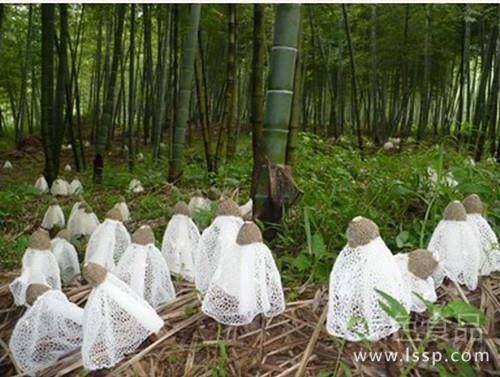
Intercropping bamboo fungus in bamboo forests
1. Raw material preparation:
1.1 Raw material ratio: per mu, use 14 cubic meters of dry, mold-free, fresh bamboo shavings, 70 kg of urea, 50 kg of superphosphate, 25 kg of calcium carbonate, and 50 kg of wheat bran.
1.2 Treatment of the cultivation material: choose a field of sandy loam soil that is easy to drain and irrigate and rich in humus, and set up a composting yard. Start building the pile for fermentation in early December each year. First spread a 40 cm thick layer of bamboo shavings in the composting yard, and at the same time scatter urea and calcium carbonate and sprinkle water. For the first few layers, do not use too much water. Repeat this piling process. When the pile reaches a height of about 1.5 m, tramp the pile firm, cover it with rice straw, and turn the pile once every 15 days so that all the raw materials are evenly mixed. When turning the pile, if the culture material is too dry, add water. Keep the moisture content of the culture material at about 60%, which is favorable for fermentation of the culture material. Generally turn the pile 1—4 times.
2. Cultivation method:
2.1 Dig drainage ditches around the field. The length and direction should be convenient for operations and for irrigation and drainage. Generally, the length is 10-15 m and the width is 1 m.
2.2 The prepared material should be used for supplementary material sowing starting at Awakening of Insects, and completed at the latest before Pure Brightness.
2.3 Ten days before sowing, apply 20 kg of urea and 50 kg of superphosphate per mu to increase fertility and provide nutrients for the growth of bamboo fungus. At sowing time, check whether there is ammonia gas in the base material. If there is, loosen it appropriately, lower the temperature, and let it cool for 3—5 days before sowing.
2.4 At sowing time, the air temperature should not exceed 28°C. First spread the base material in rows 1 m apart, sprinkle the culture material with enough water, then divide the spawn into 4-6 small pieces and place them in the middle of the base material, then scatter a layer of wheat bran. Use the head-to-tail staggered sowing method for the spawn, then cover with another layer of base material to cover the wheat bran. The culture material should be compacted, then covered with about 4 cm of clean, fertile topsoil. The soil moisture content should be 80%. After covering with soil, cover with rice straw on top (use the amount of rice straw from two mu of field for one mu of land), but not too thick, which helps preserve moisture. The acidity of the medium and soil for the growth of bamboo fungus mycelium is about 5. Keep the moisture content of the culture material and soil layer relatively stable; it must not be too dry or too wet. On sunny days when the temperature is relatively high, spray water once every 2—3 days to maintain the humidity of the culture material and covering soil. From 2—3 months after sowing, during the primordium development stage, the temperature should not be lower than 10°C.
3. Management of mycelial growth:
The mycelial growth temperature is 8°C-30°C, the suitable temperature is 15°C-28°C, the moisture content of the medium is 60%-65%, and the relative air humidity is 65%-75%. When the mycelium grows normally, at suitable natural temperatures, it can grow through the covering soil layer in about 40 days. Under normal conditions, it forms granular fungal spheres, which generally takes about 60 days from sowing. When the mycelium grows normally, it begins to form fungal spheres on the surface of the covering soil layer. From small to large, from rice-grain size to soybean size takes about 6 days, after 8 days it grows to the size of a large peanut, after 13 days it grows to walnut size, and after about 18 days the spines on the fungal spheres begin to fade. At this point the fungal spheres almost stop growing. When the fungal spheres no longer enlarge, it indicates that they have reached maturity. The temperature and humidity in the shed must be well controlled, especially the humidity of the culture material and covering soil layer. When the mature fungal spheres crack open, spray some water appropriately and control the humidity well so that the moisture content of the culture medium reaches 76%, while keeping the relative humidity at 80%. Reasonably manage the shading effect of the shade material, appropriately use weak light to stimulate the fungal spheres, and uncover the shade covering for 50—70 minutes each day, adjusting flexibly according to weather conditions.
4. Fruiting management and processing:
Mature fungal spheres generally are at a temperature of around 23°C. From the mature stage to the cracking stage of the fungal spheres, raise the relative air humidity to 85%. From the beginning of cracking to the stipe elongation stage, the relative air humidity should be about 90%. During the stage when the indusium opens, the relative air humidity should reach above 95%. After the fungal spheres crack, the cap, stipe, and finally the indusium are formed in sequence. The water needed for the growth and development of bamboo fungus mainly comes from the substrate. Therefore, special attention should be paid to maintaining the moisture content of the substrate and covering soil layer. If there is a long drought with no rain and the surface of the mushroom bed turns white, it is necessary to run water through the bed at night, and after the bed surface is wet, drain it immediately the next morning. Bamboo fungus is most afraid of direct sunlight. After budding, it is necessary to cover with a shade net to block 90% of sunlight.
When the indusium cracks to its maximum and is fully open, harvest immediately. Carefully pick the bamboo fungus from below the volva, trying as much as possible to keep the cap, volva, indusium, and other parts intact, so as to improve the quality and value of the finished product. Immediately arrange the harvested bamboo fungus for sun-drying, or take it into a drying room to dry. After drying, once it becomes soft, seal and package it immediately.
Bamboo fungus is an aerobic fungus. Therefore, whether during the mycelial growth and development stage, or during the growth of fungal spheres and the development environment of the fruiting body, the air must be fresh. Otherwise, if the carbon dioxide concentration in the shed is too high, not only will the mycelium grow slowly, but the development of the fruiting body will also be affected. But at the same time, note that when the bamboo fungus begins to spread its indusium, wind should be avoided to prevent deformed mushrooms.