Key points for spring peach orchard management: prune young trees, manage water and fertilizer for mature trees
In spring peach orchard management, prune and shape young trees, and manage water, fertilizer, pests, and diseases for fruiting trees to ensure excellent yield and high production of peaches.
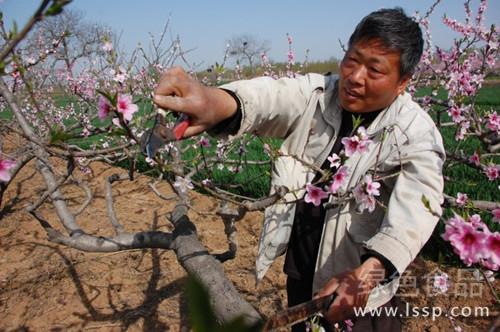
Peach tree pruning
Pruning young trees to build the canopy :
In spring, peach seedlings should be shaped, mostly into the three-main-branch natural open-center form. Generally, after planting, cut back at 50cm above the ground. Note that there should be 6-8 plump buds below the cut. After buds sprout and shoots emerge in spring, select 3-4 vigorous branches growing in different directions to train as main branches. The points where main branches arise should be spaced at a certain distance, and their vigor can be controlled by changing the angle. For the remaining branches, remove those competing with the main branches and keep the weak ones as auxiliary nourishing branches.
By May-June, when the main branches grow vigorously, main branches reaching 60-80cm can be pinched to stimulate secondary shoots and train secondary main branches and sub-main branches, expanding the canopy. The bud at the cut is generally left on the outer side, and among the lateral branches sprouting below, select one suitably positioned and vigorous branch as a sub-main branch. The sub-main branches kept on each main branch should be on the same side direction to avoid emptiness or collision. In this way, secondary main branches can be trained in one year, and by keeping secondary branches again the next time, the canopy can be formed, and production can begin in the third year.
Fertilizing and interplanting to mature the soil:
For newly developed peach orchards, expand the soil improvement area. Dig round trenches or strip trenches about 40cm deep outward from the original planting holes or trenches, and apply organic fertilizer to improve the soil. In addition, fast-acting fertilizers such as urea can be applied as a top dressing before each growing season to promote branch growth. In young orchards, various crops can be intercropped in the spaces to increase income; rice straw can be turned in or used as mulch for fertilizer. Interplanting legumes or a mix of legumes and grasses can build soil fertility and also provide feed. On terrace walls, slope-protecting grass can also be planted, and it is best to cover the ground with green crops.
Clear standing water:
Peach trees are afraid of standing water, so drainage must be done well during the rainy season. If back ditches are silted up, clear them so water flows, and pile the silt on the tree plates. In the dry season, the tree plates can be covered with loosened soil to reduce water evaporation.
Top dressing before flowering for fruiting trees:
From March to April, peach trees successively enter the stages of bud break, flowering and fruit set, and new shoot growth. To meet the nutrient needs of new shoot growth and young fruit development, top dressing before flowering is important, especially for weak fruiting trees or orchards with excessively high yield last year. Before flowering, an appropriate amount of nitrogen fertilizer can be added to promote fruit set and tree growth, but the amount should be noted to avoid excessive new shoot growth and increased fruit drop.
For 1-3 year old young trees, apply 150-200 grams of urea per tree; for weak mature trees, generally apply 300-500 grams of urea per tree. For strongly growing fruiting trees, this fertilizer may be omitted. For mature trees entering full production, nitrogen fertilizer should be applied as little as possible or not at all in spring. During the flowering and young fruit periods, waterlogging and drought are most feared. Water accumulation in the orchard can affect root absorption capacity and can also affect new roots and cause necrosis, resulting in flower and fruit drop. Therefore, flatland peach orchards should promptly clear ditches, remove silt, and fill gaps. In drought, drought relief should be done promptly, and methods such as opening ditches to lead water to moisten the bed surface or sprinkler irrigation can be used. At the same time, mix fast-acting fertilizer into the water and apply it with the water.
Pest and disease control:
In spring, peach trees are susceptible to damage from pests and diseases such as anthracnose and aphids. To prevent early pests and diseases in peach trees, before the flower buds and leaf buds protrude through the epidermis, spray the canopy with New High Lipid Film and smear the tree body with Hushu Jiangjun to prevent pest and disease invasion. Once aphids are found, use 10% imidacloprid 2000-fold solution; for anthracnose, use 80% anthracnose fumate 500-fold solution; for brown rot, use 70% zineb 500-fold solution or 50% procymidone 1000-1500-fold solution; for gummosis, scrape off the diseased spots with broken porcelain tiles and brush with 30-fold solution of Junduqing.