Early-maturing hyacinth bean: easy to grow, long harvest period, detailed growing techniques
The hyacinth bean, also known as the black-eyed pea or Emei bean, is grown over a wide range, and its harvest period is long, but the harvest comes late. Extremely early-maturing hyacinth bean varieties can reach the market about 100 days earlier. The tender pods of the hyacinth bean are rich in protein and minerals such as calcium, phosphorus and iron, as well as vitamins; they are crisp and tasty, with well-rounded nutrition.
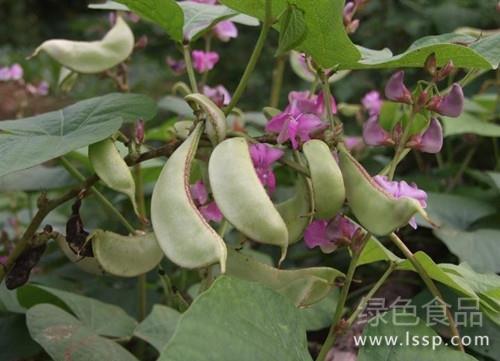
Hyacinth bean
I. Sowing:
1. Sowing time: hyacinth bean seeds germinate poorly below 15°C and stop germinating below 10°C. 20°C-25°C is the most suitable germination temperature. The optimum temperature for hyacinth bean growth and development is 20°C-37°C; above 40°C, growth deteriorates and flower drop increases. In Guangdong, sowing can be done all year round (when the temperature is below 15°C, cover with film for seedling raising); from transplanting to the start of harvest is about 50 days, and continuous harvesting can last 6 months.
2. Sowing method: before sowing, prepare the seedbed soil (nutrient soil). Mix farmyard manure and garden soil thoroughly in a 4:6 ratio and level it. The seedbed must be a raised ridge facing the sun. At sowing, keep the bed soil moist, to the degree that the bed soil holds together when squeezed by hand and breaks apart when released. According to local conditions, choose either seedbed seedling raising or nutrient-pot seedling raising. When the temperature reaches the germination and growth temperature, direct sowing is also possible, with 2-3 seeds per hole. When thinning to a stand, keep 1 strong seedling. No matter which seedling-raising method is used, the seeds should not be soaked; dry seeds must be sown.
II. Transplanting:
For those using nutrient-pot seedling raising or seedbed seedling raising, transplant in time when the young seedlings have 3-4 true leaves. Before transplanting, plow the soil and apply sufficient base fertilizer, with 3000 kg of decomposed farmyard manure per mu, plus 100 kg of compound fertilizer or cake fertilizer; apply deeply, then level the soil and make holes for transplanting. For varieties with strong growth vigor and branching ability, the base fertilizer may be appropriately reduced according to the original soil fertility.
Extremely early-maturing varieties are generally planted at about 1000 plants per mu, or transplanted at a row spacing of 100cm×60cm, with 1 plant per hole. To increase early-stage yield, the density may be appropriately increased.
III. Field management:
1. Trellising and topping/pinching: when the main vine grows to about 30cm, trellises should be set up in time and the vines guided onto them. The trellising method is the same as for cowpea; generally a "A"-shaped trellis is used, about 2.5m high, with a few horizontal support materials appropriately added at mid-height of the trellis to help the vines climb. When the main vine grows to 0.5-1m, top and pinch the main vine in time to promote the sprouting and growth of flower-spike branches. When the side vines grow to about 1m, pinch the side vines again.
2. Fertilizer and water management: after transplanting, promptly use diluted decomposed human and livestock manure urine to promote seedling growth. Because the hyacinth bean flowers and sets pods continuously, fertilizer and water supply should be strengthened after flowering and pod setting; it is best to apply fertilizer water once after each batch is picked. When picking, do not damage the flower spikes, because the flower spikes can bloom and set pods again, that is, they produce "return flowers." If there is prolonged high temperature and drought, carry out drought relief in time and spray foliar fertilizer to help preserve flowers and pods.
IV. Pest and disease control:
The main diseases of the hyacinth bean are anthracnose and downy mildew; during cultivation, high humidity and low temperature easily cause these diseases, and both can be controlled with 50% thiophanate-methyl and 75% chlorothalonil wettable powder. Aphids occurring at the seedling stage can be effectively controlled with 2.5% deltamethrin 2000-fold solution; at the flowering stage and full fruiting stage, the main damage is from the pod borer, which can be controlled with a mixture of chlorfluazuron emulsifiable concentrate and 20% fenvalerate 3000-fold solution, or by alternating 20% fenpropathrin 3000-fold solution and other insecticides for controlling borers. Pod borer damage must be controlled early: spray once at the beginning of the flowering stage before the flower buds open, and afterward observe carefully and spray in time.