How to prevent and control smut disease when the ovary of Job's tears is filled with black powder
With the extension of Job's tears cultivation time and the expansion of planting scale, the occurrence of Job's tears smut disease has become increasingly serious, affecting the yield and quality of Job's tears. Based on the occurrence patterns of Job's tears smut disease, an effective set of comprehensive control measures for Job's tears smut disease is introduced here for reference.
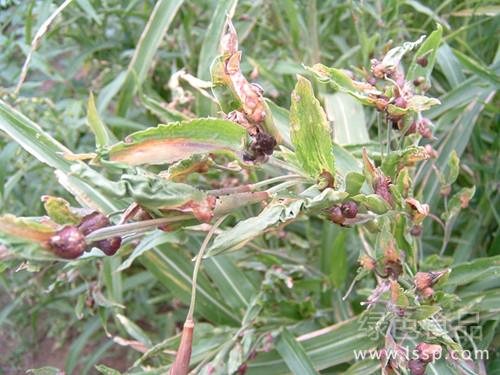
Job's tears smut disease
I. Damage symptoms: Smut disease mainly damages Job's tears seeds, and also infects leaves and young shoots. Symptoms are generally not visible at the seedling stage. When Job's tears grows to 8-9 leaves and begins to enter the young ear differentiation stage, symptoms begin to appear on the leaves, forming single or clustered purple-red tumor-like protrusions on the blades or leaf sheaths of the upper 2-3 young leaves, which later turn reddish-brown and appear withered, and black powder can be seen when peeled open. When the ovary is infected, the affected ovary swells into an oval or nearly round shape, partially hidden in the leaf sheath, initially purplish-red, gradually turning dark brown, filled with black powder inside, surrounded by the ovary externally. Every growing point of the main stem and tiller stems of infected Job's tears turns into a smut blister, and diseased plants mostly fail to set seed and form fungal galls.
II. Pathogen: Job's tears smut disease is caused by infection of Ustilago coicis, belonging to the Basidiomycotina. Chlamydospores are oval to elliptical or irregular, yellowish-brown, densely covered with small spines or warts. Chlamydospores are scattered; upon germination, they produce septate primary hyphae, and from one spore of the primary hyphae, basidiospores are produced terminally or laterally, and the basidiospores germinate to produce secondary basidiospores.
III. Occurrence characteristics: The smut pathogen overwinters as chlamydospores attached to Job's tears seeds or in the soil. In April-May of the following year, when the temperature reaches above 20°C, the pathogen spores germinate and first infect the young shoots of Job's tears. In late July, the pathogen rises to the ear with the growth of the Job's tears growing point, causing Job's tears seeds to be infected by the pathogen at the heading stage and forming smut. When the small blisters on the smut crack open, dark brown basidiospores are released again, causing repeated infection or falling into the soil, leading to disease occurrence in the following year. This disease only damages Job's tears, and does not damage gramineous crops such as corn and sorghum.
IV. Causes of disease:
1. Seed-borne pathogen. Infected seeds are the primary cause of Job's tears smut disease. Surveys found that growers have a weak concept of retaining seeds from healthy plants and collect seeds rather arbitrarily, resulting in a high rate of seed-borne pathogen, which becomes the main source of inoculum for disease occurrence in the following year.
2. Irrational farming systems. Large-scale continuous planting year after year creates favorable external conditions for the infection cycle of Job's tears smut disease. After harvesting Job's tears, many growers fail to dry the field in time and collect, sun-dry, and burn the dead and residual stems and leaves left in the field, providing a large amount of inoculum for the disease in the following year. Limited by mountainous conditions, most growers can only use traditional hoes and shovels for cultivation, making it difficult to deep-plow the field, and the inoculum in the field is not effectively buried deep. In pursuit of yield, factors such as high planting density of Job's tears and excessive application of nitrogen fertilizer also promote the spread and expansion of the pathogen. According to the occurrence characteristics of Job's tears smut disease, prevention should be the main approach, but some growers do not pay attention to the disinfection of seeds and soil, and only spray fungicides for control after the disease occurs, resulting in poor control efficacy and failure to achieve the control purpose.
V. Control techniques:
1. Timely and thorough garden cleaning. After winter begins, dry the field, collect diseased plant residues and withered leaves, burn them in a centralized manner, carry out winter plowing and soil sun-drying, and clear weeds around the field to reduce the amount of overwintering inoculum in the field.
2. Disinfection of seeds and soil. Retain seeds from healthy plants to reduce the amount of seed-borne pathogen. After years of experimental demonstration, before sowing, seed treatment with 70% thiophanate-methyl wettable powder or 50% carbendazim wettable powder at 0.5% of the seed weight achieved 100% control efficacy; for soil disinfection, 50% carbendazim wettable powder at 500 times dilution or 75% chlorothalonil wettable powder at 500 times dilution can be used for drenching.
3. Strengthen field management and apply phosphorus and potassium fertilizers in a reasonable ratio. In the same field, avoid continuous planting year after year. Maintain reasonable planting density, reduce field humidity, and reduce pathogen infection. Apply sufficient base fertilizer, do not apply fertilizer containing fungal galls, reasonably match nitrogen, phosphorus, and potassium fertilizers, and appropriately increase potassium fertilizer application to improve the disease resistance of Job's tears. After Job's tears enters the heading stage, timely inspections should be carried out; when diseased plants are found, they should be pulled out promptly and burned in a centralized manner.