Yellowing Leaves and Stunted Growth: Remedies for Nutrient Deficiency in Watermelon
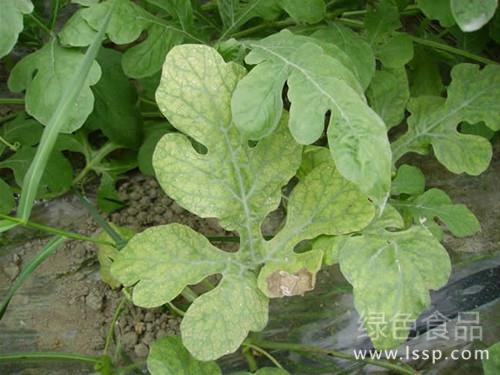
Nutrient Deficiency in Watermelon
1. Calcium deficiency: When watermelon lacks calcium, growth at the tips is hindered, and symptoms often appear on new growth such as the terminal buds and root tips; leaves turn yellow and curl, and the top leaf vines turn brown and die; the fruit stem area develops sunken spots, cracking, brown rot, and even necrosis, forming blossom-end rot fruit. Remedies: First, apply more gypsum powder or calcium-containing fertilizers such as superphosphate; second, spray the leaves with a 0.2%-0.4% calcium chloride solution.
2. Magnesium deficiency: When watermelon lacks magnesium, symptoms appear first on the old leaves. The areas between the veins near the main vein of the old leaves fade and turn yellow, but the veins remain green, and then this gradually spreads, causing the entire leaf to turn yellow and develop dead patches. It usually starts from the old leaves at the base and gradually develops upward; in severe cases, the leaves of the whole plant turn yellow-green. Remedy: When magnesium deficiency is found, promptly spray the leaves with a 0.1% magnesium sulfate solution.
3. Boron deficiency: When watermelon lacks boron, the internodes of new vines become shorter, the vine tips grow upright, the growing points are inhibited and turn white; the leaves are small, the leaf surface is wrinkled and uneven, the edges curl downward, and the leaves take on a parachute shape; there are few or no flowers, the floral organs are poorly developed or deformed, and fruit set is difficult; after fruit set, there are many deformed or hollow fruits. Boron deficiency in watermelon is easily misdiagnosed as a viral disease, but boron deficiency in watermelon has no disease center, whereas viral disease has a disease center and spreads outward in all directions. Remedy: When boron deficiency is found, spray the leaves with a 0.1%-0.2% borax solution.
4. Iron deficiency: When watermelon lacks iron, symptoms first appear on the young leaves at the top. In the early stage or when iron deficiency is not severe, the mesophyll of the new top leaves loses its green color and becomes pale green or pale yellow, while the veins remain green. As time goes on or with severe iron deficiency, the green color of the veins fades or disappears, and the entire leaf turns yellow or yellowish-white. Remedy: When iron deficiency is found, spray the leaves with a 500-1000 times diluted ferrous sulfate solution.
5. Zinc deficiency: When watermelon lacks zinc, the branches are slender, the internodes are short, leaf development is poor, the leaves are small and clustered or rosette-like, curl toward the underside, and the leaf tips and edges turn brown and gradually scorch. Remedy: When zinc deficiency symptoms appear, spray the leaves with EDTA-Zn fertilizer, generally diluted 2000-3000 times.
6. Manganese deficiency: When watermelon lacks manganese, the areas between the veins of young leaves become yellow, while the main veins remain green, and this then progresses to newly matured large leaves; seeds develop incompletely, and deformed fruits are easily formed. Remedy: When manganese deficiency is found, spray the leaves with a 0.05%-0.1% manganese sulfate solution.