Worried that most store-bought tomatoes are artificially ripened? Learn to grow potted tomatoes at home
Tomatoes are delicious whether eaten raw or cooked, and they are especially popular with the girls because they are rich in vitamin C. However, many tomatoes on the market today are artificially ripened, lacking tomato flavor and not safe either. In cities, many families like to grow some small vegetables on their balconies, which is both delicious and reassuring, so let us take a look at the cultivation techniques for potted tomatoes.
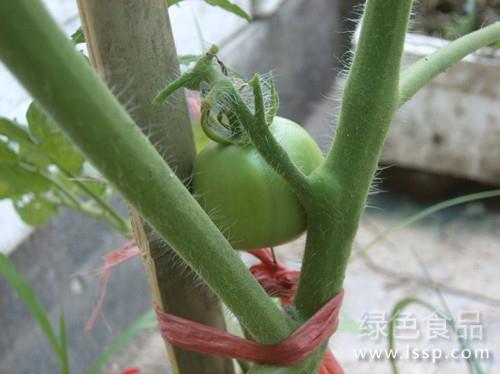
Tying the vines of potted tomatoes
1. Sowing and raising seedlings:
Sowing and raising seedlings can be done throughout the year. Choose dwarf tomato varieties that are resistant to disease, highly stress-tolerant and easy to set fruit, such as Dwarf Red Bell, Dwarf Yellow Bell, Pot Red, Duocai and so on. Before sowing, soak the seeds in 55°C warm water for half an hour, then let the water cool naturally to room temperature, continue soaking for 4-6 hours, and then germinate them at 25-28°C for 2-3 days. During germination, rinse them once a day with warm water to wash off the mucus attached to the seeds and prevent the seeds from molding and rotting. When the tomato seeds show white sprouts, they can be sown in 5 cm diameter nutrient pots. The substrate materials use peat, vermiculite, fine sand, cottonseed cake, furnace slag, cornstalk powder and so on; choose any 3 of them and mix them in a 1:1:1 ratio. Put 2 seeds per pot, cover with 0.8 cm of fine moist soil after sowing, and cover with 1 layer of film; remove the film after the seedlings emerge. In summer, use a shade net or straw mat to lower the temperature and prevent seedling scorching; in winter, use protective facilities to prevent freezing damage. Thin to the final seedling when there are two leaves and one heart. You can also raise seedlings by sowing in beds, and when the seedlings grow to 2 leaves and 1 heart, separate the seedlings into pots. Before potting, you may appropriately spray 0.5% potassium dihydrogen phosphate to increase the nutrition of the seedlings and cultivate strong seedlings. Spray zineb or chlorothalonil to prevent seedling-stage diseases.
2. Potting and planting:
When the tomato seedlings have 4-5 leaves, they can be potted. Choose a 28×30 cm flower pot, plant 4 plants per pot, or determine the number of plants according to the size of the pot. The substrate materials use peat, vermiculite, fine sand, mushroom residue, furnace slag, cornstalk powder and so on; choose any 3 of them and mix them with field soil in a 1:1:1:3 ratio. Each pot can be mixed with 100 grams of puffed chicken manure and 5 granules of ternary compound fertilizer to ensure that the substrate can provide enough nutrition. Water thoroughly after planting.
3. Daily management:
After the seedlings recover, water at least once a day during high summer temperatures, once every 2-3 days in spring and autumn, and once every 5 days in winter. Before fruiting, hoe the pot soil frequently to increase air permeability, which is beneficial to root development. After fruiting, apply 100 grams of puffed chicken manure and 5 granules of ternary compound fertilizer as a top dressing, and appropriately spray 0.5% potassium dihydrogen phosphate to provide the nutrients needed for tomato growth. Entering the enlargement stage, keep the pot soil moist, but water in the right amount; do not water too much or too frequently, to prevent root rot, leaf yellowing, leaf rot and fruit drop. In summer, cover with a shade net to prevent sunscald on the tomatoes; entering the ripening stage, avoid spraying water to prevent fruit cracking. In winter, pay attention to cold protection to prevent freezing damage.
4. Pruning:
Dwarf tomatoes belong to the self-topping varieties, with extremely short internodes and extremely dwarfed plants, so generally no pruning or trellising is needed. But if the plant is rather small, when it has not set fruit or the fruit has not enlarged, remove the flower buds or fruit to let the plant continue growing, and keep 3-4 side branches. If there is too much fruit set, use a cylindrical support welded from thin steel bars (paint the thin steel bars pure white). You can also insert a sturdy bamboo stick into the pot as a support; the bamboo stick should not exceed the height of the tomato, so as not to affect the appearance. Throughout the entire growth process, promptly remove the side branches at the base, and when old leaves at the base are found to be yellowing, they should also be removed promptly to facilitate ventilation and light transmission and reduce nutrient consumption. Dwarf tomatoes are not shaped, but some simple shaping can be done according to the shape of the flower pot to enhance their ornamental value.
5. Indoor care:
Potted tomatoes can be placed on balconies, indoors or on office desks. In winter, indoor temperatures are high and the day-night temperature difference is small, which is not conducive to tomato growth; at night, place them in a relatively cooler place so that the day-night temperature difference is 5-10 degrees. Indoor air is generally dry, so spray water on the leaves often, and spray 0.5% potassium dihydrogen phosphate or 100-fold rice vinegar solution once a week, which can both prevent pests and diseases and serve as foliar top dressing. For potted tomatoes on office desks, they should be exposed to the sun once every 2-3 days, which is beneficial to plant growth. After the tomatoes ripen, harvest and eat them promptly to prevent over-ripening and fruit cracking.