Cherry Radish Grows Fast and Has a Large Consumer Market: Detailed Greenhouse Cultivation Techniques
Cherry radish has delicate, tender quality and grows rapidly, making it very popular with consumers. To achieve year-round supply, its solar greenhouse cultivation techniques are described below.
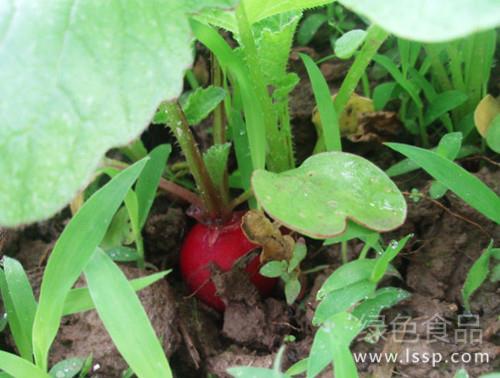
Cherry radish
1. Variety selection: Choose red-skinned varieties introduced from Japan, such as the 20-day Daikon, which has a diameter of 2-3 cm, a single root weight of 15-20 grams, an optimum growing temperature of about 20°C, and a growing period of 20-30 days; and the 40-day Daikon, which has a diameter of 2-4 cm, a single root weight of 20-25 grams, an optimum growing temperature of 15°C-22°C, and a growing period of 30-40 days, slightly longer in winter.
2. Fertilisation and land preparation: Because cherry radish has a short growing period, topdressing is generally not needed, so sufficient base fertiliser must be applied. Apply 3000-4000 kg of farmyard manure per mu, and it must be well decomposed before application to prevent seedling burn and forked roots. In addition, about 7 kg of superphosphate can be used as seed fertiliser to promote root swelling. For land preparation, flat beds are generally used, and neutral or slightly acidic sandy loam is best; when heavy clay soil is used, attention should be paid to improving it.
3. Sowing at the right time: Generally, sowing can be staggered from late September to early March of the following year, connecting with early spring open-field and autumn open-field cultivation to form year-round cultivation and supply.
4. Scientific sowing: Direct sowing is suitable, mostly in rows, with a row spacing of 10 cm, a furrow depth of about 1.5 cm, and a plant spacing of 3 cm; broadcast sowing can also be used. Open furrows and water them, sow after the water has infiltrated, and cover with about 1.5 cm of soil. Cherry radish has a short growing period and a short plant, so it can be intercropped or relay-cropped with crops that have longer growing periods to increase yield per unit area. For example, when intercropped with head lettuce in a greenhouse, the cherry radish is already harvested before the head lettuce is about to close its canopy.
5. Field management: 1. Regulate temperature and humidity. After sowing, keep warm at 22°C-25°C, and seedlings emerge in about 2-3 days; after emergence, lower the temperature appropriately to 18°C-20°C. When it exceeds 25°C, ventilation must be provided (long-term temperatures above 25°C will cause bolting), and in severe winter the night temperature should be kept above 5°C. In principle, keep the field moist, with soil water-holding capacity at 70%-80%, and water evenly. Generally, crops in the early autumn period and late early spring period need more frequent watering, while in deep winter, do not water unless the soil appears dry.
2. Rational fertilisation. Generally no topdressing is needed; if the base fertiliser is insufficient, liquid fertiliser can be applied with irrigation water.
3. Thinning and final thinning. Thin once when the cotyledons unfold, and complete final thinning in time before 3-4 true leaves appear. In the early stage, pay attention to intertillage, loosening the soil, and weeding.
4. Disease and pest prevention. Because cherry radish has a short growing period, it generally has no diseases or pests. Agricultural antibiotic 120 and agricultural streptomycin can be sprayed to prevent disease, and abamectin can be used in the early stage to prevent pests.
6. Timely harvest: Cherry radish should be harvested in time when the fleshy root diameter is 2-3 cm. Generally, harvesting begins about 30 days after sowing and emergence. If harvested too late, fibre increases, and the roots are prone to splitting and pithiness, affecting commercial quality.
7. Precautions: To grow cherry radish well and prevent or reduce uneven shape, splitting, forked roots, and pithiness, the key is to apply sufficient decomposed organic fertiliser, loosen the soil well, and keep the soil consistently moist.