Apricot trees are salt-alkali tolerant but sensitive to water: a detailed explanation of the environmental conditions required for growth
The apricot is a perennial deciduous fruit tree and can grow naturally to more than 10 m tall. It is long-lived and prefers light, is cold-tolerant, drought-tolerant and tolerant of poor soil. Its adaptability to external environmental conditions is extremely strong, and the range suitable for cultivation is also very wide. In its main production areas, the annual average temperature is -5 to 22°C, the annual accumulated temperature of ≥10°C is 1000 to 6500°C, the annual rainfall is 50 to 1600 mm, the sunshine duration is 18003400 hours, and the frost-free period is 100 to 350 days. It can thus be seen that apricot trees can not only flower and fruit in high-latitude, cold-climate, arid areas, but can also grow and develop in lower-latitude, warm-climate, humid and rainy areas. Apricot trees are relatively salt-alkali tolerant. However, apricot trees are very sensitive to water. If water accumulates in an apricot orchard for more than 3 days, it will cause yellow leaves, leaf drop and root death, leading to the death of the whole plant. Apricot flowers and young fruit are also very sensitive to low temperatures and are prone to damage from late frost, causing reduced yields.
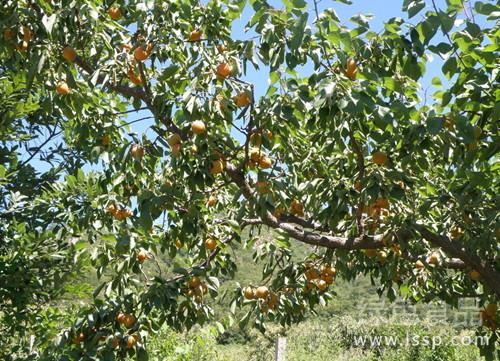
Apricot tree
How are apricot trees planted?
Planting time for apricot trees. It is divided into autumn planting and spring planting. However, in Northeast China, Northwest China, northern North China and other places, because the frost-free period is short and winters are cold, spring planting should be preferred. Digging the planting hole: the size of the hole is generally 80 cm × 80 cm × 80 cm, and its topsoil and subsoil are placed separately on both sides. When backfilling, place 20 to 30 cm of straw or weeds and fallen leaves at the bottom, then backfill the topsoil. When it is half filled, mix organic fertilizer (50 kg per plant) with soil and fill it in. When it is filled to about 30 cm from the ground, firm the pit or water it so the soil settles, then cover with a layer of topsoil, and backfill the remaining part when planting the tree. Seedling preparation: select first-grade vigorous seedlings with well-developed root systems, and prune the root system. For seedlings purchased from elsewhere, soak the roots in water and plant only after they have absorbed enough water. Planting: place the seedling in the middle of the planting hole, align it left and right, and when 1/3 of the soil has been added, lift the seedling upward so the roots spread naturally downward. Note that the graft union should be slightly above the ground. Firm the soil, then add soil until it is level with the ground surface and tread it firm.
How are pollinizer trees for apricot trees arranged?
Most apricot cultivars are self-unfruitful or have a low self-fruitful rate, and apricot fruit is not tolerant of storage and transport. Therefore, when establishing a commercial apricot orchard, it is necessary not only to consider the rational matching of early-, mid- and late-maturing cultivars and of main cultivars and pollinizer cultivars, but also to take into account the proportion of fresh-eating cultivars and processing cultivars. Generally, for small apricot orchards with relatively convenient transportation, early-maturing fresh-eating cultivars should be the main ones, the ratio of main cultivars to pollinizer cultivars should be 3 to 4:1, and pollinizer trees should preferably be planted in a radial pattern. For large apricot orchards, processing or kernel apricot cultivars should be the main ones, accounting for about 80% or more. If conditions are suitable, planting cultivars for fresh eating, processing and dual-purpose kernel and flesh use will give even better results. Pollinizer trees should not be arranged as a single cultivar; 4 to 5 cultivars should be selected to pollinate each other or planted in equal amounts to achieve the pollination effect.
How are apricot trees managed after planting?
Making beds and irrigation. After planting, make beds along the planting rows and irrigate in time. After irrigation, cover with plastic film to increase the fruit-setting rate. Trunk heading. After spring planting, the trunk can be headed. The heading height is generally 60 to 70 cm, and there should be 4 to 6 plump buds below the cut. In areas where frost damage easily occurs during the spring flowering period, the heading height can be higher, generally 70 to 80 cm. The bud below the cut should be left on the windward side, and the shaping zone should be covered with a plastic bag to prevent damage by scarab beetles and weevils. Remove the bag to ventilate when buds sprout. Replanting. After planting, dead plants found should be replanted in time to improve orchard uniformity.
How are the planting density and pattern of apricot trees determined?
In general apricot orchards, the spacing between plants and rows is 3 m × 5 m, that is, 45 trees are planted per 667 m2. The planting patterns for apricot trees generally use rectangular planting and contour planting. The characteristic of rectangular planting is that the row spacing is greater than the plant spacing, with good ventilation and light transmission and convenient management operations. Contour planting means planting along a contour line at a certain plant spacing, which is beneficial for soil and water conservation and is suitable for mountain orchards such as terraced fields and trench-and-ridge sites.