Spring fruiting management for Agaricus bisporus: moisture, temperature, diseases and supplementation of nutrients
After mid-March, when the temperature stabilizes above 12°C, Agaricus bisporus enters the spring mushroom management stage. Spring mushrooms account for about 30% of the total yield, and compared with autumn mushroom management, spring mushroom management faces several unfavorable conditions. First, after overwintering, the vitality of the Agaricus bisporus mycelium declines compared with autumn mushrooms, and the nutrients in the compost decrease accordingly. Second, in autumn the temperature changes from high to low, and the overall temperature trend is consistent with the temperature requirements for the growth of Agaricus bisporus mycelium and fruiting bodies, whereas in spring the weather changes are exactly the opposite, and the weather is unpredictable, rising and falling erratically. Therefore, spring mushroom management requires even greater care; once mismanaged, it easily leads to yellowing and shrinking of the mycelium, dead mushrooms and large-scale outbreaks of diseases and pests.
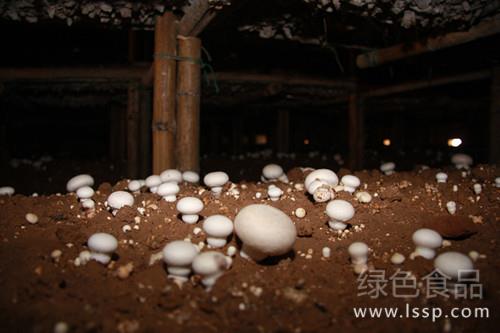
Agaricus bisporus
1. Moisture management
When adjusting water in spring, first spray the clear supernatant of limewater at pH 8-9, spraying once every 1-2 days, with 0.25 kg of water per sq m of mushroom bed, so that the moisture content of the casing soil reaches 18%. When the temperature is below 15°C, glucose nutrient solution can be sprayed along with the water to increase mycelial vitality; 5-7 days before fruiting, a 1000-fold dilution of Gujing should also be sprayed to control pests during the overwintering period. Around April, when the temperature reaches 15-25°C, this is the period when spring mushrooms proliferate, and the amount of water sprayed should be increased. In May, the temperature is often above 25°C, evaporation is high, and the spring mushroom season is about to end; the moisture content of the casing soil can be raised to its maximum limit, with about 0.5 kg of water sprayed per sq m of mushroom bed per day, to buy time to harvest the last batch of mushrooms.
The general principle of water adjustment for spring mushrooms is: steady in March, accurate in April, heavy in May. In spring the temperature is unstable, and when spraying water and ventilating, care should be taken to avoid cold snaps and dry hot winds, so as to prevent large numbers of dead mushrooms, and limewater should be sprayed frequently to adjust the pH value in time.
2. Temperature management
In the early spring stage, the temperature inside the mushroom house is relatively low, and at this time the focus should be on increasing and maintaining warmth. Before fruiting or just as fruiting begins, covers such as straw curtains can be opened at intervals during the day to use sunlight to raise the temperature, and ventilation should be carried out at noon to prevent too great a difference between day and night temperatures, keeping the mushroom house in a relatively stable temperature and humidity environment, which is favorable for the growth of Agaricus bisporus.
In the later stage of spring mushroom management, high temperature and dryness inside the mushroom house must be prevented; covers can be increased or water sprayed onto the covers to lower the temperature, and ventilation should be carried out in the morning and evening. During ventilation, strictly prevent dry southwest winds from blowing into the mushroom house, lest the mycelium in the casing soil turn yellow and shrink and lose its ability to form mushrooms. Whether raising or lowering the temperature, attention should be paid to reducing the day-night temperature difference inside the shed, to prevent dead mushrooms caused by too great a temperature difference.
3. Disease and pest control
Diseases and pests are a common problem in Agaricus bisporus cultivation, seriously affecting the yield and quality of Agaricus bisporus, and the principle of "prevention first, integrated control" must be implemented. In spring, the contradictions among temperature, humidity and air in the mushroom house must be handled well, and sources of disease (and pests) such as dead mushrooms, young mushrooms and mushroom stubs on the mushroom bed must be promptly and carefully removed. In spring, mite damage and mushroom flies are more likely to occur, so management should be strengthened.
4. Supplementing nutrients
In the later stage of Agaricus bisporus growth, because of continuous fruiting, the mycelium cannot accumulate sufficient nutrients, resulting in thin-skinned mushrooms and hollow mushrooms, and even causing young mushrooms to die in batches. Therefore, after each flush of mushrooms is harvested, spraying water should be stopped for 4-5 days for full mycelial recovery, and then nutrients should be supplemented along with water adjustment, that is, adding some nutrient solution when replenishing water. Glucose, soybean milk, and a filtrate of mushroom roots boiled with 20 times their volume of water + 0.2% sugar water + 0.1% potassium dihydrogen phosphate, etc. can be sprayed to promote vigorous mycelium and improve yield and quality; a 0.5%-1% salt solution can be sprayed on the mushroom bed, which not only whitens the mushroom bodies but also accelerates mycelial knotting.