Watermelon sweetness determines market prices: choose varieties and match fertilizers to increase sweetness
Watermelon sweetness is the most direct indicator of how a crop is received by the market. We all know that watermelon sweetness is determined by sugar content: high sugar content means sweet, low sugar content means bland. So how can growers produce watermelons with high sugar content and good economic returns? Apart from routine scientific management, the most important thing is to do your homework well on variety selection and fertilization.
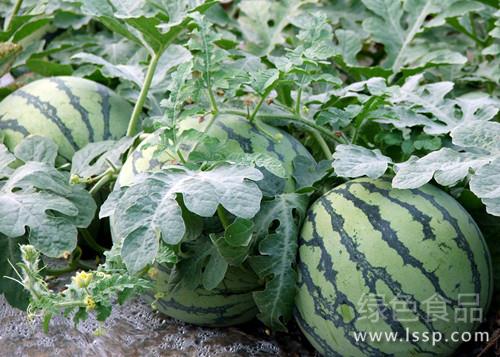
Watermelon
There are many reasons whether a watermelon is sweet:
The reasons for differences in watermelon sweetness are: first, watermelon varieties differ in their genetic basis; second, watermelons are picked at different degrees of ripeness; third, climate factors and soil texture vary; fourth, cultivation management has an influence. For example, some watermelon varieties have a sugar content of only 5%-6%, while high-sugar varieties can reach 12%; some varieties, such as Zhengzhou No. 3, have the highest sugar content at nine-tenths ripe, and their sugar content actually decreases when fully ripe. But varieties such as Xin Hong Bao and Mi Bao, when picked a little later, not only do not decrease in sugar content but increase somewhat. Generally speaking, sufficient sunlight and a large day-night temperature difference are conducive to nutrient conversion and sugar accumulation; abundant rain, low temperatures with scant sunlight, and a small day-night temperature difference mean less nutrient accumulation. Sandy loam warms up quickly and has a strong capacity to retain fertilizer and water, so watermelon sugar accumulation is greater; poor soil makes it easy for watermelon plants to suffer insufficient vegetative growth, so sugar content is low. Watermelons given increased organic fertilizer and combined phosphorus and potassium fertilizer have high sugar content; when nitrogen fertilizer is applied in a one-sided way and vegetative growth is excessive, the watermelon plants consume more nutrients and sugar content declines.
Variety selection and fertilizer matching are the most critical:
When growing watermelons, in order to increase sweetness, you should do well at the two key points of variety selection and fertilization technology.
First, choose varieties with high sugar content. Among early-maturing varieties, the fruit of Zhengza No. 5 has a sugar content of 10.5%-11%, and Jingxin No. 1 has a sugar content of around 11%; among mid-maturing varieties, Zhengza No. 6 has a sugar content of around 11%, Xin Hong Bao has a sugar content of 10%-11%, and Fengshou No. 2 and Fengshou No. 3 have a sugar content of 10%-11%; among late-maturing varieties, Hongyou No. 2 has a sugar content of around 11%. The seedless watermelon Hei Mi No. 2 has a sugar content of 11%, and the specialty early-maturing variety Bao Guan, with yellow skin and red flesh, has a sugar content of 12%.
Second, apply a sufficient amount of high-quality base fertilizer in a balanced way. In fertilizer application, organic fertilizer should be the main type, with chemical fertilizer as a supplement. In fertilizer composition, nitrogen and potassium fertilizer should be the main types, phosphorus fertilizer secondary, with an appropriate amount of trace-element fertilizer applied in combination. Among organic fertilizers, advocate the application of various types of cake fertilizer, farmyard manure, and plant ash, actively promote organic active compound fertilizer and bio-organic compound fertilizer, and at the same time appropriately apply high-content complete-element compound fertilizer, avoiding the single application of nitrogen chemical fertilizer. In the base fertilizer, apply 75-100 kg of cake fertilizer per mu, or 4000-5000 kg of farmyard manure and 50-100 kg of plant ash, or 100 kg of bio-organic compound fertilizer plus 50 kg of ammonium bicarbonate, or 100 kg of special organic compound fertilizer plus 30-40 kg of high-content compound fertilizer. Of course, each place should adjust the amount up or down according to soil texture and fertility conditions.
Third, raise the level of base fertilizer application. The application methods for watermelon base fertilizer are, first, furrow strip application, second, hole application in dug pits, and a small number of cases of broadcast application. In order to concentrate fertilizer use, reduce losses, and improve fertilizer efficiency, hole application and strip application should be advocated. Watermelon base fertilizer should be applied in stages and used in layers. The first fertilization is about 20 days before the seedlings are planted, applying 70% of the total base fertilizer at a depth of 25 cm; the second fertilization is 10 days before the seedlings are planted, applying 30% of the total base fertilizer at a depth of 10 cm. While fertilizing, mix evenly with the field soil, then cover with soil. The second application should be by hole, and after application leave markers so that the seedlings can be transplanted according to the holes, quickly absorb nutrients, and improve fertilizer use efficiency.