How should ginkgo seedlings be managed for supplementary fertilization, drought resistance, drainage and waterlogging prevention, disease prevention, and pest control?
In the management of ginkgo sowing and seedling raising, attention should be paid to the following four aspects.
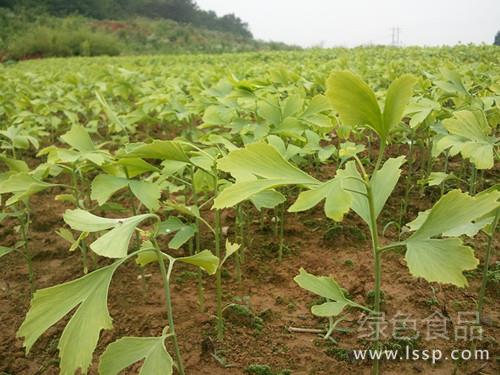
Ginkgo seedlings
First, drought resistance and drainage. When most ginkgo seeds have emerged, the bed should be watered thoroughly once in good time. Because the seedlings grow slowly, with one-year-old seedlings only about 20 cm tall, and their root systems are poorly developed, they are neither drought-resistant nor tolerant of waterlogging. In northern regions, watering should be given according to the drought conditions of the seedbed, while in southern regions drainage management should be strengthened according to the weather.
Second, timely supplementary fertilization. Ginkgo sown for seedling raising emerges relatively late (early to mid-May) and stops growing relatively early (early September), so the seedling growth period is short. The first fertilization should be in early June and can be done together with watering, using 5 kg of urea per mu; if thoroughly decomposed dilute human manure urine is used, it is safer. The second should be in early July, the third in late July, and the fourth in early August, with the amount of urea increased by 2 to 3 kg each time in sequence, to ensure the seedlings' nutritional needs. For the third and fourth applications, phosphorus and potassium fertilizer or compound fertilizer can be appropriately increased to enhance the cold resistance of the seedlings.
Third, disease prevention and pest control. Because the roots and stems of the seedlings are very tender, they are susceptible to damage from underground pests such as white grubs, mole crickets, wireworms, and cutworm larvae. If they occur over a large area, a 1000-fold phoxim solution can be sprayed on the ground; if they occur only locally, spraying can be targeted accordingly. From June to August, during the hot and rainy season, the seedlings are prone to stem rot. On pure sandy soil, because the surface temperature rises quickly, the incidence rate is very high and can easily cause mass death of seedlings, while sandy loam soil basically does not develop the disease. The control measures are to carry out timely intertillage and weeding in summer, and not to bruise the seedling stems. During hot and dry seasons, special attention should be paid to keeping the seedbed soil moist. Once diseased plants are found, they should be pulled out and burned promptly. During the seedling stage, spraying 2% to 3% ferrous sulfate once every half month gives a relatively good effect. In addition, excessive soil moisture or severe drought can both cause early leaf drop of the seedlings and affect their growth, so greater precautions should be taken.
Fourth, wider spacing and transplanting. Ginkgo seedlings grow slowly in the first 3 to 4 years, and their growth speed increases after four years. Generally, seedlings are required to reach a height of 2 to 3 m and a diameter at breast height of 3 cm before they can leave the nursery. For this reason, necessary transplanting must be carried out. If cultivating seedlings 3 to 4 m tall with a diameter at breast height of 3 to 4 cm, they must be grown for 4 to 6 years, with a density of 800 to 1000 plants per mu and a plant-row spacing of about 0.8 m × 1.0 m or 0.5 m × 1.2 m. Seedling transplanting can be carried out from late November to the following spring. The land used for transplanting should have convenient irrigation and drainage, and sufficient farmyard manure should be applied. When transplanting, care should be taken to lift, transport, and plant immediately, ensuring the root system is intact, with no broken or split roots, and protecting the terminal buds. After transplanting is completed, water thoroughly. Fertilize 3 times each year, in May, July, and October respectively.