Bitter cucumbers contain toxins; how to prevent cucumbers from turning bitter
The bitterness in cucumbers occurs because the plant contains a substance called cucurbitacin. This substance is most concentrated at the base of the cucumber stem, and it can be inherited. Its content varies with the type of vegetable, variety and cultivation conditions. Eating too many bitter cucumbers can cause symptoms of poisoning such as vomiting, diarrhea and spasms. Therefore, during cucumber cultivation, necessary measures should be taken to eliminate the formation of bitter cucumbers and ensure food safety. The main measures are as follows:
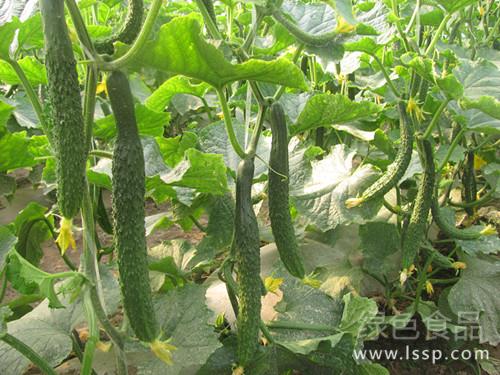
Cucumber
1. Avoid low or high temperatures. First, when the air temperature or soil temperature is below 13°C, cell permeability decreases, and the absorption of nutrients and water is inhibited, making cucumbers prone to bitterness. Second, when the greenhouse temperature is above 30°C and lasts too long, it can also cause cucumbers to turn bitter. Therefore, try to enhance the heating and insulation performance of the protective facility, adjust the temperature well, and avoid the temperature threshold at which bitterness forms.
2. Watering should be reasonable and timely. First, when the temperature is relatively high and soil moisture is low, the plant undergoes physiological drought, which easily produces bitter cucumbers. At this time, water should be supplied to cucumbers promptly to maintain the turgor pressure of the plant tissues and the stability of the plant temperature. Second, watering should be done in small amounts and more frequently, and the water temperature must not be too low, to prevent a water deficit in the plant from causing the formation of cucurbitacin in cucumbers. In addition, pay special attention that after planting, seedling hardening should not be excessive, otherwise the first fruit is prone to bitterness.
3. Fertilization should be balanced and moderate. First, root fertilization. During the seedling stage, nitrogen fertilizer application should be controlled to avoid excessive vegetative growth. By the peak flowering and fruiting stage, the ratio of nitrogen, phosphorus and potassium absorbed by cucumbers is basically 5:2:6, and at this stage the supply of nitrogen fertilizer and potassium fertilizer should be increased. Second, foliar topdressing. Spray rare earth micro-fertilizer once on the leaves at the seedling stage, early flowering stage and young fruit stage; at the full flowering stage and full fruiting stage, mix 0.5 kg of urea with 150 kg of water per mu, stir evenly, and then spray on the leaves.
4. Planting density should not be too high. Planting too densely and poor light will worsen cucumber bitterness. For protected cultivation of cucumbers, the method of dense planting early and sparse planting later should be adopted, that is, the usual plant spacing is 26-30 cm and the row spacing is 60 cm. If planted at a plant spacing of 15 cm, the "single plants" on the same ridge are not trellised; when they grow to 12 true leaves, pinch off the tips so they set fruit quickly, and after the main vine fruits are harvested, pull them out. The "replacement plants" are then trellised; when the plants grow to 1.2 m tall, pinch off the tips to speed up fruit setting, and after the main vine fruits are harvested, pull them out as well. With this cultivation method, early yield can increase by nearly 1 time, and at the same time it also reduces the occurrence of bitter cucumbers.
5. Prevent root damage. Root damage will worsen cucumber bitterness. In production, sowing should use sand trays, and when lifting seedlings, minimize root damage as much as possible. For pricking out, use plastic nutrient pots or paper bags. In cultivation, ridge planting with plastic film mulching should be used as much as possible, and when hoeing, it should be slightly deeper in the early stage and slightly shallower in the later stage.
6. Bitter cucumbers must not be saved for seed. If bitter cucumbers are kept for seed, the cucumbers produced in the next generation will still be bitter. Therefore, when cucumbers are about to mature, take a portion of the surface layer for tasting, and select those without bitterness to save for seed.