For high corn yields, watering well four times is key
"Irrigate or not, look to the crops and the sky." Whether corn needs watering depends on the corn's growth and development, the weather conditions, and the soil moisture content. If the soil moisture content is below 16%, clay soil moisture below 20%, or sandy soil moisture below 12%, then irrigation is needed. Judging from the corn's development and the periods that have a greater impact on yield, generally 4 key waterings should be done well.
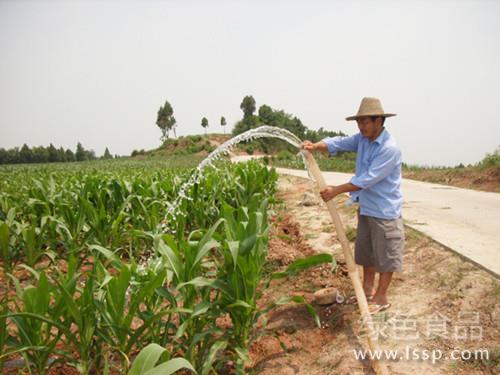
Corn watering
(1) Soil moisture water for seedbed preparation: At sowing, good soil moisture is the guarantee for achieving full, uniform, strong, and even seedlings. If the soil moisture is insufficient or uneven at sowing, it will inevitably cause missing seedlings and broken rows, or seedlings of uneven size with many weak and small plants and a high rate of empty stalks; it would be impossible for such a population to achieve high yield. The suitable soil moisture for corn sowing is between 65%∼75% of field capacity. If the soil moisture content at sowing is below 65% of field capacity, irrigation must be done before sowing; summer corn can also be watered with "covering-head water" after sowing. In spring corn areas, it is best to carry out winter irrigation and timely soil moisture conservation in early spring. Winter irrigation should be sufficient and thorough. Summer-sown or interplanted corn can be watered together with the wheat-yellowing water. The irrigation amount is generally 50∼60 cubic meters per mu. If "covering-head" water is applied, generally 40∼50 cubic meters per mu.
(2) Jointing water: During the seedling stage, corn plants are relatively small, tolerant of drought and afraid of waterlogging, and the suitable soil moisture is between 60% and 65% of field capacity. Under normal circumstances, watering is not needed. But after corn jointing, the plants grow vigorously, the tassels and ears begin to differentiate, and water demand increases. If at jointing the soil moisture content is below 65% of field capacity, watering is needed, generally about 55 cubic meters per mu. Watering at jointing benefits stem and leaf growth and ear growth as well as floret differentiation, can reduce empty stalks, and increase the number of grains per ear. For example, in the high-yield research fields of spring corn in Yanqing County and Huairou County in Beijing, watering at jointing increased the number of grains per ear by an average of 51.6 grains (an increase of 11%), and the number of ears per mu increased by 3.8%.
(3) Tasseling water: Around the period before and after corn tasseling and flowering, the leaf area is large, the temperature is high, and transpiration and evaporation are vigorous, making this the period of the corn's life with the greatest water demand and the greatest sensitivity to water. At this time, the suitable soil moisture content is 70%∼80% of field capacity; if below 70%, watering is needed, 55∼60 cubic meters per mu. Irrigation at this time can improve the vitality of corn pollen and silks, helping pollination and grain set; it can extend the functional period of leaves, improve photosynthetic capacity, and increase dry matter production. It is beneficial for grain filling, reduces grain abortion, increases the number of grains per ear, and raises the 1000-grain weight. Tasseling water must be applied promptly and sufficiently; one must not wait for the sky and rely on rain. If leaves are found to be wilting before irrigation is applied, it is already too late. According to experiments, short-term drought before and after tasseling that causes leaves to wilt for 1∼2 days before watering can also reduce yield by 20%.
(4) Grain-filling water: During the grain-filling period, a relatively large amount of water is still needed. The suitable soil moisture content is 70%∼75% of field capacity; if below 70%, irrigation is needed, generally about 55 cubic meters per mu. Irrigation at this time can prevent premature aging of corn, maintain a greater number of green leaves, and sustain relatively high photosynthesis; it can extend the grain-filling time and increase the filling rate, which is beneficial for increasing grain weight.