The shaggy ink cap mushroom is a medium-temperature edible fungus; temperature must be watched when cultivating it in summer
The shaggy ink cap mushroom (Coprinus comatus) is an edible fungus of the medium-to-slightly-high temperature type, and the optimum temperature for the growth and development of its fruiting bodies is 16-24°C. In nature, the fruiting bodies can grow once the temperature reaches above 10°C, so it can be cultivated from March to October each year. Its technical procedures are described below:
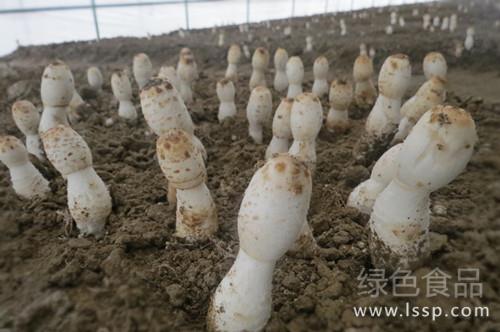
Shaggy ink cap mushroom
1. Temperature management: The temperature for spore germination of the shaggy ink cap mushroom is 22-26°C, with an optimum of 24°C. The temperature range for mycelial growth is 3-35°C, with an optimum growth temperature of 24-28°C. The mycelium will not freeze to death at -10°C, but grows slowly; above 35°C it stops growing and rapidly ages, autolyzing and turning black, and at 40°C the mycelium withers and dies. Therefore, during the fruiting period the natural temperature should preferably be kept between 10-28°C; when high or low temperature weather occurs, work to cool or warm the environment must be done well.
2. Water management techniques: After the bed surface is covered with soil, the water content of the soil layer should be gradually brought up to moisture in several applications over 2-3 days, until the water content reaches about 18%. The standard is that the soil particles have no white core, a handful can be squeezed into a ball, and it crumbles when touched to the ground and does not stick to the hand, so that the mycelium can quickly extend into the soil layer and grow within it. Taking into account the temperature, the water content of the soil layer and the mycelial growth, water is replenished by light and frequent spraying to keep the soil layer in a moist state. After about 10-15 days, once large numbers of fruiting body primordia have formed on the bed surface, the amount of water sprayed should also gradually increase to meet the water needs of fruiting body growth and development. As the fruiting bodies grow, develop and swell, the amount of water sprayed should reach 2000-2500 ml per square meter per day. After one flush of mushrooms is finished, stop watering for 2-3 days to help the mycelium recover its growth; after the next flush of mushrooms emerges, gradually increase the amount of water sprayed again, and repeat the cycle of management. The principles of water management can be summed up as: "spray plenty of water to set the mushrooms, keep the fruiting water steady, make the flush-change water heavy, replenish the maintenance water, and spray the air water frequently". Water spraying for moisture retention must be done in several small amounts, and water droplets should as far as possible not accumulate on the fruiting bodies. During the growth period the water content of the substrate is 60%-70%, with 65% being the optimum water content. The relative air humidity is kept at 80%.
3. Ventilation management: The shaggy ink cap mushroom is also an aerobic fungus, and its respiration during physiological activity is also very vigorous, taking in oxygen and releasing carbon dioxide. Its ventilation management differs somewhat from that of other mushrooms: the ventilation volume should not be too strong, otherwise the scales on the surface of the mushrooms increase markedly, affecting their commercial appearance. When spraying water on the bed surface, ventilation must be strong; after the spraying is finished, the doors and windows should not be closed in a hurry either - wait at least about 1 hour before closing them and covering with film. When the temperature is relatively high, the doors and windows of the mushroom house and both ends of the large shed or small arched shed should be hung with wet straw curtains before ventilating, so as to keep a relatively high ambient humidity inside the mushroom house as far as possible. On cloudy and rainy days, when the air humidity is high, the ventilation time can be appropriately extended. The general principle is to keep the air in the mushroom house fresh and the oxygen sufficient, while also preventing the microclimate environment from changing too drastically within a short time. Keeping the micro-environment in a relatively stable state is conducive to the normal growth and development of the fruiting bodies.
4. Insect prevention measures: Enclose the surroundings of the shade shed with insect-proof netting to prevent various insects from entering.
5. Erecting the shade shed: Strong light inhibits mycelial growth and can accelerate the aging of the shaggy ink cap mushroom mycelium. To avoid direct sunlight, a shade shed can be set up in summer. Erect a shade shed 2.5-3 m above the cultivation field, and it must be sealed and impervious to light. Cover the shed with a layer of plastic film to prevent rain from getting in. Cover it with another layer of shade netting on top, and the edges of the shade shed should preferably extend 3 m beyond each side of the cultivation field, so that sunlight from 9:00 to 16:00 cannot shine directly on the mushroom beds. The relative air humidity under the shade shed must not be too high; a maximum of 95% in the middle area is sufficient, while the relative humidity around the edges need only be kept at about 75%.