How to prevent and control deformed, shrunken and twisted corn leaves and rolled central leaves
The main causes of rolled central leaves in corn are high temperature and drought, improper herbicide application, thrips damage, and top rot infection. In production, it is advisable to carefully investigate the cause and take targeted remedial measures.
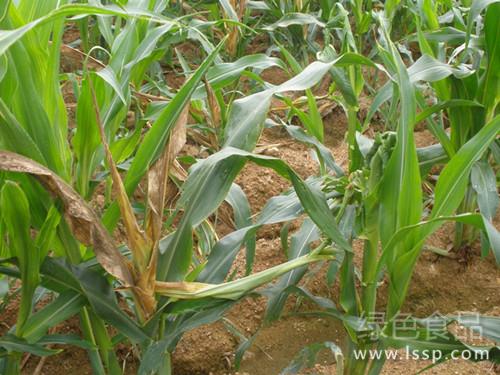
Twisted central leaf of corn
1. Caused by high temperature and drought
Different varieties have different adaptability to climate, and the proportion of curled central leaves varies greatly. Curled central leaves in corn caused by field drought generally recover gradually as soil moisture improves, and recover quickly after rain or irrigation. Spraying some high-quality foliar fertilizer can promote rapid recovery.
2. Caused by herbicide damage
When herbicides such as nicosulfuron are applied during the corn growing period, if the corn seedlings are younger than the 3-leaf stage or older than the 5-leaf stage, or if the herbicide is applied under high temperature conditions, or if the dosage is too large, or if organophosphorus pesticides are applied within 7 days before or after the herbicide application, corn is very prone to curled central leaves and shrunken leaves, accompanied by irregular yellow herbicide spots, and in severe cases the central leaves rot. When symptoms are mild, most plants recover naturally; for those with severely twisted central leaves, the central leaf can be split open manually. For affected fields, timely fertilization and irrigation, and spraying brassinolide and high-quality foliar fertilizer help promote plant recovery.
3. Caused by insect pests
There are two kinds of insect pests that cause rolled central leaves in corn: first, corn is damaged by thrips at the 3- to 5-leaf stage, with small chlorotic spots on the leaves, and thrips can be seen active when the central leaf is peeled open. Insecticides such as nitenpyram and spinetoram can be selected to control thrips, focusing the spray on the central leaf and the underside of leaves. Severely deformed plants need the twisted central leaf to be split open manually. Second, the Swedish stem fly, also known as the rye stem fly, suddenly broke out on corn in 1998, and its damage has increased year by year in recent years. Its body is very small (adult body length 1.5-2 mm, black and glossy; newly hatched larvae are as transparent as water, and mature larvae are yellow-white maggot-like), and because the damage is relatively hidden, it is generally not easy for people to notice. After hatching, the larvae bore into the central leaf through the gaps between the central leaves and cause damage, so that the tip of the central leaf is damaged and stuck by the mucus they secrete and cannot unfold, but the lower leaves continue to grow, thus causing the central leaf to form a crooked-head shape or ring shape. If corn seedlings are damaged earlier and the growing point is injured, "dead-heart seedlings" will form; if damaged later, the larvae only damage the edge of the central leaf, and when the leaf unfolds it forms a "shrunken shape", with visible shiny mucus traces. If "dead-heart seedlings" do not form, there is generally not much impact on corn.
For these two pests, control should be carried out early; applying chemicals after the corn central leaf has curled gives poor control results. Control methods include: (1) coating seeds with seed coating agents containing systemic insecticide ingredients. (2) 3-5 days after corn emergence, spray 20% phoxim and fenvalerate emulsifiable concentrate at 600 times dilution, 22% propoxur and chlorpyrifos mixture at 600 times dilution, 1.8% abamectin at 1000 times dilution, etc., and afterward combine with control of seedling-stage Asian corn borer and armyworm to control 1-2 times. (3) Combined with thinning and final singling of seedlings, manually split open or thin out the central leaves of corn seedlings with crooked-head or ring shapes that cannot unfold. (4) In fields where symptoms appear, when applying chemicals to control seedling-stage pests, spray trace elements to relieve symptoms, so as to promote robust plant growth and increase yield. (5) For fields that are relatively dry and have not received starter fertilizer, timely irrigation and topdressing should be carried out to accelerate seedling growth.
4. Caused by top rot
Top rot can occur at any growth stage of corn. The outermost leaf of the central leaf tightly wraps the inner central leaf, preventing it from unfolding and making it whip-like, with leaves deformed, shrunken or twisted, and rot often visible at the base of the central leaf, either dry rot or wet rot, with or without odor. To control corn top rot, at the early stage of occurrence, spray 58% metalaxyl? mancozeb wettable powder at 300 times dilution, or 50% carbendazim wettable powder at 500 times dilution, or 75% chlorothalonil wettable powder at 500 times dilution, and it is best to add an appropriate amount of zinc fertilizer to the spray liquid. For diseased plants, it is best to remove the nozzle and aim it at the corn central leaf to spray from top to bottom, applying 50-100 milliliters of spray liquid per plant.