Detailed Explanation of Key Potato Field Management Techniques
Potato is a crop used both as food and as a vegetable. To achieve high yield and high efficiency, the following points must be followed in field management:
1. Intertillage and Weeding In the early stage of seedling growth, the focus should be on promoting root growth and stolon development. From emergence until the appearance of 7-8 true leaves, seedlings grow slowly, temperatures are low, and water demand is low, so intertillage should be frequent and irrigation should be minimal or omitted, in order to raise soil temperature, promote good rooting, and speed up stolon elongation. In dry conditions, one watering can be given after emergence, but intertillage should be carried out promptly afterward to keep the soil loose and help produce strong seedlings. In the late seedling stage, after stolons begin to form, aboveground growth accelerates; to promote stem and leaf growth and form a larger leaf area, watering should be increased appropriately, and quick-acting N, P, and K fertilizers should be applied as a top dressing according to seedling growth, while continuing intertillage and hilling up soil, gradually thickening the soil layer.
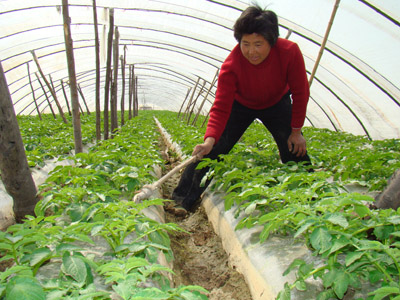
2. Fertilizer and Water Management Before potatoes show buds, watering should be controlled appropriately. When buds appear, a heavy irrigation should be given to practice seedling squatting, so as to control excessive aboveground growth and promote tuber enlargement. Seedling squatting should be combined with intertillage, and hilling up should continue. After seedling squatting, keep the soil moist, apply more P and K fertilizers along with N fertilizer, and fully meet the large demand for fertilizer and water during tuber expansion.
3. Remove Flower Buds to Save Nutrients When potatoes show buds, they should be removed promptly so that nutrients are concentrated for tuber growth.
4. Combined Spraying of Foliar Fertilizer In the late growth stage of potatoes, root absorption capacity declines and cannot meet the needs of plant growth. For this reason, foliar fertilizer can be used together to make up for the shortfall. The specific method is as follows: about 15 days before harvest, spray foliar fertilizers such as 0.5% urea and 0.3% potassium dihydrogen phosphate, which has a significant yield-increasing effect.
5. Application of Chemical Control Technology During the growth period, to prevent excessive aboveground growth, spray 100 ppm paclobutrazol or 50 ppm-100 ppm Zhuangfeng'an, requiring 50 kg of aqueous solution per mu.
6. Pest and Disease Control The main pests and diseases of potato are viral disease, early blight, late blight, potato scarab beetle, potato tuber moth, potato ladybird beetle, and so on.
Control measures: For viral disease, spray 1.5% Zhibingling emulsion at 1000 times dilution or wettable powder virus A at 500 times dilution for control; for early blight and late blight, during the onset period, spray 64% carbendazim-aluminum wettable powder at 500 times dilution or 1:1:200 Bordeaux mixture, once every 7 days-10 days, for 2 times-3 times consecutively, with relatively obvious results. For potato scarab beetle larvae, during the occurrence period, use 40% isofenphos-methyl emulsion at 800 times dilution or 50% phoxim at 1000 times dilution for drenching control; when potato tuber moth and potato ladybird beetle occur, 10% fenvalerate-malathion emulsion at 1500 times dilution can be used for control. (Source: Meishi Zhangmen Network)